
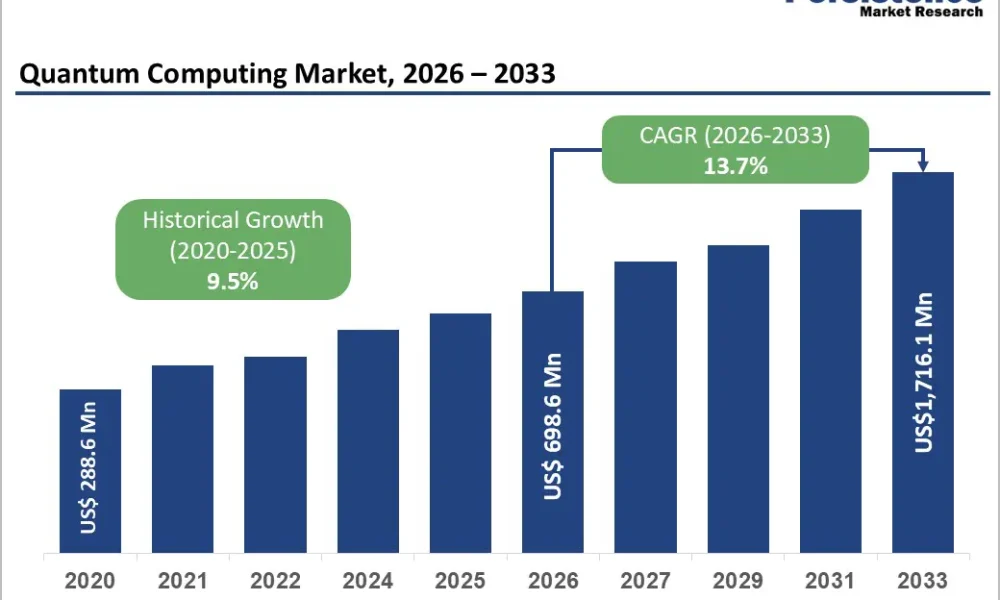
The global quantum computing market is entering a transformative phase, driven by rapid technological advancements and increasing investments from governments and private enterprises. With the market valued at US$ 698.6 million in 2026 and projected to reach US$ 1,716.1 million by 2033, the industry is expected to grow at a steady CAGR of 13.7%.
Unlike classical computing, quantum computing leverages quantum mechanics principles such as superposition and entanglement to perform complex computations at unprecedented speeds. This paradigm shift is unlocking new possibilities across industries, including healthcare, finance, manufacturing, and artificial intelligence.
Major technology companies such as IBM Corporation, Microsoft Corporation, and Google are leading innovation, supported by strong government funding initiatives worldwide.
Market Overview and Growth Dynamics
Quantum computing is transitioning from theoretical research to practical implementation. The growth trajectory of the market is supported by increasing enterprise adoption, improved hardware capabilities, and cloud-based accessibility.
Key Market Metrics
- Market Size (2026): US$ 698.6 Mn
- Forecast Value (2033): US$ 1,716.1 Mn
- CAGR (2026–2033): 13.7%
- Historical CAGR (2020–2024): 9.5%
This growth reflects a rising demand for high-performance computing solutions capable of solving problems that classical systems cannot efficiently address.
Elevate your business strategy with comprehensive market data. Request a sample report now: https://www.persistencemarketresearch.com/samples/14758
Key Market Drivers
- Rapid Advancements in Quantum Hardware
Breakthroughs in quantum hardware are significantly accelerating market growth. Companies are developing diverse quantum architectures, including superconducting qubits, trapped ions, and photonic systems.
IBM Corporation has outlined a roadmap toward a fault-tolerant quantum supercomputer by 2029, while Google has made strides in quantum error correction with its advanced chips. These innovations are crucial for achieving “quantum advantage,” where quantum systems outperform classical counterparts.
Additionally, cloud-based platforms such as Microsoft’s Azure Quantum are democratizing access to quantum resources, enabling businesses and researchers to experiment without heavy infrastructure investments.
- Expanding Applications Across Industries
Quantum computing is gaining traction across several high-impact sectors:
- Healthcare: Accelerates drug discovery and molecular simulations
- Finance: Enhances risk modeling and portfolio optimization
- Manufacturing: Optimizes supply chain and production processes
- Artificial Intelligence: Speeds up machine learning algorithms
Collaborations between IBM Corporation and biotech firms have already demonstrated quantum capabilities in simulating complex molecular structures, showcasing real-world applications.
- Strong Government and Private Investments
Governments worldwide are heavily investing in quantum research:
- United States: Multi-billion-dollar funding initiatives
- Japan: $7.4 billion commitment
- China: Large-scale venture funding programs
- Europe: €1 billion Quantum Flagship Program
These investments are fostering innovation ecosystems and accelerating commercialization.
Market Restraints
- Technical Complexity and Error Rates
Quantum systems are extremely sensitive to environmental disturbances. Maintaining stable qubits requires near absolute-zero temperatures and sophisticated cryogenic systems.
Error correction remains a major challenge, as thousands of physical qubits are needed to create a single reliable logical qubit. This complexity slows down scalability and widespread adoption.
- High Capital Investment
Quantum computing infrastructure is expensive, with systems costing between $10 million and $100 million. In addition to hardware costs, organizations must invest in:
- Skilled workforce training
- Integration with existing IT systems
- Custom algorithm development
The lack of immediate commercial returns further discourages smaller enterprises from adopting the technology.
Emerging Opportunities
- Quantum-Enhanced Artificial Intelligence
The integration of quantum computing with AI is one of the most promising opportunities. Quantum systems can process high-dimensional datasets simultaneously, drastically reducing training time for machine learning models.
Hybrid quantum-classical systems are emerging as practical solutions, combining quantum processing power with classical computing efficiency.
- Quantum Cybersecurity and Post-Quantum Cryptography
As quantum computers evolve, they pose a threat to current encryption systems. This has led to increased demand for quantum-safe security solutions.
Organizations are investing in:
- Quantum Key Distribution (QKD)
- Post-quantum cryptographic algorithms
- Secure communication networks
Companies like Accenture are partnering with cybersecurity firms to develop quantum-resilient solutions aligned with global standards.
Segment Analysis
By Component: Quantum Computing Devices Dominate
Quantum computing devices hold approximately 64% market share, driven by their foundational role in enabling quantum capabilities.
Key hardware technologies include:
- Superconducting qubits
- Trapped ion systems
- Neutral atom platforms
- Photonic quantum computing
Companies such as D-Wave Systems Inc. and IonQ are advancing specialized hardware solutions to gain competitive advantage.
By Application: Simulation & Testing Leads
Simulation and testing account for around 45% of the market, as quantum systems excel at modeling complex physical and chemical interactions.
Applications include:
- Drug discovery
- Material science
- Chemical simulations
Financial modeling is another rapidly growing segment, with quantum computing improving Monte Carlo simulations and risk assessments.
Industry Insights
Healthcare & Life Sciences
This sector dominates quantum adoption, contributing 38–42% of market share. Quantum computing significantly reduces drug discovery timelines and costs by enabling precise molecular simulations.
Pharmaceutical companies are increasingly collaborating with quantum providers to accelerate innovation.
Banking & Financial Services
Accounting for 28–32% market share, financial institutions are leveraging quantum computing for:
- Portfolio optimization
- Fraud detection
- Risk analysis
Quantum algorithms offer faster and more accurate results compared to classical systems.
Manufacturing and Logistics
Quantum computing is emerging as a powerful tool for:
- Supply chain optimization
- Production scheduling
- Predictive maintenance
These applications are particularly valuable in complex industrial environments.
Regional Insights
North America: Market Leader
North America holds approximately 37% of global market share, led by the United States. The region benefits from:
- Strong government funding
- Presence of major companies
- Advanced research infrastructure
IBM Corporation and Google continue to drive innovation through large-scale projects and research initiatives.
Europe: Collaborative Innovation Hub
Europe is advancing through coordinated programs such as the Quantum Flagship initiative. Countries like Germany, France, and Spain are investing heavily in quantum infrastructure and research.
The region emphasizes collaboration, enabling shared access to quantum systems across multiple nations.
Asia-Pacific: Fastest Growing Region
Asia-Pacific is witnessing rapid growth due to aggressive investments:
- China’s large-scale funding initiatives
- Japan’s $7.4 billion quantum strategy
- South Korea’s technology partnerships
These efforts are positioning the region as a future leader in quantum innovation.
Competitive Landscape
The quantum computing market is highly competitive, featuring a mix of tech giants and specialized startups.
Leading Companies
- IBM Corporation
- Microsoft Corporation
- Intel Corporation
- D-Wave Systems Inc.
- Xanadu Quantum Technologies Inc.
These companies are investing heavily in R&D, forming strategic partnerships, and expanding cloud-based quantum services.
Recent Developments
- IBM Corporation launched advanced quantum systems with improved scalability and performance.
- Accenture invested in post-quantum cybersecurity solutions.
- Strategic collaborations across industries are accelerating practical quantum applications.
Future Outlook: Toward Quantum Advantage
The future of quantum computing lies in achieving practical and scalable quantum advantage. While challenges remain, ongoing advancements in hardware, software, and hybrid computing models are bringing this goal closer.
Key trends shaping the future include:
- Development of fault-tolerant quantum systems
- Expansion of cloud-based quantum platforms
- Integration with AI and big data technologies
- Growing focus on quantum cybersecurity
As the ecosystem matures, quantum computing is expected to transition from experimental to mainstream technology, transforming industries and redefining computational possibilities.
Conclusion
The quantum computing market is on a steady growth trajectory, driven by innovation, investment, and expanding real-world applications. Despite challenges such as high costs and technical complexity, the potential benefits far outweigh the limitations.
With strong participation from global leaders like IBM Corporation, Microsoft Corporation, and Google, along with increasing government support, the industry is poised for significant breakthroughs.
As businesses continue to explore quantum capabilities, the coming decade will likely mark the transition from early experimentation to widespread adoption—ushering in a new era of computing power and innovation.
Related Reports:




