
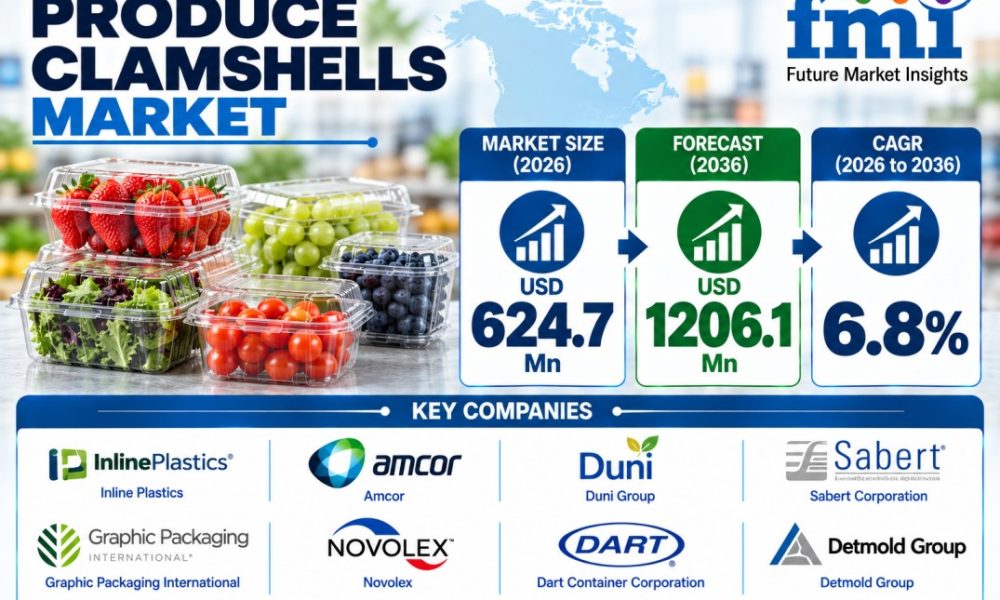
The global produce clamshells market is projected to reach USD 1,206.1 million by 2036, rising from USD 624.7 million in 2026 at a 6.8% CAGR, according to Future Market Insights.
Demand is increasingly linked to material conversion. Produce packers and foodservice operators are evaluating recyclable, recycled-content, fiber, compostable, and reusable alternatives while trying to maintain the closure performance, stackability, visibility, and pack-out routines of incumbent containers. The commercial challenge is therefore not simply selecting a new material. Packaging teams must prove that the replacement format works within the same operating environment while meeting local recovery and food-contact requirements.
>> Get Detailed Market Forecasts, Competitive Benchmarking, and Pricing Trends: https://www.futuremarketinsights.com/reports/sample/rep-gb-34828
Standard Formats Lead the Market
Standard formats are projected to account for 41.0% of format type demand in 2026. Their familiar footprints can reduce tooling changes, distributor-stock disruption, and pack-out adjustments during material conversion.
This is particularly important for multi-site foodservice programs. A material change that requires every location to modify its handling routine can create additional qualification and implementation costs.
By material, rPET and PP are expected to lead with a combined 27.0% share in 2026. Clear rPET supports product visibility, while PP provides a useful option where higher heat exposure or microwave use is required.
The report also identifies standard meal formats at 43.0% share in 2026, reflecting demand for repeatable portions that can stack and move efficiently through distribution.
QSR Chains Create Repeat Demand
QSR chains are forecast to represent 30.0% of end-use demand in 2026.
Large restaurant networks tend to standardize packaging specifications across multiple locations. This creates recurring demand once a format has passed food-contact, operational, distribution, and recovery requirements.
A packaging conversion can therefore affect more than the container itself. It can influence case counts, distributor inventories, storage footprints, pack-out routines, and field operations.
Detmold Group opened a Spartanburg facility in July 2026 to supply major QSR customers with locally produced paper-based packaging, illustrating the importance of regional production and replenishment capability in multi-site foodservice programs.
Material Conversion Requires More Qualification
Packaging regulations are increasing the documentation required for material changes.
California’s September 2025 covered-material guidance includes clamshells and hinged food containers under SB 54 categories. The report notes that resin identification and recovery documentation can therefore become part of packaging specifications during conversion.
At the same time, recovery systems differ across countries and jurisdictions. The report cites Eurostat data showing that 2023 plastic-packaging recycling rates ranged from 23.0% in Hungary to 59.5% in Belgium. Such differences affect how much commercial value can be assigned to a recyclability claim.
Nandini Roy Choudhury, Principal Consultant at Future Market Insights, states:
“Produce clamshell programs should compare closure failure risk and nesting loss before a material change reaches chainwide purchasing approval. Commercial value comes from preserving pack-out dimensions and case counts while documenting the recovery route for each approved resin or fiber format.”
The emphasis on closure and nesting reflects a wider shift toward performance-based packaging procurement.
👉 Access the Complete Report in PDF Format: https://www.futuremarketinsights.com/reports/brochure/rep-gb-34828
Regional Growth Outlook
The UAE is projected to record the highest CAGR among the profiled markets at 8.4%, followed by South Korea at 7.8%, the USA at 7.5%, Germany at 7.2%, and the UK at 6.9% through 2036.
Regional requirements vary significantly.
In the UAE, foodservice operators are qualifying alternatives as single-use plastic restrictions expand. South Korea is increasingly focused on recycled-resin traceability and virgin-plastic reduction. In the USA, national foodservice chains must balance standardized case specifications with differing state recovery requirements.
Germany’s mature recycling infrastructure places greater emphasis on polymer identification and recovery performance, while UK recyclability assessment ratings increasingly connect packaging design with disposal fees.
Competitive Landscape
The market includes rigid packaging manufacturers, foodservice specialists, and companies developing alternative material routes.
Key companies profiled by Future Market Insights include Inline Plastics, Amcor, Duni Group, Sabert Corporation, Graphic Packaging International, Novolex, Dart Container Corporation, and Detmold Group.
The competitive landscape includes several approaches. Inline Plastics, Amcor, Sabert, Novolex, and Dart provide established rigid or hinged packaging platforms. Graphic Packaging International and Detmold Group provide paperboard and fiber conversion options, while Duni Group focuses strongly on foodservice material transitions and reusable systems.
Recent developments include Sabert’s opening of a 300,000-square-foot Georgia distribution facility in August 2026, Inline Plastics’ introduction of a black-base 8×6 Safe-T-Chef clamshell with tamper protection in March 2026, and Novolex’s April 2025 combination with Pactiv Evergreen.
As packaging regulations and recovery requirements continue to influence purchasing decisions, the strongest commercial opportunities will come from formats that maintain proven geometry while providing documented material and recovery pathways.
To explore how FMI Custom Research can support your strategic priorities, connect with our team at – [email protected]
About Future Market Insights (FMI)
Future Market Insights, Inc. is an ESOMAR-certified, ISO 9001:2015 market research and consulting organization trusted by Fortune 500 companies. With a global presence across the U.S., UK, India, and Dubai, FMI delivers data-driven insights across 30+ industries and 1200 markets worldwide.



