
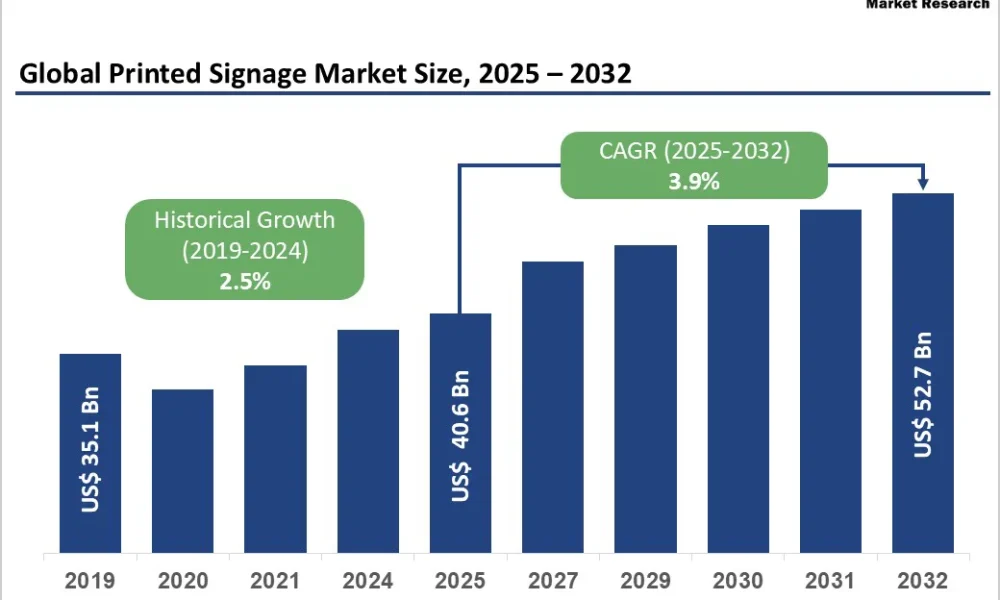
The global printed signage market continues to demonstrate resilient, steady growth despite the rapid rise of digital alternatives. Valued at US$ 40.6 billion in 2025, the market is projected to reach US$ 52.7 billion by 2032, expanding at a compound annual growth rate (CAGR) of 3.9% during the forecast period. This growth reflects sustained baseline demand from retail environments, outdoor advertising, corporate wayfinding, and events, supported by declining costs of digital and inkjet printing technologies and rising adoption of recyclable and eco-friendly substrates.
Printed signage remains a cornerstone of visual communication. While the sector is mature, it is far from stagnant. Instead, it is evolving through shorter production cycles, personalization, print-to-store fulfillment models, and sustainability-driven innovation. The balance between long-life outdoor signage and high-turnover promotional graphics continues to shape supplier strategies and investment priorities worldwide.
Market Overview and Growth Outlook
Printed signage refers to visual graphics produced using printing technologies and displayed across indoor and outdoor environments to convey branding, promotional, informational, or directional messages. Common formats include billboards, banners, posters, point-of-purchase (POP) displays, window graphics, vehicle wraps, and corporate wayfinding systems.
Despite competition from digital signage, printed signage retains strong relevance due to its cost efficiency, durability, design flexibility, and ease of deployment. For many applications—particularly outdoor advertising, temporary promotions, political campaigns, and local retail—printed signage remains the preferred medium.
From 2019 to 2024, the global printed signage market grew at a modest 2.5% CAGR, reflecting pandemic-era disruptions and delayed advertising spend. However, from 2025 onward, growth is expected to accelerate modestly as economic activity stabilizes, retail refresh cycles resume, and infrastructure and urban development projects expand globally.
Key Drivers Supporting Market Expansion
Steady Retail and Brand Refresh Cycles
Retail remains the single most important end-use sector for printed signage. Brick-and-mortar stores rely heavily on in-store graphics, window displays, seasonal promotions, and POP signage to influence purchasing decisions. Frequent refresh cycles—often quarterly or even monthly—generate recurring demand for short-run, fast-turnaround print jobs.
As experiential retail strategies gain traction, brands are increasingly investing in high-quality, visually engaging printed signage to complement store layouts and customer journeys.
Continued Strength of Outdoor Advertising
Outdoor printed signage, particularly billboards and large-format displays, continues to command a significant share of global advertising budgets. Printed billboards remain cost-effective for long-duration campaigns, offering high visibility and minimal maintenance compared to digital screens.
Infrastructure development, highway expansion, transit advertising, and urban beautification projects—especially in emerging economies—are driving new installations and replacement demand.
Cost Declines in Digital and Inkjet Printing
Advancements in large-format inkjet printing have significantly reduced per-unit production costs while improving speed, resolution, and substrate compatibility. This has enabled printers to profitably serve short-run and customized orders, which were previously uneconomical under traditional offset printing.
Lower hardware costs, improved ink efficiency, and automation have widened market access for regional and mid-sized print service providers, supporting industry-wide capacity expansion.
Sustainability and Recyclable Substrates
Sustainability is no longer optional in the printed signage market. Brands and advertisers increasingly demand PVC-free materials, recyclable substrates, water-based inks, and low-waste production methods.
The growing availability of eco-friendly substrates—such as paper-based boards, biodegradable textiles, and recyclable plastics—has helped printed signage maintain relevance in an environmentally conscious advertising landscape.
Market Restraints and Challenges
While growth prospects remain stable, the printed signage market faces several structural challenges:
- Competition from digital signage, particularly in high-traffic indoor environments
- Rising raw material costs, including paper, plastics, and inks
- Environmental regulations restricting certain substrates and chemicals
- Price pressure due to fragmented supplier bases and commoditization
However, these challenges are largely offset by operational efficiencies, technology upgrades, and the enduring cost advantage of printed formats in many use cases.
Product Type Analysis
Billboards and Outdoor Signage: Market Leader
Billboards and outdoor signage dominate the global printed signage market, accounting for an estimated 33% market share. Their leadership is driven by:
- High material consumption
- Long installation and display durations
- Large physical formats
- Recurring replacement due to weather exposure and campaign turnover
Outdoor signage remains indispensable for brand visibility, political advertising, real estate promotion, and infrastructure-linked advertising spaces.
Point-of-Purchase and In-Store Displays
POP displays represent one of the fastest-moving segments within printed signage. These include shelf talkers, floor graphics, end-cap displays, and promotional stands. Growth is fueled by retailers’ focus on impulse purchases and in-store differentiation.
Short-run customization and rapid design updates are key characteristics of this segment.
Event and Promotional Graphics
Trade shows, exhibitions, sports events, and cultural festivals continue to drive demand for temporary printed signage, including banners, backdrops, and directional graphics. The rebound of in-person events post-pandemic has positively impacted this segment.
Print Technology Trends
Dominance of Large-Format Inkjet Printing
Large-format inkjet printing leads the market with approximately 56% share, making it the most widely adopted technology across signage applications. Its dominance is attributed to:
- Compatibility with a wide range of substrates
- High print quality and resolution
- Faster turnaround times
- Lower setup costs compared to offset printing
Ongoing hardware upgrades—such as hybrid UV printers and textile-capable inkjet systems—are further expanding application possibilities.
Offset and Screen Printing
While offset and screen printing continue to be used for high-volume and specialty applications, their market share is gradually declining. These technologies remain relevant in long-run standardized signage but lack the flexibility required for personalized and short-run jobs.
Regional Market Insights
North America: Market Leader
North America holds the largest share of the global printed signage market, accounting for an estimated 37% of total revenue. The region benefits from:
- A mature and well-established retail ecosystem
- Consistent billboard replacement cycles
- High advertising expenditure per capita
- Advanced printing infrastructure
The United States remains the dominant contributor, supported by strong demand from retail chains, real estate, political campaigns, and corporate branding.
Asia Pacific: Fastest-Growing Region
Asia Pacific is the fastest-growing regional market, driven by rapid urbanization, infrastructure expansion, and the rise of organized retail. Countries such as China, India, Indonesia, and Vietnam are witnessing increased spending on outdoor advertising and political signage.
The region also benefits from cost-competitive manufacturing, making it a hub for textile printing, hybrid printer production, and substrate innovation.
Europe: Sustainability-Driven Market
Europe’s printed signage market is shaped by stringent environmental regulations and strong sustainability mandates. Demand is shifting toward recyclable materials and energy-efficient production methods, influencing supplier investments and product portfolios.
Investment and Competitive Landscape
Printed signage suppliers are actively investing in:
- Automation and workflow optimization
- Cloud-based ordering and design platforms
- Eco-friendly substrate production
- Hybrid and textile printing capabilities
Industry capital expenditure is estimated to grow at 6–7% annually, reflecting confidence in long-term demand stability. The competitive landscape remains fragmented, with a mix of global print service providers, regional specialists, and local shops catering to niche applications.
Emerging Trends Shaping the Market
Print-to-Store Fulfillment Models
Retailers increasingly demand just-in-time, location-specific signage, prompting suppliers to adopt decentralized production and print-to-store delivery models. This reduces inventory costs and improves campaign agility.
Personalization and Short-Run Printing
Advances in digital printing enable hyper-localized messaging, personalized promotions, and limited-edition campaigns, strengthening printed signage’s role in omnichannel marketing strategies.
Integration with Digital Campaigns
Rather than competing with digital signage, printed formats are increasingly used alongside digital displays, QR codes, and mobile engagement tools, creating hybrid advertising experiences.
Future Outlook
The global printed signage market is expected to remain a stable, cash-generative industry through 2032. While growth rates are moderate, the sector’s resilience lies in its adaptability, cost efficiency, and wide application base.
Sustainability, automation, and customization will define the next phase of evolution. Suppliers that invest in eco-friendly materials, flexible production technologies, and integrated digital workflows will be best positioned to capture long-term value.
Related Reports:




