
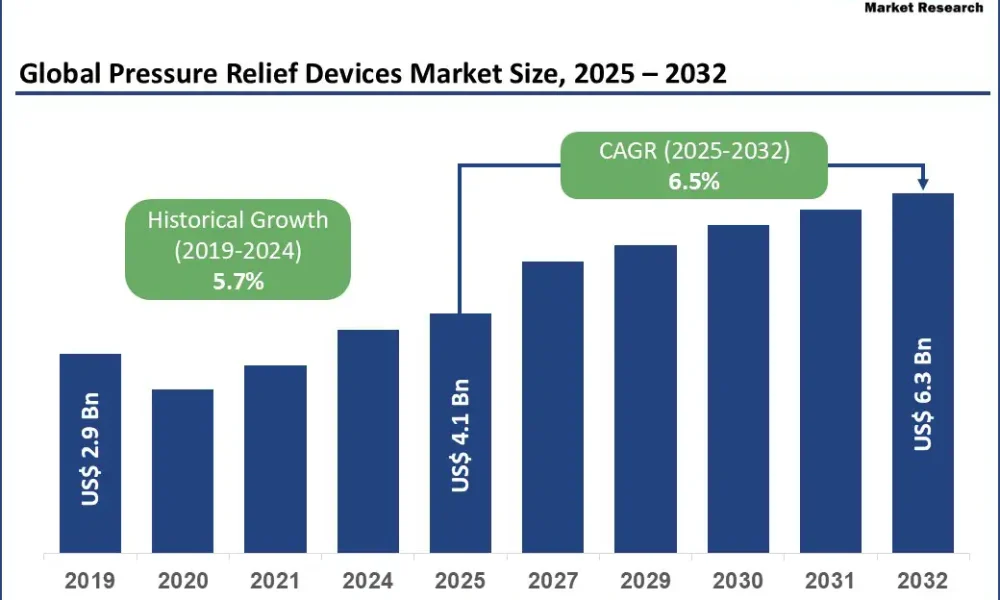
The pressure relief devices market has witnessed significant growth over the past few years, primarily driven by the rising prevalence of pressure ulcers, an aging global population, and increased healthcare awareness. The global market, valued at approximately US$ 4.1 billion in 2025, is projected to expand at a robust compound annual growth rate (CAGR) of 6.5%, reaching US$ 6.3 billion by 2032. The rising demand for advanced therapeutic surfaces, particularly within hospitals and long-term care centers, is a key factor influencing this growth. This article explores the current trends, market segmentation, regional insights, and key factors shaping the future of the pressure relief devices industry.
Key Highlights from the Report
• The global pressure relief devices market is projected to reach US$ 6.3 billion by 2032.
• North America holds the largest market share, with a 32% share in 2025.
• Asia Pacific is the fastest-growing region, projected at a CAGR of 7.8%.
• Low-tech pressure relief devices, particularly foam-based mattresses, dominate the market.
• Hospitals account for the largest share of the market, contributing over 40% of demand.
• Air-fluidized beds within high-tech pressure relief devices are experiencing rapid growth.
Download Your Free Sample & Explore Key Insights: https://www.persistencemarketresearch.com/samples/2826
Market Overview: Growth Drivers and Trends
The global pressure relief devices market is poised for significant growth due to a combination of key factors, including the increasing prevalence of pressure ulcers, technological advancements, and a growing awareness of patient safety. Pressure ulcers, also known as bedsores or decubitus ulcers, are a major health concern, particularly in hospitalized patients and long-term care settings. These ulcers occur when prolonged pressure reduces blood flow to specific parts of the body, leading to tissue damage. According to the World Health Organization (WHO), pressure ulcers affect 8-10% of hospitalized patients globally, a statistic that underscores the critical need for preventive solutions.
As the healthcare industry focuses on reducing hospital-acquired pressure injuries, there has been a growing adoption of pressure relief devices such as low-air-loss mattresses, foam-based overlays, and air-fluidized beds. These devices not only help prevent pressure ulcers but also facilitate the healing process, improving patient outcomes and reducing overall healthcare costs. The rising focus on patient safety, alongside regulatory initiatives such as reimbursement policies that support pressure ulcer prevention, is further propelling the growth of this market. North America, with its advanced healthcare infrastructure and strict clinical guidelines, remains the market leader, while Asia Pacific is witnessing rapid growth due to increased healthcare investments and an expanding geriatric population.
Market Segmentation
By Product Type
The pressure relief devices market is broadly segmented into low-tech and high-tech devices. Low-tech devices dominate the market, accounting for around 65% of the total share in 2025. Foam-based mattresses and overlays, known for their affordability and ease of use, make up the majority of this segment. These devices are commonly used in hospitals, long-term care centers, and home care settings. Foam-based mattresses are also the fastest-growing sub-segment, with a projected CAGR of 7.2%. Gel- and fiber-filled mattresses also maintain steady demand due to their comfort and moderate pressure redistribution properties.
On the other hand, high-tech devices such as air-fluidized beds, low-air-loss systems, and hybrid smart mattresses are gaining traction, particularly in critical care and rehabilitation settings. These devices are equipped with advanced pressure monitoring capabilities and are integrated with smart technologies, which improve clinical outcomes and operational efficiency. The air-fluidized beds segment, in particular, is growing at a CAGR of 5.8%, as healthcare providers seek to enhance preventive care for patients at high risk of developing pressure ulcers.
By End-User
The end-user segmentation of the pressure relief devices market is dominated by hospitals, which are expected to hold over 40% of the market share in 2025. Hospitals are the primary settings for the treatment of pressure ulcers, with patient safety protocols and mandatory use of pressure-relieving surfaces in critical areas such as ICUs driving the demand for these devices. Additionally, the rising volume of surgeries and post-operative care requirements further boosts the adoption of pressure relief devices in hospitals.
The home care segment is the fastest-growing end-user segment, driven by the aging population and the increasing preference for home-based healthcare services. Home care providers are adopting low-tech pressure relief devices due to their cost-effectiveness and ease of use. Long-term care centers and rehabilitation centers also contribute significantly to market growth, as the need for pressure ulcer prevention and recovery solutions continues to rise, particularly in aging populations.
Regional Insights
North America: Market Leadership and Technological Integration
North America is the largest market for pressure relief devices, with the United States accounting for the majority of the demand. In 2025, North America is expected to represent 32% of the global market share, driven by strong healthcare infrastructure, advanced wound care protocols, and supportive reimbursement policies. The U.S. healthcare system emphasizes patient safety, with hospitals required to meet stringent guidelines for preventing hospital-acquired pressure injuries. As a result, there is a high adoption rate of both low-tech and high-tech pressure relief devices in the region.
Canada also plays a significant role in the North American market, with increased government investment in elderly care and long-term care services. The country’s aging population and rising healthcare spending are expected to drive continued demand for pressure relief devices in both institutional and home care settings.
Asia Pacific: The Fastest-Growing Market
The Asia Pacific region is expected to experience the highest growth rate in the pressure relief devices market, with a projected CAGR of 7.8% during the forecast period. This growth is largely attributed to the increasing healthcare investments in countries such as China, India, and Japan, as well as the expanding geriatric population. China, in particular, is witnessing rapid adoption of advanced pressure relief devices, with government initiatives aimed at improving healthcare infrastructure and wound management. India is also emerging as a key growth hub, with the Ayushman Bharat program expanding access to pressure ulcer prevention devices.
Southeast Asian countries, including Indonesia and Malaysia, are investing in cost-efficient pressure relief devices for private hospitals and home care. As healthcare systems in these countries continue to evolve, the demand for both high-tech and low-tech devices is expected to rise.
Get Custom Insights Designed for Your Business: https://www.persistencemarketresearch.com/request-customization/2826
Europe: Balanced Growth Between Innovation and Affordability
Europe is expected to represent around 29% of the global pressure relief devices market in 2025. The region’s healthcare systems, particularly in Germany, the United Kingdom, and France, emphasize pressure ulcer prevention through government policies and reimbursement frameworks. Germany, with its advanced healthcare infrastructure, is a key player in the European market, while the UK’s National Health Service (NHS) drives the demand for cost-efficient solutions like foam-based mattresses in hospitals and care homes.
Scandinavian countries such as Sweden and Denmark are witnessing higher adoption rates of high-tech pressure relief devices, including air-fluidized and kinetic beds, due to stricter regulatory standards and a focus on digital healthcare integration.
Market Drivers
The primary driver for the growth of the pressure relief devices market is the increasing prevalence of pressure ulcers, which affects a significant portion of hospitalized patients worldwide. According to the Agency for Healthcare Research and Quality (AHRQ), approximately 2.5 million patients in the U.S. develop pressure ulcers annually, generating treatment costs exceeding $11 billion. This growing burden has created an urgent demand for effective pressure ulcer prevention and management solutions.
Additionally, healthcare institutions are under mounting pressure to adhere to stricter patient safety regulations. Government initiatives in various regions, such as reimbursement incentives for pressure ulcer prevention, are pushing hospitals and long-term care centers to adopt pressure relief devices. Technological advancements, including the integration of smart features in therapeutic surfaces, are also driving market growth by improving clinical outcomes and staff efficiency.
Market Restraints
Despite the growing demand for pressure relief devices, several factors are hindering market growth. One of the primary restraints is the lack of standardization in clinical guidelines and variability in reimbursement policies across different regions. In some countries, reimbursement for high-tech pressure relief devices is limited, which restricts their adoption in healthcare settings, particularly in emerging economies.
Furthermore, in regions like Asia Pacific and Latin America, pressure ulcer prevention protocols are inconsistently applied, leading to uneven demand for advanced devices. These disparities pose challenges for manufacturers looking to scale their products in global markets.
Market Opportunities
The increasing integration of smart technologies in healthcare presents a significant opportunity for the pressure relief devices market. The development of sensor-enabled mattresses that monitor patient movement, pressure distribution, and alert caregivers in real-time is transforming the way pressure ulcers are managed. These innovations not only improve clinical outcomes but also optimize hospital resources and staff efficiency.
Governments and healthcare authorities, particularly in the U.S., are actively encouraging the adoption of digital solutions by offering incentives for hospitals that reduce pressure ulcer incidence. The growing trend toward value-based healthcare is expected to further accelerate the demand for smart, sensor-enabled pressure relief devices.
Checkout Now & Download Complete Market Report: https://www.persistencemarketresearch.com/checkout/2826
Company Insights
Several leading companies dominate the pressure relief devices market, including:
• Arjo (formerly ArjoHuntleigh)
• Hill-Rom Holdings (Baxter International)
• Invacare Corporation
• Paramount Bed Co., Ltd.
• 3M Health Care
• Essity Health & Medical (Essity AB)
• Smith & Nephew
• Stryker Corporation
• Talley Group Ltd.
• Acelity
• Drive DeVilbiss Healthcare
• French Medical
• Roho
• Medtronic
• B. Braun SE
Pressure Relief Devices Market Segmentation
By Product Type
- High-tech Pressure Relief Devices
- Air Fluidized Beds
- Kinetic Beds
- Low-tech Pressure Relief Devices
- Foam-Based Mattress
- Gel-Based Mattress
- Fiber-Filled Mattress
- Water/Fluid-Filled Mattress
- Air-Filled Mattress
- Mattress Overlays
By End-user
- Hospitals
- Long Term Care Centers
- Rehabilitation Centers
- Home Care Settings
By Region
- North America
- Europe
- East Asia
- South Asia and Oceania
- Latin America
- Middle East and Africa
Recent Developments:
In June 2023, Baxter International (Hillrom) launched the Progressa+ ICU bed in the U.S., offering enhanced skin protection and support surfaces designed to reduce pressure injuries.
In September 2021, Baxter International completed a US$10.5 billion acquisition of Hillrom, expanding its capabilities in connected care and pressure relief innovations across the healthcare continuum.
Conclusion
The pressure relief devices market is poised for steady growth driven by an increasing global demand for pressure ulcer prevention solutions, technological innovations, and rising healthcare standards. While North America and Europe remain dominant in terms of market share, the Asia Pacific region presents significant growth opportunities, fueled by healthcare investments and an aging population. As the healthcare industry continues to prioritize patient safety and cost-effective care, the demand for advanced pressure relief devices will continue to rise, creating opportunities for both established players and new entrants in the market.




