
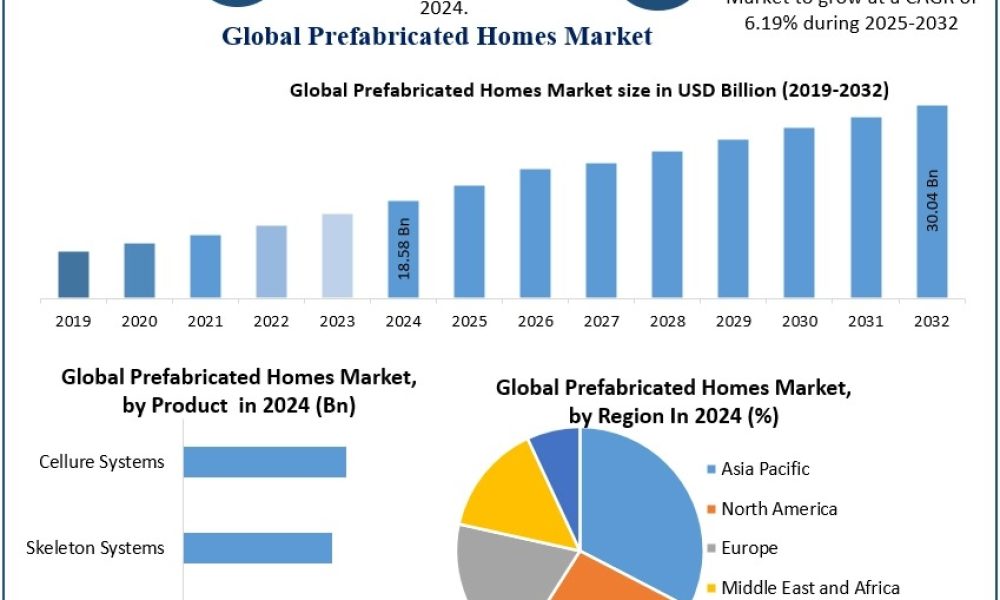
As per a recent study released by Maximize Market Research, titled, “Prefabricated Homes Market,” The Prefabricated Homes Market, size was valued at USD 18.58 Billion in 2024 and the total Prefabricated Homes revenue is expected to grow at a CAGR of 6.19% from 2025 to 2032, reaching nearly USD 30.04 Billion.
Prefabricated Homes Market Overview:
Prefabricated homes—also known as prefab or modular homes—are houses manufactured off-site in controlled factory settings and then transported and assembled on-location. This method offers a streamlined construction process: components are built indoors, quality-control is enhanced, weather delays are reduced, and on-site completion time is shortened. Because of this, prefab homes have emerged as a viable alternative to conventional stick-built houses, especially when cost, speed and reliability are key considerations.
In recent years, prefabricated homes have attracted more attention not only for affordability but also for design flexibility, sustainability credentials and customisation. With increasing preferences for faster builds and modern construction solutions, these homes are being positioned as mainstream options rather than just niche alternatives. They combine factory precision with on-site assembly to meet evolving housing needs across residential, affordable and even commercial sectors.
Want to Preview the Full Report? Download Your Free Sample Now :https://www.maximizemarketresearch.com/request-sample/230638/
Prefabricated Homes Market Dynamics
One of the major growth drivers in the prefabricated homes market is the growing demand for affordable, fast-delivered housing in urbanising regions. As populations move toward cities, housing supply-chains face pressure—traditional construction timelines and costs often struggle to keep up. Prefab homes help meet this gap by reducing build time, lowering labour dependency, and enabling more controlled production. Additionally, governments in several regions are supporting off-site construction methods through incentives, fast-track approvals and policies aimed at household expansion and infrastructure growth.
On the flip side, the market still encounters a number of challenges. Perception barriers persist—some consumers and stakeholders continue to view prefab homes as lower quality or less durable compared to conventional homes. Regulatory and zoning hurdles also arise, since many regions’ building codes and financing systems are tailored to traditional construction. Moreover, upfront investment for factory setup, transportation logistics and installation at site can be significant, and supply-chain disruptions (for materials, modules, transport) may affect project timelines and cost certainty.
Prefabricated Homes Market Outlook and Future Trends :
Looking ahead, the prefabricated homes market is poised to continue evolving rapidly, though future success will increasingly depend on value rather than just volume. Key trends include greater emphasis on smart, sustainable and high-design prefab homes—integrating renewable energy systems, high efficiency insulating materials, and modular adaptability (for additions or relocations). As technology and materials improve, prefab homes are likely to blur the line between factory-built and custom site-built homes in terms of quality and aesthetics.
Another important future trend is the growth of modular and multi-storey prefab developments, and the expansion of prefab into new segments such as multi-family residential, student housing and temporary disaster-relief shelters. Factory automation, digital design tools, and improved logistics will drive cost efficiencies and customization. Also, as consumer awareness grows and finance/insurance products tailored to prefab structures mature, adoption barriers will lessen—opening up new markets and applications for prefab homes.
Prefabricated Homes Market Regional Insights:
Regionally, the Asia-Pacific region stands out as a major growth engine for prefabricated homes. Rapid urbanisation, high infrastructure investment, large housing-deficit policy support, and growing disposable incomes in countries such as China, India and Southeast Asian nations make this region structurally important. In addition, many governments are promoting off-site construction as a way to accelerate housing delivery and reduce construction waste.
In contrast, North America and Europe are relatively mature markets for prefab housing. Growth in these regions is more focused on value-added segments: higher-end design-forward prefab homes, green construction, custom modular estates or relocatable homes rather than simply affordable housing. While volume growth may be slower, demand for premium finishes, sustainability certification and smart-home integration is stronger. Other regions—including Latin America, the Middle East & Africa—offer incremental opportunity, though barriers such as regulatory inconsistency, financing limitations and transport/logistics challenges may moderate pace.
Prefabricated Homes Market Segmentation
by Product
Panel Systems
Skeleton Systems
Cellure Systems
by Component
Metal
Non-Metal
Passive Yaw Systems
by End User
Industrial
Residential
Commercial
Some of the current players in the Prefabricated Homes Market are:
North America
1. Thomasnet
2. Clayton Homes
3. Champion Homes
4. Champion Homes
5. Katerra
Asia Pacific
1. Daiwa House Industry.
2. Sekisui House.
3. Ichijo.
4. Panasonic Homes.
5. Toyota Housing Corporation.
Europe
1. Lindal Cedar Homes Inc
2. Red Sea Housing Services
3. Astron Buildings
4. United Partition Systems
5. Butler Manufacturing Company
About Maximize Market Research:
Maximize Market Research is one of the fastest-growing market research and business consulting firms serving clients globally. Our revenue impact and focused growth-driven research initiatives make us a proud partner of majority of the Fortune 500 companies. We have a diversified portfolio and serve a variety of industries such as IT & telecom, chemical, food & beverage, aerospace & defense, healthcare and others.
Contact Maximize Market Research:
MAXIMIZE MARKET RESEARCH PVT. LTD.
⮝ 3rd Floor, Navale IT park Phase 2,
Pune Banglore Highway, Narhe
Pune, Maharashtra 411041, India.
✆ +91 9607365656
🖂 [email protected]




