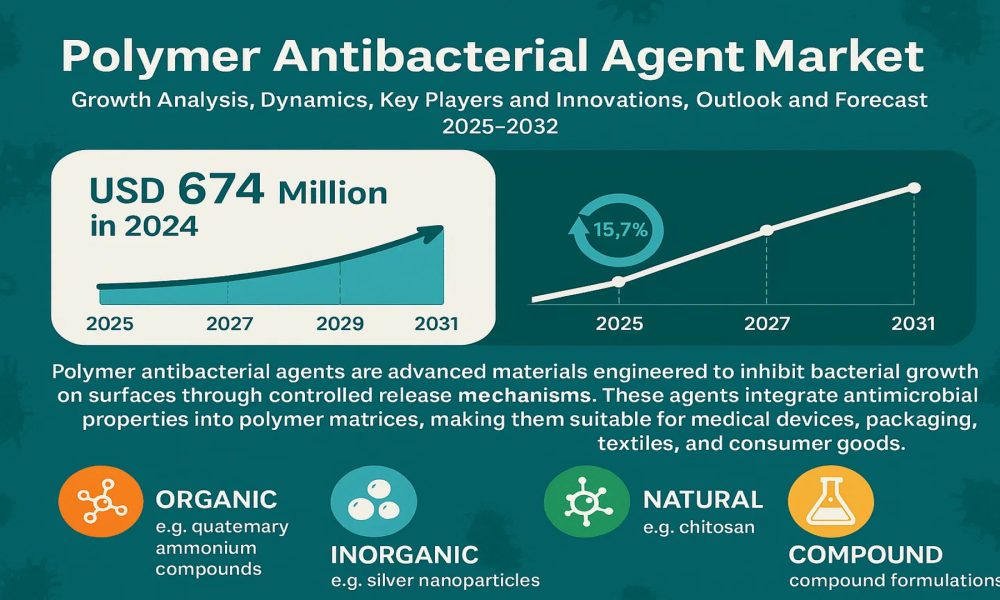
Polymer Antibacterial Agent Market was valued at USD 674 million in 2024. The market is projected to grow from USD 789 million in 2025 to USD 1,623 million by 2031, exhibiting a CAGR of 13.7% during the forecast period.
Polymer antibacterial agents are advanced materials engineered to inhibit bacterial growth on surfaces through controlled release mechanisms. These agents integrate antimicrobial properties into polymer matrices, making them suitable for medical devices, packaging, textiles, and consumer goods. Key types include organic (e.g., quaternary ammonium compounds), inorganic (e.g., silver nanoparticles), natural (e.g., chitosan), and compound formulations.
Rising health awareness and stringent hygiene standards are accelerating demand, particularly in healthcare applications. However, regulatory hurdles and high production costs pose challenges. Recent innovations like BASF’s Irgaguard® antimicrobial technology demonstrate industry efforts to enhance product efficacy. Asia-Pacific dominates consumption due to expanding healthcare infrastructure, while North America leads in technological advancements.
Claim Your Free Sample Report- https://www.intelmarketresearch.com/download-free-sample/9983/polymer-antibacterial-agent-market
MARKET DYNAMICS
MARKET DRIVERS
Growing Demand for Antimicrobial Polymers in Healthcare to Accelerate Market Expansion
The global polymer antibacterial agent market is witnessing substantial growth, primarily driven by rising demand in the healthcare sector. With increasing awareness about hospital-acquired infections (HAIs) and antimicrobial resistance, healthcare facilities are adopting antimicrobial polymers for medical devices, surgical equipment, and packaging. Antimicrobial polymers reduce bacterial adhesion and growth on surfaces by up to 99.9%, significantly lowering infection risks. The healthcare sector is expected to maintain its dominant share, accounting for over 42% of total antibacterial polymer applications, as hospitals and clinics prioritize infection control measures.
Expanding Food Packaging Applications to Fuel Market Growth
Food safety concerns are propelling the adoption of antibacterial polymer additives in packaging solutions. Antimicrobial polymers help extend shelf life by inhibiting bacterial and fungal growth in food products while maintaining freshness. The food packaging segment is projected to grow at over 15% CAGR through 2031 as regulatory bodies impose stricter food safety standards. Polymer films embedded with silver ions or organic antimicrobial compounds are increasingly replacing conventional packaging materials in perishable food sectors. Major food producers are investing in active packaging technologies, creating sustained demand for high-performance antibacterial polymer agents.
Stringent Hygiene Regulations in Consumer Goods to Drive Adoption
Consumer awareness about hygiene and sanitation is transforming product design across multiple industries. Regulations requiring antimicrobial properties in consumer products such as textiles, appliances, and electronics are accelerating market penetration. For instance, antimicrobial plastic additives are increasingly used in touchscreens, refrigerator linings, and children’s toys to prevent microbial contamination. The consumer goods sector accounts for nearly 28% of polymer antibacterial agent consumption, with Asia-Pacific emerging as the fastest-growing regional market due to rising disposable incomes and health consciousness.
MARKET OPPORTUNITIES
Advancements in Smart Antimicrobial Polymers to Unlock New Applications
Emerging technologies in stimuli-responsive antimicrobial polymers present transformative opportunities. Materials that activate antibacterial properties only when needed – such as in response to moisture, pH changes, or microbial presence – are gaining research attention. These “smart” polymer systems could revolutionize medical implants and wound care by providing targeted, on-demand antimicrobial action while minimizing unnecessary chemical exposure. The smart polymer segment is forecast to grow at over 18% CAGR through 2031 as healthcare and packaging industries adopt these advanced materials.
Sustainable Antibacterial Solutions to Drive Future Market Expansion
Growing environmental concerns are accelerating development of bio-based and renewable antimicrobial polymers. Plant-derived compounds like chitosan and essential oil extracts are being incorporated into polymer matrices as eco-friendly alternatives to synthetic antibacterial agents. The natural antimicrobial polymer segment, though currently small, is projected to triple in market value by 2030 as sustainability becomes a key purchasing criterion across industries. Regulatory support for green chemistry initiatives further enhances the commercial viability of these solutions.
Segment Analysis:
By Type
- Organic Type
- Inorganic Type
- Natural Type
- Compound Type
Inorganic Type is widely adopted due to its superior efficacy against bacteria and better stability in industrial applications.
By Application
- Medical Industry
- Chemical Industry
- Biological Industry
Medical Industry is the dominant segment, owing to rising demand for antimicrobial coatings in medical devices and hospital settings.
By End User
- Pharmaceutical Companies
- Healthcare Facilities
- Chemical Manufacturers
- Research Institutions
Pharmaceutical Companies lead in consumption due to their extensive R&D investments in antimicrobial solutions.
List of Key Polymer Antibacterial Agent Companies Profiled
- BASF SE (Germany)
- Dow Chemical Company (U.S.)
- Microban International (U.S./U.K.)
- Biocote Ltd. (U.K.)
- Agion Technologies (U.S.)
- Sinanen Zeomic (Japan)
- Toagosei Co. Ltd. (Japan)
- Dymatic Chemicals (China)
- SANITIZED AG (Switzerland)
- Milliken Chemical (U.S.)
- Pure Bioscience (U.S.)
- Trevira GmbH (Germany)
POLYMER ANTIBACTERIAL AGENT MARKET TRENDS
Growing Demand from Healthcare and Packaging Industries Drives Market Expansion
The global polymer antibacterial agent market is experiencing robust growth, primarily fueled by heightened demand in medical and packaging applications. The healthcare sector accounts for approximately 38% of total market consumption, with antibacterial polymers increasingly used in medical devices, wound care products, and hospital surfaces to prevent infections. Meanwhile, antimicrobial packaging solutions are gaining traction in the food and consumer goods industries, projected to grow at a CAGR of 14.2% through 2030, as manufacturers prioritize extended shelf-life and contamination prevention.
Other Trends
Nanotechnology Integration
Advancements in nanotechnology are revolutionizing polymer antibacterial agents, with nano-silver and nano-copper composites demonstrating superior efficacy against drug-resistant bacteria. These materials show 3-5 times greater antimicrobial activity compared to conventional alternatives while requiring smaller quantities. Recent developments in controlled-release mechanisms allow sustained antibacterial action over extended periods, making them ideal for implants and protective coatings.
Regulatory Push for Sustainable Antimicrobial Solutions
Stringent environmental regulations are reshaping product formulations, with the EU’s Biocidal Products Regulation (BPR) and US EPA guidelines driving innovation in eco-friendly antimicrobial agents. This has led to a 25% increase in R&D investments for biodegradable polymer-based antibacterial solutions since 2022. Manufacturers are focusing on natural antibacterial polymers like chitosan and polylysine derivatives, which combine effective microbial inhibition with reduced environmental impact.
Market Consolidation and Strategic Partnerships
The competitive landscape is witnessing increased consolidation, with 5 major acquisitions completed in 2023 alone as companies seek to expand their product portfolios and geographic reach. Additionally, cross-industry collaborations between material scientists and microbiologists are accelerating the development of next-generation antibacterial polymers with broader spectrum activity. These partnerships are particularly focused on addressing emerging challenges like biofilm formation and antibiotic resistance in clinical settings.
Claim Your Free Sample Report- https://www.intelmarketresearch.com/download-free-sample/9983/polymer-antibacterial-agent-market
Recent Developments in Polymer Antibacterial Agent Market
- Innovations in Biodegradable Polymers
- Companies are increasingly focusing on biodegradable polymer-based antibacterial agents to meet sustainability goals.
- These polymers reduce environmental impact while maintaining effective antibacterial properties, targeting applications in packaging, healthcare, and personal care.
- Rising Demand in Healthcare and Medical Devices
- The COVID-19 pandemic accelerated the adoption of antibacterial polymers in medical equipment, wound dressings, and surgical tools.
- Key players are developing polymers with long-lasting antibacterial activity to improve infection control in hospitals.
- Collaboration and Strategic Partnerships
- Leading chemical and polymer manufacturers are entering partnerships to expand their product portfolios and enter new regional markets.
- Example: Collaborations to integrate nanotechnology with polymers for enhanced antibacterial efficacy.
- Expansion of Production Facilities
- Companies are investing in regional manufacturing units, particularly in Asia-Pacific, to meet rising demand from packaging and healthcare sectors.
- This is expected to improve supply chain efficiency and reduce production costs.
- Development of Multi-functional Polymers
- Research is focusing on polymers that combine antibacterial properties with other functionalities like UV resistance, flame retardancy, or water repellence.
- These multi-functional polymers are gaining traction in construction, textiles, and electronics.
- Regulatory Approvals and Certifications
- New antibacterial polymers are receiving approvals from FDA and European regulatory bodies, enhancing market credibility.
- This trend encourages adoption in food packaging, medical, and cosmetic applications.
About Intel Market Research
Intel Market Research delivers actionable insights in technology and infrastructure markets. Our data-driven analysis leverages:
- Real-time infrastructure monitoring
- Techno-economic feasibility studies
Competitive intelligence across 100+ countries
Trusted by Fortune 500 firms, we empower strategic decisions with precision.
International: +1(332) 2424 294 | Asia: +91 9169164321
Website: https://www.intelmarketresearch.com
Follow us on LinkedIn: https://www.linkedin.com/company/intel-market-research
Market Research Reports | Market Trends | SWOT Analysis | Industrial Survey – Intelmarketresearch
Intel market research provides market research reports and company research reports across worldwide industries. We also offers customized market research solutions




