
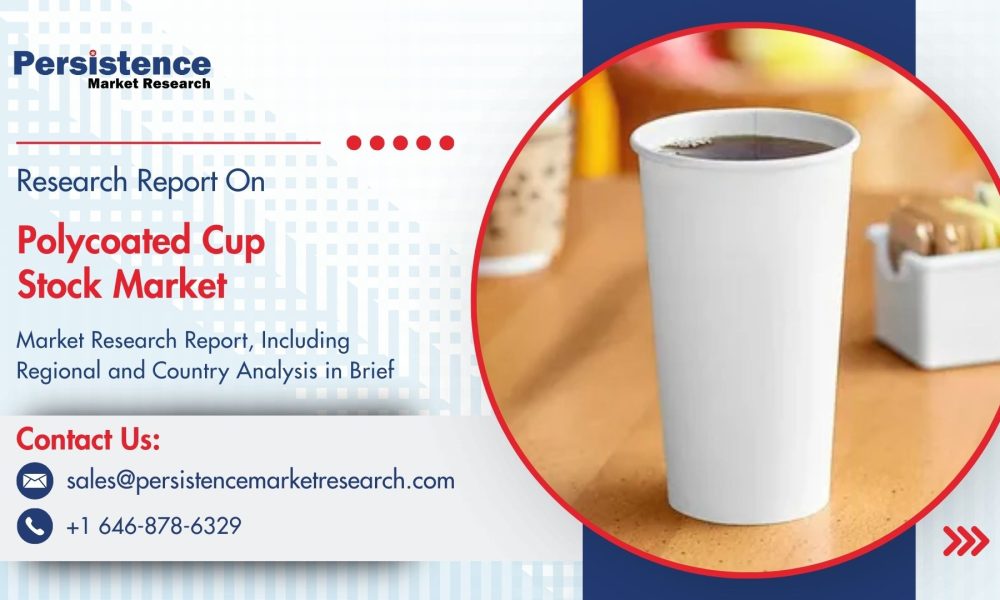
Polycoated Cup Stock Market: Brewing Growth in Sustainable Packaging
The global polycoated cup stock market is rapidly gaining traction as consumer lifestyles shift toward convenience, sustainability becomes a central corporate focus, and regulatory pressures restrict traditional plastics. Polycoated cup stock — paperboard panels coated with polymers to impart moisture resistance and structural strength — has become essential in the production of disposable cups used in foodservice, quick-service restaurants (QSRs), cafés, and beverage chains worldwide. Its evolution reflects broader trends in packaging: demand for on-the-go consumption solutions, regulatory emphasis on recyclability, and material innovation aimed at reconciling performance with environmental responsibility.
The global market was valued at approximately US$617.5 million in 2026 and is projected to grow to US$823.6 million by 2033, registering a compound annual growth rate (CAGR) of around 4.2% between 2026 and 2033. This sustained expansion underscores the increasing reliance on polycoated cup stock across diverse end-use industries, particularly foodservice and delivery-centric channels.
Get Your FREE Sample Report Instantly – Click Now: https://www.persistencemarketresearch.com/samples/36112
What Is Polycoated Cup Stock?
Polycoated cup stock is a paperboard substrate treated with a barrier layer — typically polyethylene (PE), plant-based polymers, polypropylene coatings, or advanced water-based barriers — to provide moisture resistance, grease protection, and heat endurance. These treated boards are essential for manufacturing disposable cups, ensuring structural integrity for both hot and cold beverages while meeting hygienic and safety standards.
As markets move away from single-use plastics and toward recyclable or repulpable materials, polycoated cup stocks have emerged as a critical transitional solution — bridging functional performance with evolving sustainability requirements.
Market Drivers: Convenience Culture and Sustainability Mandates
- Growth of Foodservice and Digital Delivery Channels
One of the most powerful drivers of demand for polycoated cup stock is the expansion of the foodservice ecosystem. Quick-service restaurants, cafés, coffee chains, and cloud kitchen models are proliferating globally as consumer preferences shift toward convenience and time-efficient dining. Integrated with digital delivery platforms such as Zomato, Uber Eats, and DoorDash, these outlets are selling more on-the-go beverages and food items than ever before.
Takeaway and delivery sales create consistent demand for disposable cups that are leak-resistant and durable, particularly in beverage combinations such as coffee, tea, iced drinks, and smoothies. Increased order frequency — driven by combo meals and beverage bundling — further elevates unit consumption of polycoated cup stock.
- Sustainability and Regulatory Pressure
Environmental regulation has emerged as a defining force in the packaging industry. Legislations like the EU’s Single-Use Plastics Directive and extended producer responsibility (EPR) frameworks in the U.K. and U.S. are nudging brands and manufacturers away from conventional plastics toward recyclable, compostable, or repulpable alternatives.
This shift drives demand for polycoated cup substrates with advanced coatings that maintain barrier performance while supporting recycling or biodegradation. Water-based and plant-based coatings, fluorine-free barriers, and technologies that enhance repulpability are gaining traction as compliance and sustainability metrics increasingly influence procurement decisions.
- Innovation in Material Technologies
Technological advancements in coating chemistry and substrate engineering are reshaping the polycoated cup stock landscape. Repulpable coatings and bio-based polymers are increasingly compatible with existing converting lines, reducing the historical trade-off between recyclability and performance. Improvements in coating adhesion, heat sealing, and moisture resistance enhance the operational efficiency of cup production while enabling manufacturers to offer products that satisfy both regulatory and consumer expectations.
Get a Customized Market View in One Click: https://www.persistencemarketresearch.com/request-customization/36112
Market Segmentation and Key Trends
By End-Use Industry
The foodservice segment remains the largest and most significant contributor to market share — accounting for approximately 42.3% in 2026 — due to its high beverage throughput and recurring procurement cycles. From multinational coffee chains to local QSRs, consistent print quality, dimensional accuracy, and heat resistance are critical performance requirements.
Delivery-centric and cloud kitchen models represent the fastest-growing end-use sub-segment, propelled by digital ordering ecosystems and consumer demand for convenience. Suppliers that can support rapid replenishment cycles, regional converting needs, and custom branding are best positioned to capture growth in this dynamic environment.
By Product Form
Finished cups — which combine coating, printing, and forming processes — accounted for about 38.4% of market value in 2026. This segment delivers higher revenue per ton of board and is preferred by large retail and foodservice chains for branded programs and promotional campaigns. Print customization and design consistency are significant differentiators, especially for global beverage brands seeking uniform packaging across markets.
By Coating Type
The market is diversifying beyond traditional polyethylene coatings toward plant-based, polypropylene, and water-based barrier coatings, driven by sustainability mandates and consumer preference for eco-friendly materials. These innovative coatings aim to balance performance with recyclability and reduced environmental impact.
By Cup Size
Polycoated cup stock spans multiple sizes — from small (≤8 oz) to medium (9–16 oz) and large formats — as well as double-wall constructions that offer enhanced insulation for hot beverages. Demand varies by region and consumption habits, with medium-size and double-wall formats experiencing robust uptake in café and specialty beverage segments.
Regional Insights
North America: Leading with Mature Demand and Sustainability Initiatives
North America is projected to hold approximately 33.5% of the global market share in 2026, led by high per-capita beverage consumption and a dense ecosystem of QSR and café formats. Corporate sustainability commitments and compliance with evolving regulatory frameworks, such as California’s extended producer responsibility laws, further shape material selection and innovation in barrier technologies.
Europe: Policy-Driven Transition Toward Recyclable Barriers
European markets — anchored by Germany, the U.K., and France — exhibit a mature demand pattern characterized by strong café culture and stringent packaging regulations. Initiatives to improve recyclability and reduce fossil-based polymer use have accelerated the adoption of water-based and repulpable barrier solutions in paper cups used across urban takeaway channels.
Asia Pacific: Fastest-Growing Region
Asia Pacific is the fastest-growing region, fueled by urbanization, rising disposable incomes, and expanding QSR presence in countries such as China and India. Domestic and global beverage brands are rapidly scaling store networks, driving recurrent procurement of polycoated cup stock — particularly in premium beverage formats and private-label programs.
Market Challenges
Despite growth momentum, the polycoated cup stock market faces a few key challenges:
- Recycling Infrastructure Limitations: Even with advanced coatings, inconsistent recycling systems — especially in emerging regions — complicate end-of-life processing and material recovery, slowing adoption of recyclable solutions.
- Input Cost Volatility: Fluctuations in pulp, resin, and energy prices impact manufacturing costs, squeezing margins for producers and sometimes limiting price pass-through to converters.
Competitive Landscape
The market is moderately fragmented, featuring global packaging giants and regional converters. Key players include Graphic Packaging International, Stora Enso, Mondi Group, WestRock Company, International Paper, Huhtamaki Oyj, and Metsä Board. Competitive differentiation centers on sustainable coating technologies, regional production capacity, long-term supply agreements, and the ability to meet evolving sustainability specifications from major foodservice brands.
For In-Depth Competitive Analysis, Buy Now: https://www.persistencemarketresearch.com/checkout/36112
Future Outlook
Looking ahead, the polycoated cup stock market is poised for sustainable expansion. Continued innovation in repulpable, bio-based, and advanced barrier coatings will help reconcile performance with recycling goals. Expansion of regional converting capacity and the increasing prominence of branded, customizable cups will further stimulate value growth. As sustainability remains central to procurement decisions and regulatory frameworks tighten, polycoated cup stock is set to become an even more integral part of the global packaging ecosystem.
About Persistence Market Research:
Persistence Market Research delivers strategic research solutions that drive business growth. Founded in 2012 and registered in England and Wales in 2023 as Persistence Research & Consultancy Services Ltd., we have completed 3,600+ custom and syndicated studies and supported 2,700+ projects for leading research firms. Combining traditional methodologies with modern tools, we provide actionable insights to multinational corporations, consultants, investors, and government bodies, earning strong trust through long-term client relationships.
Contact Us:
Persistence Market Research
Second Floor, 150 Fleet Street,
London, EC4A 2DQ, United Kingdom
USA Phone: +1 646-878-6329
UK Phone: +44 203-837-5656
Email: [email protected]
Web: https://www.persistencemarketresearch.com




