
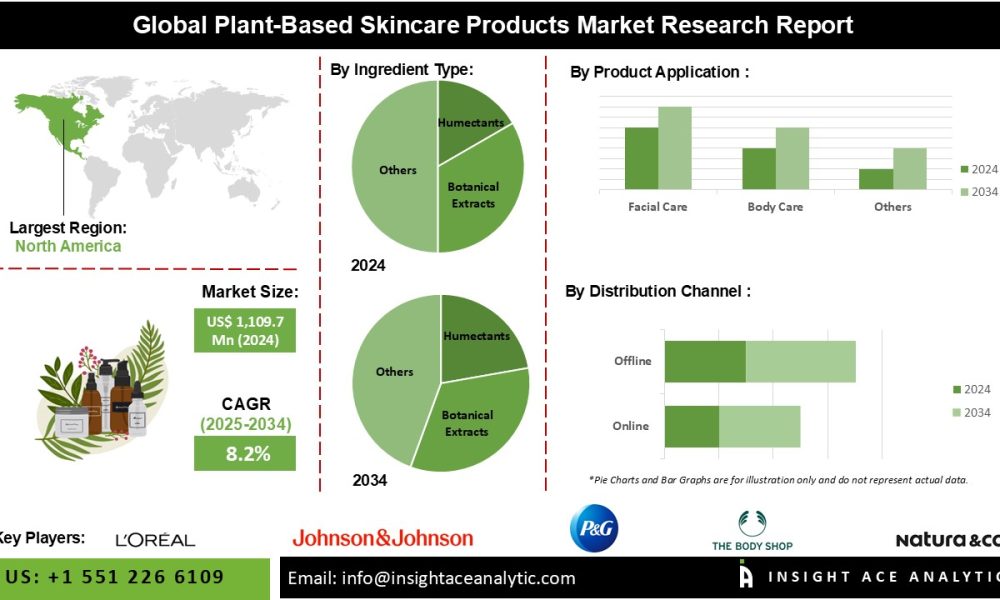
InsightAce Analytic Pvt. Ltd. announces the release of a market assessment report on the “Global Plant-Based Skincare Products Market Size, Share & Trends Analysis Report By Ingredient Type (Botanical Extracts, Plant-Based Oils, Plant Butters, Essential Oils, Humectants, Plant-Based Vitamins, Others (e.g., collagen, peptides, CBD)), Product Application (Facial Care, Body Care, Hair Care, Specialized Treatments), Distribution Channel (Online, Offline) Market Outlook And Industry Analysis 2034″
The Global Plant-Based Skincare Products Market is valued at USD 1,109.7 Mn in 2024 and it is expected to reach USD 2,394.1 Mn by the year 2034, with a CAGR of 8.2 % during the forecast period of 2025-2034.
Check this Report Brochure : https://www.insightaceanalytic.com/request-sample/3021
The plant-based skincare products market is experiencing robust growth, driven by increasing consumer preference for natural, sustainable, and gentle alternatives to conventional skincare formulations. Plant-based skincare refers to personal care products formulated primarily with botanical ingredients—such as plant extracts, oils, butters, and waxes derived from fruits, seeds, flowers, and herbs—rather than synthetic chemicals or animal-derived substances. These formulations are often vegan and rich in bioactive compounds including antioxidants, vitamins, minerals, and essential fatty acids, which contribute to improved skin health and appearance.
Unlike traditional skincare products that may contain synthetic additives or animal-based components, plant-based alternatives leverage botanical actives such as essential oils, natural waxes, and upcycled plant materials to deliver effective results while minimizing the risk of skin irritation or adverse reactions. These ingredients are utilized across a broad range of product categories, including cleansers, moisturizers, face washes, serums, facial oils, masks, exfoliators, sunscreens, and post-sun care.
Plant-based skincare products are suitable for various skin types and concerns, including hydration, anti-aging, sensitivity, acne, dryness, and inflammation. Their ability to support the skin microbiome, regulate moisture balance, and address common dermatological issues has contributed to their increasing popularity. Furthermore, their holistic, environmentally conscious, and cruelty-free positioning appeals strongly to health-conscious consumers and individuals with sensitive skin, thereby reinforcing the market’s upward trajectory.
List of Prominent Players in the Plant-Based Skincare Products Market:
- L’Oréal S.A.
- The Estée Lauder Companies Inc.
- Unilever
- Procter & Gamble
- Johnson & Johnson
- The Body Shop
- Natura & Co.
- Biossance
- Five Dot Botanics
- Arata
- Kosas Cosmetics
- OSEA
- Evonik
- Symrise
- Organic Harvest
- FOM London Skincare
- Bloomtown
- Burt’s Bees
- The Hain Celestial Group (Avalon Organics)
- Bare Escentuals Beauty, Inc. (Shiseido)
- Three Ships Beauty
- LOLI Beauty
- Seed Phytonutrients
- Codex Labs
- Saie
- Skin at Peace
- Typology
- Clockface Beauty
- Shea Yeah
- Oquist Cosmetics
- ROWSE
- Lamixtura
- The Kind Planet Company
- Kankan
- The Kind Lab
- Neera Naturals
- KORA Organics
- Conserving Beauty
- Raw Apothecary
Market Dynamics
Drivers:
The growth of the plant-based skincare market is primarily driven by increasing consumer awareness of health and wellness, leading to a preference for products formulated with natural, plant-derived ingredients over synthetic or animal-based alternatives. Concerns regarding sustainability and animal welfare are also contributing significantly to the rising demand for vegan and cruelty-free skincare products. The clean beauty movement has further accelerated this trend, encouraging the adoption of transparent, chemical-free formulations. Additionally, the rising popularity of plant-based and vegan lifestyles—amplified by social media and beauty influencers—particularly among younger demographics, is bolstering market expansion.
Challenges:
Despite its growth, the plant-based skincare industry faces several challenges. High production and ingredient costs, often due to the use of premium natural ingredients, sustainable sourcing practices, and eco-friendly preservatives, can limit accessibility. Moreover, the absence of synthetic preservatives typically results in shorter product shelf life and stability issues. Performance consistency is another concern, as natural ingredients may not always match the efficacy, texture, or absorption qualities of synthetic alternatives, which can impact consumer satisfaction and brand loyalty.
Regional Trends:
Europe currently leads the global plant-based skincare market, underpinned by strong consumer demand for natural, vegan, and ethically produced personal care products. Heightened awareness of health, environmental, and ethical considerations supports this growth. The region’s well-established personal care industry—particularly in countries such as Germany, France, Italy, and the United Kingdom—has facilitated innovation and product development in this segment. Furthermore, strict EU regulations regarding cosmetic ingredients and animal testing have accelerated the shift toward plant-based formulations. Cultural trends, including the widespread adoption of veganism and clean beauty ideals, continue to reinforce market growth across the region.
Recent Developments:
- In April 2025, Symrise introduced the Mindera platform, a 100% plant-based, patent-protected solution for natural cosmetic product protection. This innovation marks a key step toward clean beauty, offering sustainable, science-backed preservation for personal care formulations and reinforcing Symrise’s commitment to eco-conscious, high-performance solutions.
- In Feb 2024, Evonik launched Vecollag Fortify L, a vegan, skin-identical collagen for beauty and personal care, targeting anti-aging and hydration needs. It meets rising demand for sustainable, non-animal collagen and reinforces Evonik’s position in biotech-driven, clean beauty solutions.
Segmentation of Trusted Platform Module Market-
By Ingredient Type:
- Botanical Extracts
- Plant-Based Oils
- Plant Butters
- Essential Oils
- Humectants
- Plant-Based Vitamins
- Others (e.g., collagen, peptides, CBD)
By Product Application:
- Facial Care
- Body Care
- Hair Care
- Specialized Treatments
By Distribution Channel:
- Online
- Offline
By Region-
North America-
- The US
- Canada
Europe-
- Germany
- The UK
- France
- Italy
- Spain
- Rest of Europe
Asia-Pacific-
- China
- Japan
- India
- South Korea
- South East Asia
- Rest of Asia Pacific
Latin America-
- Brazil
- Argentina
- Mexico
- Rest of Latin America
Middle East & Africa-
- GCC Countries
- South Africa
- Rest of Middle East and Africa
About Us:
InsightAce Analytic is a market research and consulting firm that enables clients to make strategic decisions. Our qualitative and quantitative market intelligence solutions inform the need for market and competitive intelligence to expand businesses. We help clients gain competitive advantage by identifying untapped markets, exploring new and competing technologies, segmenting potential markets and repositioning products. Our expertise is in providing syndicated and custom market intelligence reports with an in-depth analysis with key market insights in a timely and cost-effective manner.




