

Pipeline Transportation Market Overview
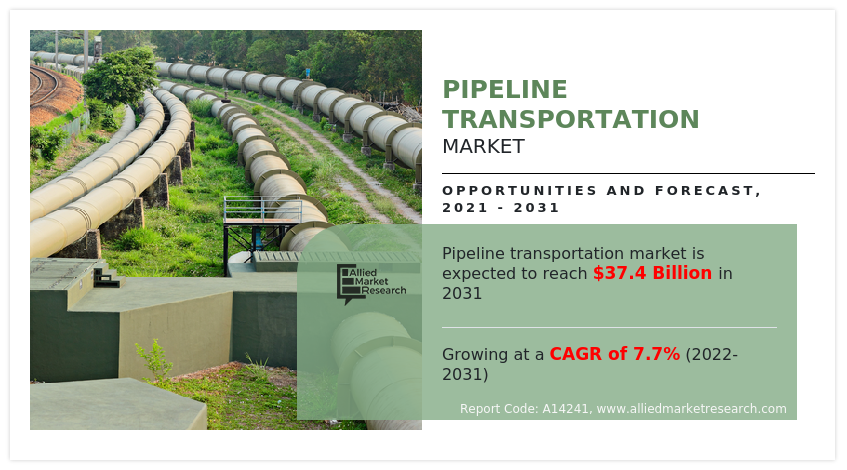
According to a new report published by Allied Market Research, the global pipeline transportation market size was valued at $17.9 billion in 2021 and is projected to reach $37.4 billion by 2031, registering a CAGR of 7.7% from 2022 to 2031. Increasing demand for efficient long-distance transport of oil, gas, chemicals, and water is a key factor driving the pipeline transportation market worldwide. 🌍⛽
Introduction
Pipeline transportation refers to the movement of liquids, gases, and sometimes solids through a network of pipes over long distances. This method is widely used for transporting crude oil, natural gas, and refined petroleum products. In addition, pipelines are used to carry water, slurry, sewage, and even certain food-grade liquids.
Compared to road, rail, or maritime transport, pipelines offer significant advantages such as continuous operation, lower operating costs, automation, minimal human intervention, and reduced environmental impact. These benefits are contributing to steady growth in the pipeline transportation market across developed and emerging economies.
Download PDF Brochure: https://www.alliedmarketresearch.com/request-sample/A14241
Advantages Driving Market Adoption
One of the primary drivers of the pipeline transportation market is its cost efficiency. Pipelines can move large volumes of materials over long distances with minimal energy consumption once installed. They also operate continuously, making them ideal for industries that require a stable supply of raw materials.
Automation further enhances efficiency by enabling remote monitoring and control of loading, unloading, and flow management. This reduces labor costs and improves operational safety. Environmental benefits, such as lower greenhouse gas emissions compared to trucking or shipping, also support adoption as governments worldwide push for cleaner logistics solutions. 🌱
Rising Need for Surveillance and Security
Despite its advantages, pipeline infrastructure faces significant risks. Pipelines often traverse remote areas, water bodies, mountains, and populated regions, making them vulnerable to vandalism, theft, accidental damage, and terrorist activities.
As a result, the demand for advanced surveillance systems, leak detection technologies, and security solutions has increased substantially. Continuous monitoring is essential because pipelines frequently transport hazardous and flammable materials. Any leakage can cause environmental damage, safety hazards, and financial losses.
These risks present both challenges and opportunities within the pipeline transportation market, encouraging investments in protective technologies and infrastructure upgrades.
Digitalization and Network Communication Solutions
Modern pipeline systems are rapidly evolving with digital technologies. Integration of sensors, communication networks, and data analytics enables real-time monitoring of pipeline conditions, pressure levels, and flow rates.
Network communication solutions—including optical fiber networks, microwave communication systems, and satellite links—play a critical role in ensuring reliable data transmission across vast distances. In 2021, this segment accounted for the largest share of the pipeline transportation market among solution types.
Fiber-optic systems, in particular, are widely used because they allow high-speed data transfer and can detect vibrations or disturbances along the pipeline route, improving safety and operational efficiency.
Demand for Safe Transport of Hazardous Materials
Transporting hazardous liquids and gases requires highly secure and reliable methods. Pipelines provide a safer alternative to road and rail transport, reducing the risk of accidents and spills.
Industries dealing with chemicals, petroleum products, and natural gas increasingly rely on pipelines to ensure uninterrupted supply chains. The need for cost-effective and secure transportation of such materials is expected to continue fueling the pipeline transportation market in the coming years.
Growing concerns about illegal tapping and potential terrorist threats also encourage governments and companies to invest in advanced monitoring systems, creating new growth opportunities.
Market Segmentation by Type
The pipeline transportation market is segmented by type into oil and gas, coal, chemical, water, and others.
The oil and gas segment dominated the market in 2021, accounting for approximately 51.6% of the total share. This dominance is due to the extensive use of pipelines for transporting crude oil, refined petroleum products, and natural gas across countries and regions.
Pipelines remain the most economical method for moving large quantities of hydrocarbons over land. There are three main categories:
- Gathering systems that collect oil from production sites
- Crude oil pipelines that transport unrefined oil to refineries
- Refined product pipelines that deliver fuels such as gasoline, kerosene, jet fuel, and heating oil to end users
Solution and Service Analysis
By solution type, the pipeline transportation market includes security solutions, automation and control, integrity and tracking systems, network communication solutions, and others.
Network communication solutions led the market in 2021 due to the increasing need for real-time data exchange and remote management. Microwave networks use radio waves to transmit information between fixed locations, while satellite systems enable connectivity in remote areas.
In terms of services, maintenance and support accounted for the largest share. Pipeline infrastructure requires regular inspection, servicing, and repairs to ensure safe operation. Maintenance activities include checking valves, pumps, sensors, and structural integrity to prevent failures and extend system lifespan.
Regional Outlook
Regionally, Asia-Pacific held the largest share of the pipeline transportation market in 2021 and is expected to grow at a CAGR of 8.1% during the forecast period. Rapid industrialization, urbanization, and rising energy demand are key factors driving growth in this region.
Highly populated and developing countries such as China and India are investing heavily in energy infrastructure, including pipeline networks. In addition, Indonesia is expanding its transportation systems to support economic development. 🌏
These nations rank among the top countries globally in terms of pipeline network length, making Asia-Pacific a major consumer in the pipeline transportation market.
Impact of COVID-19
The COVID-19 pandemic initially had a negative impact on the pipeline transportation market. Lockdowns and industrial shutdowns reduced demand for petroleum and chemical products, leading to lower utilization of pipeline infrastructure.
Supply chain disruptions and workforce shortages further slowed operations. However, pipelines proved to be resilient during the crisis because they provide direct connections between production sites and processing facilities.
Government investments in infrastructure projects to stimulate economic recovery also supported the deployment of new pipelines, helping the market regain momentum.
Competitive Landscape
The pipeline transportation market features several major global players focused on technological innovation and strategic partnerships. Key companies include Alstom, ABB Ltd., Schneider Electric, Siemens, Esri, Emerson Electric, Trimble Inc., Rockwell Automation, TechnipFMC, and Alcatel-Lucent.
These organizations are investing in digital solutions, automation technologies, and infrastructure expansion to strengthen their market positions.
Get a Customized Research Report: https://www.alliedmarketresearch.com/request-for-customization/A14241
Conclusion
In conclusion, the pipeline transportation market is poised for strong growth as global demand for energy, water, and chemical distribution continues to rise. Pipelines offer a reliable, cost-effective, and environmentally friendly transportation method for bulk materials over long distances.
Advancements in monitoring technologies, communication systems, and safety solutions are further enhancing efficiency and security. While challenges such as security risks and infrastructure complexity remain, ongoing investments and technological innovation are expected to drive sustained expansion of the pipeline transportation market in the coming decade. 🚀
Other Trending Reports:-
Gas Pipeline Infrastructure Market
About Us
Allied Market Research (AMR) is a full-service market research and business-consulting wing of Allied Analytics LLP based in Portland, Oregon. Allied Market Research provides global enterprises as well as medium and small businesses with unmatched quality of “Market Research Reports” and “Business Intelligence Solutions.” AMR has a targeted view to provide business insights and consulting to assist its clients to make strategic business decisions and achieve sustainable growth in their respective market domain.
Pawan Kumar, the CEO of Allied Market Research, is leading the organization toward providing high-quality data and insights. We are in professional corporate relations with various companies and this helps us in digging out market data that helps us generate accurate research data tables and confirms utmost accuracy in our market forecasting. Each and every data presented in the reports published by us is extracted through primary interviews with top officials from leading companies of domain concerned. Our secondary data procurement methodology includes deep online and offline research and discussion with knowledgeable professionals and analysts in the industry.




