
The global pharmaceutical excipients market is witnessing robust growth driven by rising demand for high-quality drug formulations and patient-centric therapies. Pharmaceutical excipients, which are inactive substances used alongside active pharmaceutical ingredients (APIs), play a crucial role in ensuring the stability, efficacy, and bioavailability of drugs. These substances, which include fillers, binders, coatings, and stabilizers, are indispensable for solid, liquid, and parenteral dosage forms. Over the past decade, increasing adoption of advanced drug delivery systems, expanding generic drug manufacturing, and the formulation of biologics and advanced therapies have significantly boosted the market. The push for orally disintegrating tablets, controlled-release formulations, and age-specific dosage forms has further enhanced the requirement for specialized excipients.
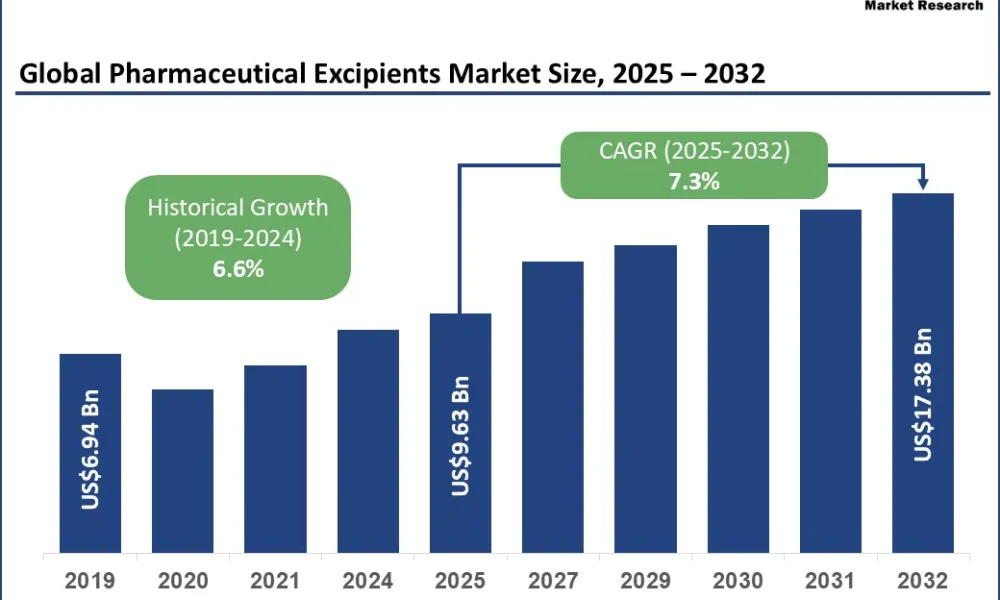
The market size is projected to reach US$17.38 billion by 2032 from an estimated US$9.63 billion in 2025, registering a CAGR of 7.3% during the forecast period. In terms of segments, fillers and diluents dominate with an approximate market share of 41.2% in 2025 due to their critical role in solid oral dosage forms. Solid dosage forms are expected to maintain a leading position with a 68% share, driven by the widespread preference for tablets and capsules. Geographically, North America commands the largest share at 40.7%, supported by robust pharmaceutical R&D, stringent regulatory frameworks, and early adoption of advanced manufacturing technologies. Conversely, the Asia Pacific region is projected to exhibit the highest growth rate, fueled by expanding generic drug production, increasing healthcare investments, and favorable government policies in countries like India and China.
Download Your Free Sample & Explore Key Insights: https://www.persistencemarketresearch.com/samples/4421
Key Highlights from the Report
• Fillers & diluents segment dominates the market with the highest market share in 2025.
• Coating materials segment is expected to witness the fastest CAGR through 2032.
• Solid dosage forms maintain the largest share due to widespread tablet and capsule consumption.
• North America leads the regional market owing to strong R&D and regulatory frameworks.
• Asia Pacific is the fastest-growing region, driven by generic drug manufacturing and healthcare expansion.
• Increasing patient-centric formulations are boosting demand for advanced excipients.
Market Segmentation
The pharmaceutical excipients market can be segmented based on product functionality, dosage forms, and end-user applications. In terms of functionality, fillers and diluents dominate due to their ability to provide bulk, improve compressibility, and enhance tablet and capsule integrity. Coating materials, binders, disintegrants, lubricants, and glidants constitute other functional segments, with coating materials witnessing the highest projected CAGR due to their role in drug stability, taste masking, and controlled-release mechanisms. Regarding dosage forms, the market is led by solid forms, primarily tablets and capsules, accounting for over two-thirds of total revenue. Liquid and semi-solid forms are growing steadily, driven by increasing pediatric and geriatric patient needs and the rise of biologics. Additionally, specialized excipients for parenteral formulations and advanced delivery systems are becoming increasingly relevant as the pharmaceutical industry shifts toward patient-centric and targeted therapies.
End-user segmentation distinguishes between pharmaceutical manufacturers, contract research organizations (CROs), and biotechnology companies. Pharmaceutical manufacturers remain the primary consumers, utilizing excipients to develop generics, branded formulations, and novel drug delivery systems. Biotechnology firms are increasingly integrating advanced excipients to stabilize sensitive biologics such as monoclonal antibodies, vaccines, and gene therapies. CROs play a critical role in formulation optimization, particularly for custom excipients tailored to experimental or orphan drug formulations. Across all segments, excipients are moving toward multifunctional and co-processed variants that reduce formulation complexity, enhance patient compliance, and improve bioavailability.
Regional Insights
North America maintains the largest share of the pharmaceutical excipients market due to its well-established pharmaceutical ecosystem. The United States, in particular, benefits from a dense network of innovative pharmaceutical companies, stringent FDA regulations, and high adoption rates of advanced manufacturing technologies such as continuous processing. This combination ensures robust demand for high-purity excipients, including parenteral-grade polysorbates, cellulose derivatives, and co-processed blends that support the formulation of both generics and complex biologics. The region’s focus on R&D, patient-centric formulations, and high-quality manufacturing standards further reinforces North America’s leadership in the market.
The Asia Pacific market is the fastest-growing globally, with India and China emerging as the primary growth drivers. India’s generic drug industry, often referred to as the “pharmacy of the world,” produces over 300 generic drug approvals annually in the U.S., creating significant demand for fillers, binders, and coating excipients. Favorable government initiatives such as India’s “Pharma Vision 2030” encourage domestic excipient production and reduce dependency on imports. China’s expanding biopharmaceutical sector, aligned with global regulatory standards, attracts multinational collaborations and investment in excipient manufacturing. Europe holds a stable market share, supported by mature pharmaceutical infrastructure, strict regulatory oversight, and a growing emphasis on eco-friendly, multifunctional excipients for biosimilars and advanced drug delivery formulations.
Get Custom Insights Designed for Your Business: https://www.persistencemarketresearch.com/request-customization/4421
Market Drivers
The pharmaceutical excipients market is primarily driven by the increasing production of generic drugs following looming patent expirations. The anticipated loss of exclusivity for blockbuster drugs valued at over US$180 billion across the U.S. and European Union between 2025 and 2035 has created a massive demand for cost-effective excipients capable of supporting large-scale, high-quality formulations. Additionally, the growing emphasis on patient-centric formulations such as orally disintegrating tablets, controlled-release systems, and pediatric-friendly liquids has accelerated the need for specialized excipients. Regulatory support for multifunctional and co-processed excipients, coupled with rising R&D investments in advanced drug delivery systems, further fuels market growth. The emergence of biologics and sensitive therapeutics, including monoclonal antibodies and gene therapies, has intensified the demand for excipients that ensure stability, solubility, and bioavailability, creating new opportunities for innovation.
Market Restraints
Despite strong growth, the market faces challenges related to regulatory complexity and supply chain constraints. Tariffs on pharmaceutical imports, particularly in the U.S., have raised the cost of excipients sourced from key suppliers in China and India. These trade barriers threaten the affordability and availability of generic drugs and may force manufacturers to restructure sourcing strategies, resulting in potential delays and higher production costs. Additionally, the stringent quality standards required for high-purity excipients and specialized biologic-grade formulations impose regulatory and operational hurdles, limiting market entry for smaller players. Market volatility, fluctuating raw material costs, and environmental compliance pressures further restrain the widespread adoption of certain excipient types.
Market Opportunities
The pharmaceutical excipients market presents numerous opportunities for growth and innovation. The rising focus on patient-centric and age-specific formulations is driving demand for excipients that improve solubility, taste masking, and controlled-release properties. The surge in biologics and complex therapies opens avenues for high-value excipients capable of stabilizing sensitive molecules. Expanding generic drug production, particularly in emerging markets such as India and China, offers significant volume-based opportunities. Advances in co-processed excipients, biopolymers, and sustainable ingredients provide a dual benefit of improved formulation performance and alignment with environmental regulations. Furthermore, strategic collaborations, mergers, and acquisitions among excipient manufacturers facilitate market penetration and geographic expansion, enabling companies to capitalize on evolving industry trends.
Checkout Now & Download Complete Market Report: https://www.persistencemarketresearch.com/checkout/4421
Company Insights
• Ashland Global Holdings, Inc.
• BASF SE
• DuPont de Nemours, Inc.
• Roquette Frères
• Evonik Industries AG
• Associated British Foods plc
• Archer Daniels Midland Company (ADM)
• Croda International Plc
• Kerry Group plc
• Wacker Chemie AG
Recent Developments: In July 2025, Sigachi Industries inaugurated a new R&D center in Hyderabad to strengthen API development and regulatory compliance capabilities. In June 2025, BASF launched a GMP Solution Center in Michigan, enhancing its biopharma and pharmaceutical ingredient portfolio, including advanced analytical testing and clean-room packaging for high-purity excipients.
Conclusion
The pharmaceutical excipients market is poised for substantial growth, driven by the convergence of rising generic drug production, expanding biologics development, and increasing demand for patient-centric formulations. Solid dosage forms and fillers/diluents dominate current market trends, while coating materials and liquid formulations are expected to witness rapid growth. North America leads in market share due to robust R&D infrastructure and regulatory standards, whereas the Asia Pacific region is emerging as the fastest-growing market owing to expanding pharmaceutical manufacturing and supportive government initiatives. Despite challenges such as tariffs and regulatory barriers, the market presents significant opportunities for innovation in multifunctional, co-processed, and sustainable excipients. Leading companies continue to invest in research, advanced manufacturing, and strategic collaborations to meet evolving market needs, positioning the pharmaceutical excipients sector for continued expansion through 2032 and beyond.




