
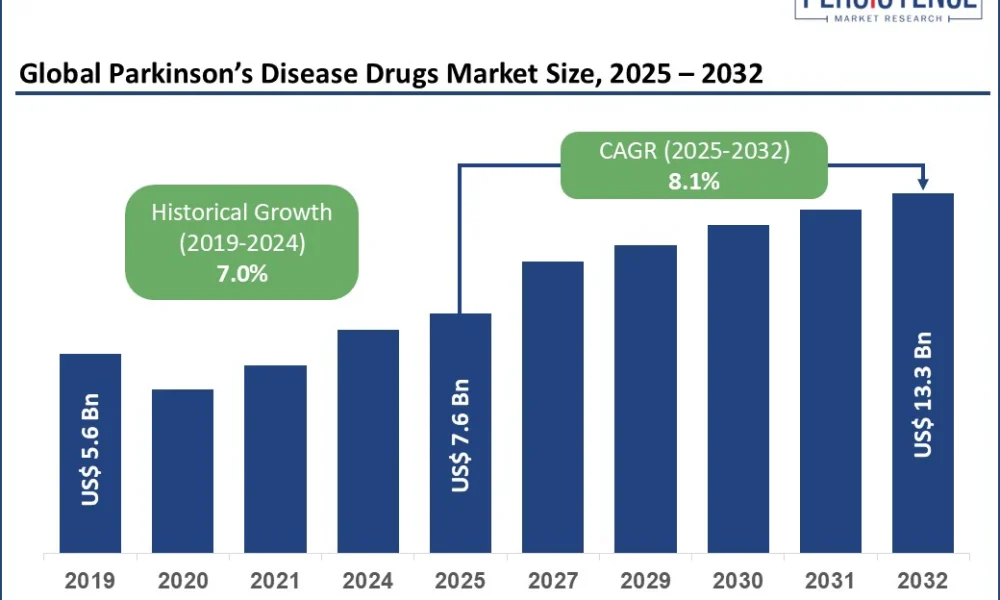
The Parkinson’s disease drugs market has emerged as a critical segment within the global pharmaceutical landscape, driven by the increasing prevalence of Parkinson’s disease and advances in therapeutic innovation. Parkinson’s disease, a progressive neurodegenerative disorder, affects motor functions and non-motor symptoms, creating a substantial and growing demand for effective pharmacological interventions. The global market is projected to grow from an estimated US$ 7.6 billion in 2025 to approximately US$ 13.3 billion by 2032, reflecting a robust compound annual growth rate (CAGR) of 8.1%. This growth is fueled by demographic shifts, particularly the aging population in developed regions, as well as rising awareness, early diagnosis initiatives, and expanding access to treatment.
Among the key growth drivers, the introduction of precision medicine platforms and targeted therapies has significantly enhanced treatment efficacy, allowing for patient-specific interventions. Carbidopa-levodopa continues to dominate the market as the gold standard therapy due to decades of clinical use and proven efficacy, while novel drug classes such as adenosine A2A antagonists are gaining traction. North America remains the leading geographical region, holding approximately 45.6% of the market share in 2025, largely due to high therapeutic saturation, strong insurance coverage, and proactive adoption of disease-modifying therapies. The region’s well-established healthcare infrastructure, combined with robust public and private funding, makes it a hub for innovation and early adoption of advanced treatment modalities.
Download Your Free Sample & Explore Key Insights: https://www.persistencemarketresearch.com/samples/35531
Key Highlights from the Report
• Introduction of precision medicine platforms enables segmentation of patients for targeted drug response.
• Key players are repositioning existing central nervous system drugs to address Parkinson’s non-motor symptoms.
• Untapped markets in Asia Pacific and Latin America offer substantial growth potential for branded and generic drugs.
• Decades of clinical data strengthen carbidopa-levodopa as the standard therapy for motor symptom management.
• Oral formulations are projected to hold 74.8% market share in 2025 due to ease of titration and chronic use.
• Comprehensive insurance coverage and Medicare support in North America are boosting adoption of novel therapies.
Market Segmentation
The Parkinson’s disease drugs market is segmented primarily by mechanism of action and route of administration. Mechanism-based segmentation includes dopamine agonists, anticholinergics, MAO-B inhibitors, amantadine, carbidopa-levodopa, and adenosine A2A antagonists. Carbidopa-levodopa is projected to capture nearly 36.7% of the market share in 2025 due to its ability to directly address dopamine deficiency, the hallmark of Parkinson’s disease. Adenosine A2A antagonists are emerging as complementary non-dopaminergic options, providing improved motor control without exacerbating traditional dopamine-related side effects.
By route of administration, the market is categorized into oral, transdermal, subcutaneous, intranasal, and infusion methods. Oral administration remains dominant due to its convenience for long-term use and flexibility in dose adjustment, making it suitable for the majority of patients, particularly those in early to mid-stage Parkinson’s disease. Transdermal delivery systems are also gaining traction, particularly for advanced-stage patients, offering continuous drug release and improved symptom management by overcoming gastrointestinal absorption challenges common in Parkinson’s patients.
Regional Insights
North America leads the Parkinson’s disease drugs market, with high prevalence rates, advanced healthcare systems, and proactive adoption of novel therapies contributing to a projected 45.6% market share in 2025. The U.S. is the largest contributor, fueled by rising awareness, strong reimbursement policies, and FDA approvals for innovative drug delivery systems such as inhaled levodopa powders. Europe, while facing cost-containment pressures, demonstrates significant adoption of adjunctive therapies and disease-modifying interventions, supported by public-private partnerships and regulatory incentives from the EMA. In Asia Pacific, Japan is a leader in innovation and adoption of advanced therapies, while China is witnessing rapid expansion through local R&D and regulatory support. South Korea and India are emerging and price-sensitive markets, respectively, with varying degrees of access to novel therapies.
Get Custom Insights Designed for Your Business: https://www.persistencemarketresearch.com/request-customization/35531
Market Drivers
The Parkinson’s disease drugs market is primarily driven by increased awareness and early diagnosis initiatives, which expand the treatable patient pool and shift treatment initiation to earlier disease stages. Public health campaigns by organizations such as the Michael J. Fox Foundation and the Parkinson’s Foundation have heightened recognition of early non-motor symptoms, resulting in earlier diagnosis and longer-term treatment requirements. This trend has led to increased demand for dopamine-sparing agents and adjunctive therapies, particularly in high-awareness regions. Moreover, demographic trends, including a growing elderly population worldwide, and rising healthcare expenditures continue to reinforce the market’s growth trajectory.
Market Restraints
The market faces significant challenges related to adverse events and long-term tolerability of Parkinson’s disease drugs. Levodopa-induced dyskinesia, experienced by up to 80% of patients after extended therapy, remains a major clinical concern, often limiting dosage escalation and necessitating complex adjunctive regimens. Dopamine agonists, though effective in early-stage disease management, are associated with impulse control disorders such as compulsive gambling, hypersexuality, and binge eating, affecting adherence and limiting therapeutic flexibility. These side effects create barriers to optimal treatment and necessitate careful patient monitoring, constraining overall market growth.
Market Opportunities
Expanding insurance coverage and reimbursement policies are creating substantial opportunities in the Parkinson’s disease drugs market. Inclusion of novel and high-cost therapies such as Inbrija, Rytary, apomorphine infusion, and Duodopa intestinal gel under Medicare and private insurance plans in the U.S. and Europe has improved patient access and uptake. This coverage expansion facilitates early intervention and supports the adoption of innovative drug delivery systems, delaying the need for invasive procedures like deep brain stimulation. Markets in Asia Pacific and Latin America, with growing awareness and unmet clinical needs, present additional opportunities for branded and generic drug growth.
Checkout Now & Download Complete Market Report: https://www.persistencemarketresearch.com/checkout/35531
Company Insights
• AbbVie Inc.
• GSK plc
• Viatris Inc.
• Amneal Pharmaceuticals LLC
• Boehringer Ingelheim Intl. GmbH
• F. Hoffmann-La Roche Ltd.
• Novartis AG
• Pfizer Inc.
• Teva Pharmaceutical Industries Ltd.
• Sunovion Pharmaceuticals Inc.
• AstraZeneca
• ABL Bio
• ACADIA Pharmaceuticals Inc.
• Prevail Therapeutics
Recent developments include the University of South Australia’s development of a long-acting injectable formulation that delivers key Parkinson’s medications for an entire week, and Neuraxpharm’s collaboration with Dizlin Pharmaceuticals to accelerate the Infudopa SubC drug-device combination therapy, enhancing continuous levodopa-carbidopa delivery in advanced Parkinson’s patients.
Conclusion
The Parkinson’s disease drugs market is witnessing a transformative phase characterized by rapid therapeutic innovation, early diagnosis, and expanding access through insurance coverage. Dominated by carbidopa-levodopa yet increasingly diversified through non-dopaminergic and adjunctive therapies, the market is poised for sustained growth across developed and emerging regions. While challenges such as long-term side effects and patient adherence persist, opportunities in insurance expansion, novel delivery systems, and regional market penetration continue to drive optimism for stakeholders. With a projected CAGR of 8.1% from 2025 to 2032, the Parkinson’s disease drugs market remains a strategically significant and high-growth segment within global neurology therapeutics.




