
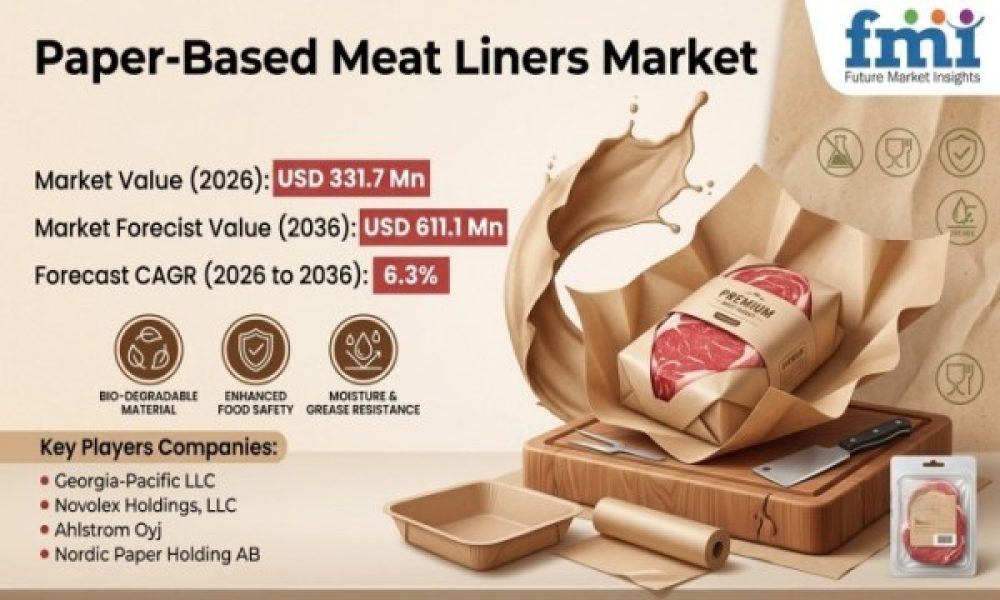
The global Paper-Based Meat Liners Market is projected to grow from USD 331.7 million in 2026 to USD 611.1 million by 2036, registering a 6.3% CAGR, according to Future Market Insights (FMI). Demand is being supported by recurring liner use across meat cutting, staging, separation and display activities where processors need paper constructions that can manage purge, grease and moisture during handling.
Paper-based meat liners are increasingly evaluated as complete finished constructions rather than as commodity paper. Processors assess wet-strength retention, clean release, food-contact suitability, dimensions and performance under actual chilled or frozen operating conditions before recurring orders are established.
Processing Throughput Supports Recurring Liner Consumption
Meat processing plants use liners during routine cutting and display operations. Each additional processing or packing step can increase recurring consumption of sheets, rolls and interleaves.
Investment in processing capacity is therefore relevant to liner demand. In September 2024, USDA awarded more than USD 35 million to 15 independent processors across 12 states. New and expanded facilities must qualify food-contact meat packaging materials before regular purchasing begins.
The qualification process can affect supplier selection and order timing. Processors need consistent dimensions, documented constructions and performance that remains stable under production conditions.
Get detailed market forecasts, competitive benchmarking, and pricing trends:
https://www.futuremarketinsights.com/reports/sample/rep-gb-34670
Butcher Paper Liners Lead Product Type
By product type, butcher paper liners are projected to account for 30.0% of the market in 2026. Their flexible sizing supports established cutting-table and retail-counter workflows.
By paper grade, kraft-butcher paper is estimated to hold 36.0% in 2026, supported by its combination of strength, foldability and converting cost. Processors can select basis weight and surface treatment according to purge load and handling requirements.
Functionally, leak and drip control is forecast to represent 34.0% of the market in 2026. Visible purge management remains a practical requirement on cutting tables and retail displays. Fresh meat can require rapid fluid capture, while frozen products place greater emphasis on low-temperature strength.
The sales channel structure also reflects the importance of qualification. Direct-OEM supply is forecast to lead with a 44.0% share in 2026, as larger processing programs often require defined constructions, converted formats and accountable technical support.
Qualification Requirements Create Both Constraints and Opportunities
Paper-based liner substitution is not simply a matter of replacing one material with another. Moisture resistance, grease holdout, clean release and recycling classification can influence the approval process.
Additional barrier treatments may improve performance under certain handling conditions, but they can also affect release behavior or recycling claims. Regulation (EU) 2025/40 is increasing attention on packaging minimization and recyclability across Europe, making documentation and production trials increasingly relevant to material changes.
This creates an opportunity for barrier papers that provide wet strength and grease resistance without fluorochemical treatments. Such constructions can address meat-handling applications where untreated paper does not provide sufficient performance.
Regional Markets Show Different Commercial Priorities
The five profiled countries show different growth patterns.
Brazil is projected to record the highest CAGR at 6.7%, followed by the United Kingdom at 6.2%, Germany at 6.1%, the United States at 5.7% and Japan at 4.9%.
Brazil’s outlook reflects high meat-processing throughput and demand for dependable supply across production and cold-chain operations. In the United Kingdom, packaging costs, recovery claims and retailer sustainability requirements influence liner selection.
Germany places greater emphasis on material declarations and consistency under chilled conditions. The United States continues to evaluate paper alternatives through processor-led trials, while Japan’s market is shaped by stable specifications and extensive qualification procedures.
Analyst Perspective
“Paper-based meat liner programs should be judged on wet-strength retention and clean release across approved converting runs. Mills and converters protect recurring volume by documenting finished constructions and holding regional inventory for dimensions cleared by processor quality teams.”
— Nandini Roy Choudhury, Principal Consultant, Future Market Insights
Competitive Landscape
The market includes integrated food and paper packaging groups, specialty barrier-paper producers and foodservice paper converters. Key companies profiled by FMI include Georgia-Pacific LLC, Novolex Holdings, LLC, Ahlstrom Oyj, Nordic Paper Holding AB, Twin Rivers Paper Company, Seaman Paper Company of Massachusetts, Inc., Oren International, Inc. and Handy Wacks Corporation.
Recent developments include Ahlstrom’s inauguration of a new parchmentizer at its Saint-Séverin plant in France in May 2025, Nordic Paper’s approval of water-handling investments at its Bäckhammar mill in April 2025, and Novolex’s completion of its combination with Pactiv Evergreen Inc. in April 2025.
Report Scope
FMI’s Paper-Based Meat Liners Market analysis covers product type, paper grade, function, application, end use, sales channel and region. The study covers North America, Latin America, Europe, East Asia, South Asia and Pacific, and the Middle East and Africa. The forecast period extends from 2026 to 2036.
The market definition includes revenue from paper-based sheets, rolls, interleaves and coated liner papers sold for direct meat, poultry, deli and seafood handling. Plastic films, foam trays, corrugated cases and downstream meat revenue are outside the defined market boundary.
Full Report: https://www.futuremarketinsights.com/reports/paper-based-meat-liners-market
FMI Custom Research: Strategic Intelligence for Confident Decision-Making
In today’s rapidly evolving business environment, leadership teams need more than market data—they need clear, actionable intelligence tailored to their strategic objectives. FMI’s Custom Research solutions are designed around the specific business questions organizations need answered, enabling executives to evaluate growth opportunities, validate investments, assess competitive dynamics, and reduce uncertainty before making critical decisions. By combining deep industry expertise, primary research, and proprietary market intelligence, FMI delivers insights that help organizations move from assumptions to evidence-based strategies with greater speed and confidence.
Business Impact
FMI helps organizations transform market complexity into strategic clarity, enabling leadership teams to identify growth opportunities faster, optimize resource allocation, strengthen competitive positioning, and make high-stakes business decisions with confidence.
To explore how FMI Custom Research can support your strategic priorities, please connect with our team at – [email protected]
About Future Market Insights (FMI)
Future Market Insights, Inc. (FMI) is an ESOMAR-certified, ISO 9001:2015 market research and consulting organization, trusted by Fortune 500 clients and global enterprises. With operations in the U.S., UK, India, and Dubai, FMI provides data-backed insights and strategic intelligence across 30+ industries and 1200 markets worldwide.



