
Market Overview
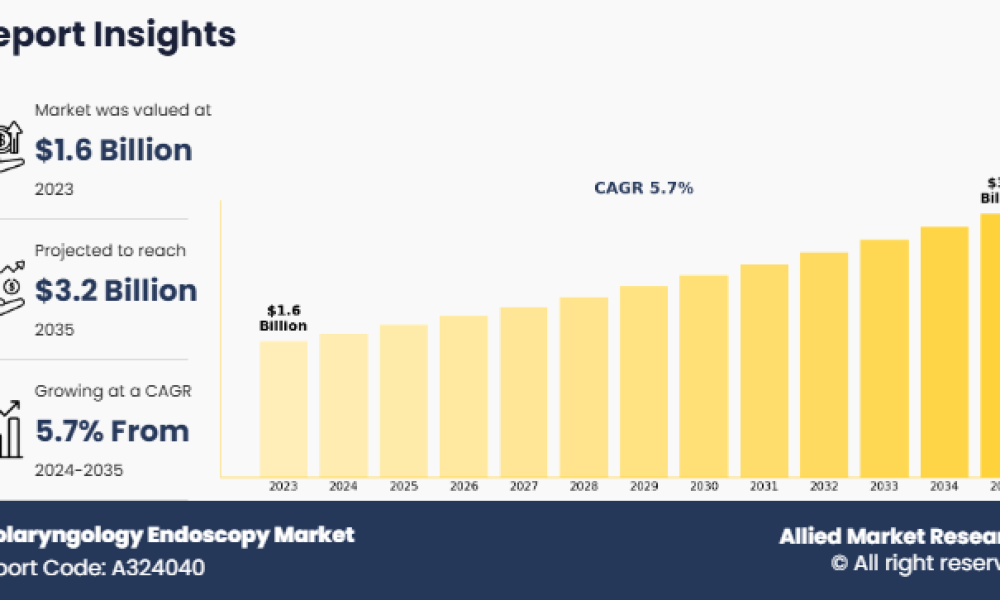
The global otolaryngology endoscopy market was valued at $1.6 billion in 2023 and is projected to reach $3.2 billion by 2035, expanding at a CAGR of 5.7% (2024–2035).
Growth is fueled by:
Increasing prevalence of ENT disorders
Adoption of minimally invasive procedures
Technological advancements in endoscopic imaging and navigation systems
Rising geriatric population
Improved healthcare infrastructure in emerging markets
By 2030, 1 in 6 people globally will be aged 60+, with the 60+ population expected to grow from 1 billion (2020) to 1.4 billion (2030). Aging-related ENT conditions, coupled with a surge in outpatient procedures, are expected to significantly boost demand for otolaryngology endoscopy systems.
Get a Sample Copy of this Report: https://www.alliedmarketresearch.com/request-sample/A324040
Key Takeaways
By Type:
Laryngoscopes led in 2023 and are projected to post the highest CAGR through 2035.
By Usability:
Reusable endoscopes dominated in 2023.
Disposable endoscopes expected to grow fastest due to infection control benefits.
By End User:
Hospitals were the leading segment in 2023.
Ambulatory Surgical Centers (ASCs) forecasted to grow at the highest CAGR.
By Region:
North America led the market in 2023.
Asia-Pacific expected to record the fastest growth during the forecast period.
Market Dynamics
Drivers
Increasing prevalence of ENT disorders (e.g., sinusitis, otitis media, laryngitis).
Advances in endoscopic technology (HD video, 3D imaging, NBI).
Strong preference for minimally invasive procedures (shorter recovery, less pain).
Growth in outpatient and office-based ENT procedures.
Restraints
High equipment costs and maintenance.
Shortage of trained professionals in advanced endoscopy.
Stringent regulatory approval processes.
Opportunities
Growing demand for outpatient and in-office ENT procedures.
Emerging market expansion in Asia-Pacific, Latin America, and the Middle East.
Rising demand for portable and disposable endoscopes.
Segmental Analysis
By Type
Laryngoscopes dominate due to rising laryngeal cancer, vocal cord disorders, and respiratory conditions.
Advancements in flexible, HD laryngoscopes drive adoption.
By Usability
Reusable endoscopes: Cost-effective and durable, dominant in hospitals.
Disposable endoscopes: Fastest-growing segment, driven by infection control needs.
By End User
Hospitals: Largest segment, leveraging advanced diagnostic setups.
ASCs: Fastest-growing, supported by the trend toward cost-effective outpatient care.
Regional Analysis
North America: Largest revenue share (2023) due to advanced infrastructure, favorable reimbursement, and high prevalence of ENT diseases.
Asia-Pacific: Highest growth potential, with aging population, increased healthcare spending, and expanding infrastructure (notably in India & China).
Europe & LAMEA: Steady growth driven by healthcare modernization and ENT awareness programs.
Competitive Landscape
Key Players
Ambu A/S
Karl Storz SE & Co. KG
Fujifilm Holdings Corporation
Olympus Corporation
BSEDATA
Optim LLC
Pioneer Healthcare Technologies
Ottomed Endoscopy
HOYA Corporation
American Diagnostic Corporation
Recent Developments
Sep 2023: Olympus launched Vathin E SteriScope single-use flexible video rhinolaryngoscope.
Jul 2020: Optim partnered with MedShare to distribute ENTity Nasopharyngoscopes to underserved regions.
Conclusion
The otolaryngology endoscopy market is on a strong growth trajectory, fueled by aging populations, rising ENT disorders, and demand for minimally invasive outpatient care. While challenges remain (high cost, regulatory barriers), technological innovations and expansion in emerging markets are expected to open significant opportunities for manufacturers and healthcare providers.




