
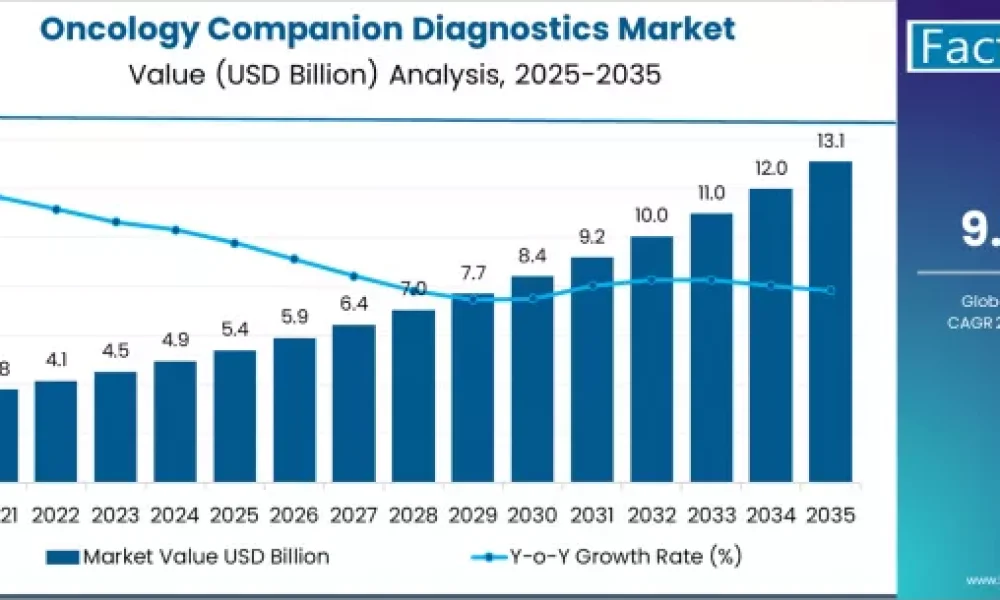
The U.S. oncology companion diagnostics (CDx) market is entering a decade of rapid expansion, fueled by measurable increases in precision-medicine adoption, the rise of targeted cancer therapies, and advances in genomic and digital diagnostic technologies. The market, valued at USD 3.2 billion in 2024, is projected to reach USD 9.8 billion by 2035, reflecting a 10.5% compound annual growth rate (CAGR) over the forecast period.
As the therapeutic landscape becomes increasingly biomarker-driven, companion diagnostics are shifting from optional tools to essential components of clinical decision-making. Between 2025 and 2035, more than 65% of newly developed oncology drugs are expected to require a paired diagnostic to guide patient selection, accelerating integration of CDx into routine cancer care.
NGS-Based CDx Surpasses 50% Market Share and Continues to Rise
Next-generation sequencing (NGS) continues to transform the CDx market. In 2024, NGS-based companion diagnostics accounted for 52% of total U.S. market revenue, a share anticipated to rise to 68% by 2035.
Key measurable trends include:
Rising test volume: NGS oncology CDx tests increased from 1.9 million in 2021 to 3.4 million in 2024, with test volume expected to exceed 7.6 million annually by 2035.
Declining sequencing costs: Average per-sample sequencing costs fell by 19% between 2020 and 2024.
Faster results: Median turnaround time for broad genomic profiling has improved to 7–9 days, compared to 14 days in 2020.
Coverage policies have also strengthened adoption. By 2024, 78% of commercial insurers offered coverage for at least one FDA-approved NGS-based oncology test, up from 42% five years earlier.
To access the complete data tables and in-depth insights, request a Discount On The Report here:
https://www.factmr.com/connectus/sample?flag=S&rep_id=12344
Liquid Biopsy CDx Becomes the Fastest-Growing Segment
Liquid biopsy companion diagnostics—driven by advances in circulating tumor DNA (ctDNA) analysis—continue to gain significant traction due to their non-invasive nature and applicability for both therapy selection and real-time monitoring.
Current growth indicators include:
Market value: USD 480 million in 2024
Forecasted value: Over USD 2.1 billion by 2035
Growth rate: 15.7% CAGR, the highest among all CDx modalities
Clinical adoption: Utilization increased from 29% of oncologists in 2019 to 47% in 2024, with expectations surpassing 70% by 2030
Lung, colorectal, and breast cancers account for over 62% of all liquid biopsy–guided therapeutic decisions.
Biomarker Portfolio Expands Toward 200+ Actionable Markers
The U.S. biomarker landscape is expanding rapidly as cancer biology becomes better understood. Approximately 112 biomarkers were routinely used for therapy matching in 2024; this number is projected to reach 200–230 biomarkers by 2030.
Observed biomarker trends include:
PD-L1 testing: More than 1.1 million tests performed in 2024
HER2-low classification growth: Testing volume increased 31% between 2022 and 2024
TMB and MSI rise: Use increased from 9% of oncology patients in 2020 to 26% in 2024, with expectations of reaching 45% by 2030
The expanding biomarker pipeline supports both tumor-specific and tumor-agnostic therapy strategies, strengthening CDx demand across diverse cancer types.
Regulatory Environment Accelerates Market Progress
Regulatory processes for companion diagnostics have become more streamlined, enabling faster and more predictable market entry.
Key performance indicators include:
Drug–CDx co-approvals: Increased from 6 (2014–2016) to 21 (2020–2024)
Reduced review times: Average approval timelines decreased from 13.2 months to 8.9 months over the past decade
Greater use of real-world evidence: RWE contributed to 37% of decisions involving CDx during 2024
These regulatory efficiencies shorten development timelines and support broader availability of matched therapy–diagnostic launches.
AI, Multi-Omics, and Digital Pathology Strengthen Diagnostic Precision
Digital technologies are reshaping how companion diagnostics are developed, interpreted, and validated.
Notable advances include:
AI variant analysis tools used in 64% of genomic interpretations, reducing analysis time by up to 42%
Digital pathology adoption increasing from 18% of biomarker scoring in 2024 to a projected 55% by 2035
Multi-omic CDx assays expected to grow from 6% of the market to 22% by 2035
These platforms support greater accuracy, consistency, and scalability across both clinical labs and oncology centers.
Data-Driven Market Growth Indicators (2025–2035)
Cancer incidence: Expected to reach 2.26 million new annual U.S. cases by 2035
Therapeutic dependence on biomarkers: Projected to rise to 72% of new oncology drug approvals by 2030
Partnership expansion: More than 75 new CDx co-development collaborations formed between diagnostic and pharmaceutical companies from 2020–2024
Clinical adoption: 91% of academic medical centers currently use at least one FDA-approved CDx platform; expected to reach near-universal adoption by 2028
A Data-Defined Future for Precision Oncology
The U.S. oncology companion diagnostics market is positioned for sustained, quantifiable growth from 2025 through 2035. With revenue expected to exceed USD 9.8 billion, the decade ahead will be marked by rapid biomarker expansion, enhanced testing technologies, and deeper integration between diagnostic and therapeutic development.
Increasingly sophisticated, data-driven diagnostic tools will continue to elevate precision oncology, enabling more accurate therapy selection, reducing treatment inefficiencies, and improving patient outcomes nationwide.
To View Related Report :



