
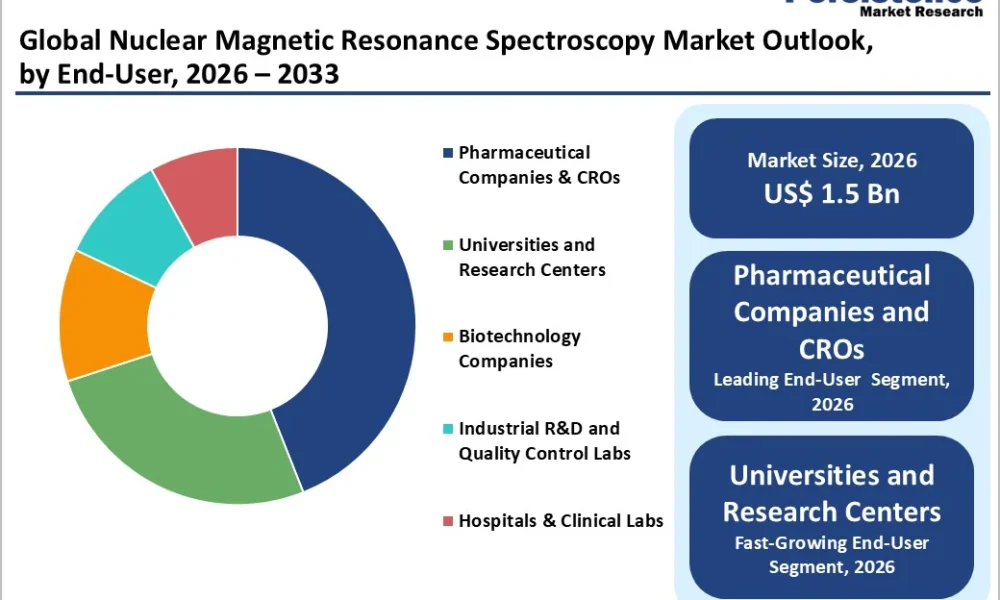
The global Nuclear Magnetic Resonance (NMR) spectroscopy market has emerged as a vital segment of analytical instrumentation, driven by the increasing demand for precise molecular characterization and structural elucidation across pharmaceuticals, biotechnology, and material science applications. NMR spectroscopy is a non-destructive analytical technique that provides comprehensive information about the molecular structure, dynamics, and interactions of chemical compounds. Its versatility extends to diverse industries, including food authentication, petrochemicals, and energy storage, reinforcing its strategic importance for research, development, and quality control processes. With a combination of high accuracy, reproducibility, and multi-nuclear capabilities, NMR spectroscopy enables organizations to make informed decisions in drug development, metabolomics, and advanced materials research.
The market is projected to grow from an estimated US$ 1.5 billion in 2026 to approximately US$ 2.2 billion by 2033, reflecting a compound annual growth rate (CAGR) of 5.6% during the forecast period. This growth is underpinned by increasing global pharmaceutical R&D expenditure, adoption of high-field NMR systems in structural biology, and expansion of battery research programs. North America dominates the market, accounting for nearly 40% of the global share in 2026, primarily due to its strong pharmaceutical base, presence of major NMR instrument manufacturers, and extensive academic networks. Meanwhile, the Asia Pacific region is poised to be the fastest-growing market owing to its growing investment in research infrastructure, government funding, and rapidly expanding pharmaceutical and biotech sectors. Within the end-user landscape, pharmaceutical companies and contract research organizations (CROs) are leading adopters of NMR technology, driven by the demand for drug discovery, structural analysis, and stringent regulatory compliance.
Download Your Free Sample & Explore Key Insights: https://www.persistencemarketresearch.com/samples/15007
Key Highlights from the Report
• The global NMR spectroscopy market is expected to reach US$ 2.2 billion by 2033.
• High-field NMR instruments capture a majority revenue share of 65% in 2026.
• Pharmaceutical and biotechnology applications dominate with an estimated 37% market share.
• North America is the leading region, holding around 40% of the market in 2026.
• Asia Pacific is the fastest-growing region, supported by rising research investments.
• Universities and research centers represent the fastest-growing end-user segment.
Market Segmentation
The NMR spectroscopy market is broadly segmented based on product type, application, and end-user, each addressing distinct analytical requirements. Product-wise, high-field NMR instruments, operating at magnetic field strengths exceeding 300 MHz, are preferred in pharmaceutical R&D and academic research due to their superior spectral resolution and molecular characterization capabilities. Conversely, low-field and benchtop NMR instruments are gaining traction across industrial and quality control environments due to their cost-effectiveness, compact design, and straightforward integration into existing workflows. These instruments are increasingly deployed in chemical manufacturing, food analysis, and energy storage research, where routine process monitoring and rapid operational decision-making are critical.
In terms of applications, pharmaceuticals and biotechnology remain the dominant segment, benefiting from regulatory mandates and extensive R&D spending. Energy and battery research, however, is emerging as the fastest-growing application area, driven by the global push for electric vehicles, grid-scale energy storage, and advanced materials innovation. Other applications include food and beverage authentication, petrochemical analysis, and materials science, where NMR provides precise molecular insights essential for quality assurance and product development. End-user segmentation highlights pharmaceutical companies and CROs as primary consumers, followed by universities and research centers, which are witnessing accelerated adoption due to increased funding, high-field NMR deployment, and growing research infrastructure, particularly in the Asia Pacific region.
Regional Insights
North America maintains a dominant position in the NMR spectroscopy market, fueled by the region’s robust pharmaceutical and biotechnology industrial base, high R&D intensity, and strong presence of leading NMR instrument manufacturers. The region’s sophisticated academic networks and regulatory requirements, particularly from the U.S. FDA, further accelerate the adoption of high-field and benchtop NMR systems. European countries, including Germany, Switzerland, and the U.K., also represent significant market players, leveraging a strong concentration of pharmaceutical and chemical manufacturing centers, advanced research institutions, and stringent EMA regulatory standards. Meanwhile, Asia Pacific is the fastest-growing region, with countries like China, India, Japan, and South Korea investing heavily in research infrastructure, academic programs, and pharmaceutical manufacturing, driving rapid adoption of NMR technologies in industrial, clinical, and academic applications.
Get Custom Insights Designed for Your Business: https://www.persistencemarketresearch.com/request-customization/15007
Market Drivers
Several factors are driving the sustained growth of the NMR spectroscopy market. Increasing investments in pharmaceutical and biotechnology R&D are expanding demand for high-precision analytical instruments capable of delivering detailed molecular and structural insights. High-field NMR systems are particularly critical for complex drug discovery processes, biologics analysis, and metabolomics studies. Additionally, the rising adoption of NMR in clinical diagnostics and metabolomics programs is supporting early disease detection, biomarker identification, and longitudinal patient monitoring, establishing the technology as a vital tool in both research and healthcare applications. Governmental incentives, strategic collaborations between academia and industry, and the expansion of CRO capabilities further amplify market demand, particularly in regions investing in advanced research infrastructure.
Market Restraints
The growth of the NMR spectroscopy market faces certain constraints from alternative analytical techniques. Technologies such as mass spectrometry, infrared spectroscopy, chromatography, and X-ray diffraction offer faster results, lower operational complexity, and reduced capital investment, making them attractive substitutes for organizations prioritizing efficiency and cost-effectiveness. Additionally, these methods integrate seamlessly into automated, high-throughput workflows, providing scalability without extensive infrastructure investment. This competitive landscape challenges the adoption of high-field NMR systems, compelling potential buyers to carefully weigh factors like total cost of ownership, turnaround time, operational convenience, and compatibility with existing laboratory systems before procurement.
Market Opportunities
Emerging applications in energy storage, battery research, and advanced materials development present significant growth opportunities for the NMR spectroscopy market. The global shift toward electric vehicles and renewable energy solutions has created strong demand for high-precision analysis of lithium-ion dynamics, electrolyte performance, and solid-state structures, where NMR spectroscopy plays a crucial role. Furthermore, expanding metabolomics research, clinical diagnostics programs, and academic research initiatives in developing regions offer additional commercial potential. Technological innovations such as miniaturized benchtop NMR instruments, quantum sensing enhancements, and software-integrated multi-nuclear detection are further broadening the application landscape and increasing accessibility, creating fertile ground for market expansion.
Checkout Now & Download Complete Market Report: https://www.persistencemarketresearch.com/checkout/15007
Company Insights
The global NMR spectroscopy market is moderately consolidated, with a few dominant companies driving most of the revenue through specialized instrumentation and integrated analytical solutions. Key market players include:
• Bruker Corporation
• JEOL Ltd.
• Oxford Instruments plc
• Agilent Technologies
• Magritek
• Nanalysis Scientific
• Anasazi Instruments
• Spinlock
• Cryogenic Ltd.
• QOneTec
• Thermo Fisher Scientific
• Shimadzu Corporation
• HITACHI High-Tech
• Waters Corporation
Market Segmentation
By Product Type
- Low-field NMR Spectroscopy
- High-field NMR Spectroscopy
By Application
- Pharmaceuticals & Biotechnology
- Academic & Research Institutes
- Chemical & Petrochemical Analysis
- Food & Beverage
- Materials Science
- Energy/Battery Research & Quality Control
- Clinical & Diagnostic
By End-User
- Pharmaceutical Companies & Contract Research Organizations (CROs)
- Biotechnology Companies
- Universities & Research Centers
- Hospitals & Clinical Labs
- Industrial R&D and Quality Control Labs
By Region
- North America
- Europe
- East Asia
- South Asia & Oceania
- Latin America
- Middle East & Africa
Recent Developments
• In December 2025, researchers at the Max Planck Institute for Intelligent Systems developed a quantum sensing approach for nanotesla sensitivity, enabling high-precision NMR applications in minimally invasive medical procedures.
• In August 2025, Purdue University achieved atomic-scale NMR spectroscopy by embedding carbon-13 isotopes into hexagonal boron nitride (hBN), allowing single-spin detection with enhanced resolution for quantum sensing and computing applications.
Conclusion
The Nuclear Magnetic Resonance (NMR) spectroscopy market is poised for sustained growth, driven by increasing demand in pharmaceuticals, biotechnology, energy storage, and advanced materials research. High-field NMR systems dominate the market due to their superior spectral resolution and molecular characterization capabilities, while low-field and benchtop instruments are rapidly gaining traction in industrial and quality control applications. Regional growth is led by North America, with Europe maintaining a strong foothold and Asia Pacific emerging as the fastest-growing market. Despite competitive pressures from alternative analytical techniques, opportunities in metabolomics, clinical diagnostics, and energy research are driving innovation and adoption. With continuous technological advancements, strategic collaborations, and expanding R&D investments, the NMR spectroscopy market is expected to remain a cornerstone of analytical science, supporting critical research and industrial applications worldwide.




