
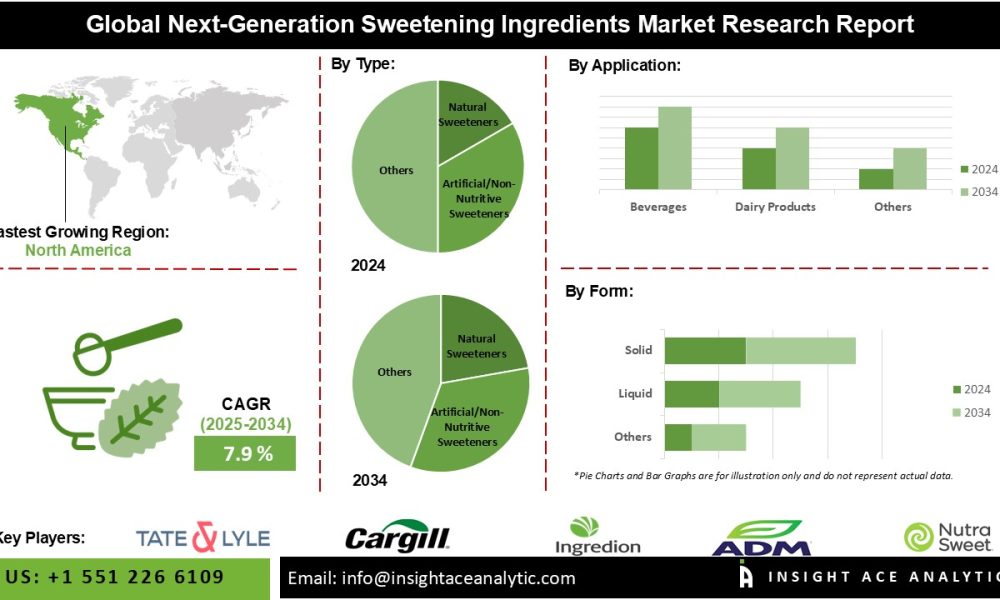
InsightAce Analytic Pvt. Ltd. announces the release of a market assessment report on the “Next-Generation Sweetening Ingredients Market”-, By Type (Natural Sweeteners, Artificial/Non-Nutritive Sweeteners, Novel Sweeteners), By Form ( Solid, Liquid, Granular), By Application (Bakery & Confectionery, Beverages, Dairy & Frozen Desserts, Pharmaceuticals, Others), By End-User (B2C, B2B, Direct Sales), By Distribution Channel (Supermarkets/Hypermarkets, Convenience Stores, Online Stores, Specialty, Retail, Others), and Global Forecasts, 2025-2034 And Segment Revenue and Forecast To 2034.”
Global Next-Generation Sweetening Ingredients Market Size is predicted to develop a 7.9 % CAGR during the forecast period for 2025-2034.
Check this Report Brochure : https://www.insightaceanalytic.com/request-sample/3025
Next-generation sweetening ingredients represent a new category of advanced sugar alternatives developed to overcome the limitations of traditional sugars and earlier generations of artificial or natural sweeteners. These ingredients are engineered to more closely replicate the taste, texture, and mouthfeel of conventional sugar while addressing common drawbacks such as undesirable aftertastes often associated with high-intensity sweeteners. In addition to providing sweetness, these formulations offer functional health benefits, including low or zero caloric content and minimal impact on blood glucose and insulin levels—making them suitable for individuals managing diabetes, weight control, or metabolic conditions. Some variants also possess added nutritional attributes, such as prebiotic and antioxidant properties.
A notable example is allulose, a naturally occurring “rare sugar” found in trace amounts in foods like figs, wheat, and raisins. Allulose delivers comparable sweetness and bulk to sucrose but contributes just 0.4 calories per gram and has no measurable impact on blood sugar levels. Its functional advantages—such as browning and texture retention—make it suitable for a broad range of culinary applications.
The rising demand for next-generation sweeteners is being fueled by increasing consumer awareness of health-related issues such as obesity and diabetes, as well as a shift toward clean-label and functional food products. Additionally, regulatory initiatives targeting sugar reduction in processed foods and beverages—through measures such as sugar taxes and mandatory nutrition labeling—are prompting manufacturers to reformulate existing products with healthier alternatives.
Technological advancements in food science are enabling the development of innovative sweetening solutions, particularly within the natural segment. Ingredients such as tagatose, which offers prebiotic benefits, and monk fruit extract, recognized for its antioxidant content, are gaining prominence among health-conscious consumers. Popular dietary movements including keto, paleo, and low-glycemic index diets are further accelerating the adoption of sweeteners like allulose and isomaltulose, which avoid blood glucose spikes.
These ingredients are being increasingly integrated into functional food and beverage categories such as protein bars, electrolyte drinks, nutraceuticals, dairy products, baked goods, confectionery, sauces, and ready-to-eat meals. This transition presents a substantial opportunity for food manufacturers to create reduced-sugar or sugar-free offerings that preserve flavor, texture, and consumer appeal—aligning with both regulatory requirements and evolving consumer preferences.
List of Prominent Players in the Next-Generation Sweetening Ingredients Market:
- Tate & Lyle PLC
- Cargill, Incorporated
- Ingredion Incorporated
- Ajinomoto Co., Inc.
- DuPont Nutrition & Health
- Archer Daniels Midland Co. (ADM)
- PureCircle Ltd.
- JK Sucralose Inc.
- International Flavors & Fragrances Inc. (IFF)
- NutraSweet Company
- Merisant Company
- Sweegen
- GLG Life Tech Corporation
- Heartland Food Products Group
- Roquette Frères
- Almendra
- B Food Science Co., Ltd.
- Ecogreen Oleochemicals
- Pruthvi Foods Pvt Ltd.
- Swerve, L.L.C.
- Changzhou Guanghui Food Ingredients Co., Ltd.
- Anhui Jinhe Industrial Co. Ltd.
- Ozark Holdings, LLC
- R. Grace & Co.
- Honeywell International Inc.
Market Dynamics for Next-Generation Sweetening Ingredients
Drivers:
The increasing global prevalence of diabetes, coupled with the rising adoption of low-carbohydrate, ketogenic, and paleo diets, is significantly accelerating the demand for sweeteners that do not elevate blood glucose levels. Ingredients such as allulose, tagatose, and isomaltulose are gaining traction within specialized nutrition segments due to their low glycemic indices and added functional benefits. Technological advancements in biotechnology—particularly in fermentation and enzymatic processing—are facilitating the scalable and cost-efficient production of these sweeteners.
For instance, precision-fermented allulose and improved stevia derivatives such as fermented Rebaudioside M have enhanced taste profiles and greater heat stability, enabling broader integration into a variety of food and beverage applications. Moreover, the expanding functional foods sector—including fortified beverages, protein-enriched snacks, and nutraceuticals—is further driving demand for reduced-sugar or sugar-free solutions that maintain sensory appeal.
Challenges:
Despite their benefits, advanced sweeteners such as allulose, tagatose, and precision-fermented stevia are manufactured using complex biotechnological methods, including microbial fermentation and enzymatic transformation. These processes, while improving product purity and functional attributes, are typically more cost-intensive than conventional sweetener production methods. As a result, next-generation sweeteners often carry a higher price point compared to traditional sugars and earlier artificial alternatives, which can limit their accessibility and adoption in price-sensitive markets.
Regional Trends:
The Asia-Pacific region is projected to maintain the largest market share over the forecast period. Increasing public awareness of chronic health conditions such as obesity, cardiovascular disease, and diabetes is influencing consumer preferences in key markets like China, India, Japan, and South Korea. There is a rising demand for low-calorie, low-glycemic, and naturally derived sugar substitutes as individuals seek to manage their weight and blood sugar levels. Urbanization and lifestyle shifts have led to increased consumption of processed and packaged foods, thereby elevating health risks associated with excessive sugar intake. This trend is encouraging the reformulation of products using next-generation sweeteners.
Meanwhile, North America is experiencing rapid growth in this market. The region benefits from a well-established demand for clean-label, low-carb, and keto-compatible products. The United States, in particular, has approved the use of several next-generation sweeteners, including allulose, tagatose, and fermented stevia variants. Continued investment in research and development, supported by both major food corporations and emerging startups, is fostering innovation and accelerating market penetration.
Recent Developments:
- In March 2023, NutraSweet, with an owned and fully integrated supply chain that encompasses sourcing and extraction in South America and production in the United States, the well-known sweetener brand has emerged as the only stevia manufacturer in the world. NutraSweet has made strategic adjustments in recent years to concentrate solely on natural sweeteners. When combined, the facilities offer the ideal supply chain solution, with substantial bioconversion and processing capabilities in the U.S. and ideal growing conditions for stevia cultivation, which is native to South America, in Peru.
- In March 2021, Cargill, Incorporated (US) and DSM (Netherlands) entered into a joint venture, Avansya, to produce EverSweet stevia sugar replacements on a commercial scale. This helped meet the rising demand for foods and drinks with less calories.
Segmentation of Next-Generation Sweetening Ingredients Market.
Global Next-Generation Sweetening Ingredients Market – By Type
- Natural Sweeteners
- Stevia
- Monk Fruit (Luo Han Guo)
- Honey
- Molasses
- Date Palm/Date Sugar
- Sugar Alcohols (Erythritol, Xylitol, Mannitol, Sorbitol)
- Sweet Proteins (Thaumatin, Brazzein)
- Others (Maple Syrup, Coconut Sugar, Palm Sugar)
- Artificial/Non-Nutritive Sweeteners
- Aspartame
- Sucralose
- Acesulfame-K
- Saccharin
- Neotame
- Tagatose
- Novel Sweeteners
- Allulose
- Citrus-Derived Sweeteners
- Synthetic Biology-Derived Sweeteners
Global Next-Generation Sweetening Ingredients Market – By Form
- Solid
- Liquid
- Granular
Global Next-Generation Sweetening Ingredients Market – By Application
- Bakery & Confectionery
- Beverages
- Dairy & Frozen Desserts
- Pharmaceuticals
- Others
Global Next-Generation Sweetening Ingredients Market – By End-User
- B2C (Business-to-Consumer)
- B2B (Business-to-Business)
- Direct Sales
Global Next-Generation Sweetening Ingredients Market – By Distribution Channel
- Supermarkets/Hypermarkets
- Convenience Stores
- Online Stores
- Specialty Retail
- Others
Global Next-Generation Sweetening Ingredients Market – By Region
North America-
- The US
- Canada
Europe-
- Germany
- The UK
- France
- Italy
- Spain
- Rest of Europe
Asia-Pacific-
- China
- Japan
- India
- South Korea
- Southeast Asia
- Rest of Asia Pacific
Latin America-
- Brazil
- Argentina
- Mexico
- Rest of Latin America
Middle East & Africa-
- GCC Countries
- South Africa
- Rest of the Middle East and Africa
About Us:
InsightAce Analytic is a market research and consulting firm that enables clients to make strategic decisions. Our qualitative and quantitative market intelligence solutions inform the need for market and competitive intelligence to expand businesses. We help clients gain competitive advantage by identifying untapped markets, exploring new and competing technologies, segmenting potential markets and repositioning products. expertise is in providing syndicated and custom market intelligence reports with an in-depth analysis with key market insights in a timely and cost-effective manner.




