
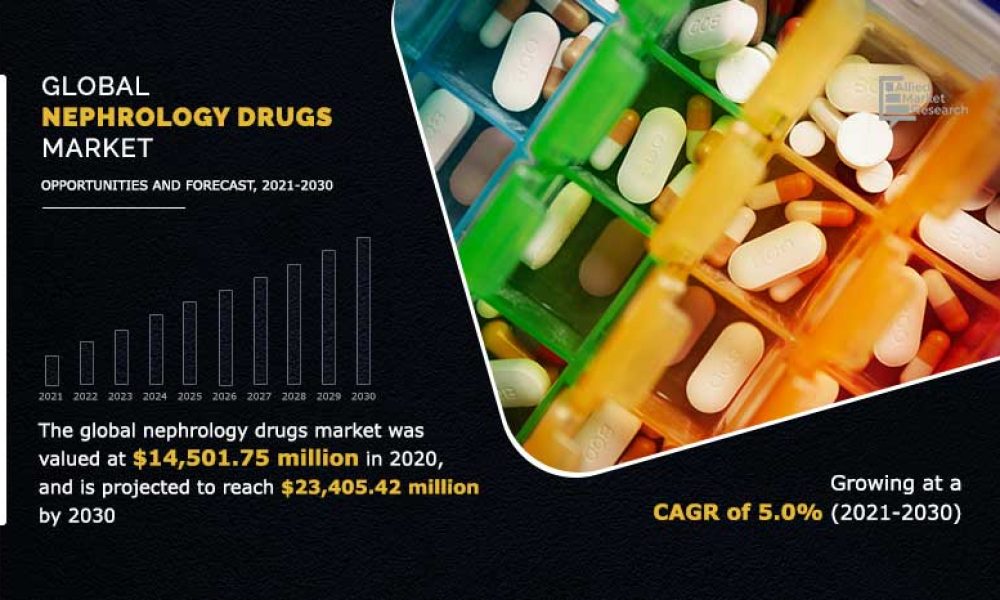
The global nephrology drugs market was valued at $14.5 billion in 2020 and is projected to reach $23.4 billion by 2030, growing at a CAGR of 5.0% from 2021 to 2030. The market growth is primarily attributed to a surge in kidney-related diseases, a growing geriatric population, and advances in drug R&D and treatment technologies.
What Are Nephrology Drugs?
Nephrology drugs are used for the diagnosis, treatment, and management of kidney disorders, including chronic kidney disease (CKD), kidney stones, kidney failure, and kidney cancer. These drugs regulate blood pressure, correct anemia, reduce inflammation, and preserve nephron function. Common nephrology drugs include:
Invokana
Phoslo
Renvela
Sensipar
Procrit
Key Market Drivers
Rising Kidney Failure Cases
Surge in patients with chronic kidney disease (CKD) and end-stage renal disease (ESRD) is increasing the demand for effective nephrology drugs.
Lifestyle-Related Risk Factors
Growing prevalence of obesity, hypertension, diabetes, and excessive alcohol consumption is leading to more kidney disorders.
Growing Geriatric Population
The elderly are more vulnerable to nephrology disorders due to age-related decline in kidney function.
Advancements in Diagnosis and Treatment
Improvements in early diagnostic tools, targeted therapies, and personalized treatment options are accelerating market growth.
R&D and Drug Innovation
Pharmaceutical companies are increasingly investing in novel drug development, clinical trials, and combination therapies.
Government Support and Policy
Favorable insurance schemes, regulatory approvals, and public awareness programs are creating new growth opportunities.
Market Restraints
High treatment costs, especially for advanced therapies and biologics.
Lack of awareness and early detection in low-income regions.
Complex regulatory approvals for new drug launches.
Segmentation Analysis
By Drug Class
ACE Inhibitors lead the market in 2020 and are expected to continue their dominance, driven by:
High use in hypertension and proteinuria management.
Proven renal protection benefits in diabetic and cardiovascular patients.
Other key classes include:
Calcium channel blockers
Beta blockers
Diuretics
Erythropoiesis-stimulating agents (ESAs)
By Route of Administration
Oral drugs dominate due to:
Convenience and patient compliance.
Focus of key players on oral formulations and controlled-release pills.
Parenteral drugs are gaining traction for:
Acute and emergency treatments.
Use in hospital settings for ESRD and severe CKD.
By Distribution Channel
Retail pharmacies captured the largest market share in 2020:
Easy access for chronic disease patients.
Expanded presence in urban and rural areas.
Online pharmacies are also rising due to:
Growing e-commerce penetration.
Increased patient demand for home delivery and digital consultations.
Regional Insights
North America
Largest market share in 2020 due to:
High prevalence of CKD and hypertension.
Strong presence of key pharmaceutical companies.
Public awareness campaigns and insurance coverage for chronic kidney diseases.
Asia-Pacific
Fastest-growing region due to:
Rapid increase in kidney disease cases.
Expansion of healthcare infrastructure.
Growing investments in drug development and entry of global pharmaceutical players.
Europe
Strong market with high adoption of innovative nephrology treatments, especially in countries like Germany, UK, and France.
LAMEA
Expected to grow steadily with government health programs and increased focus on chronic disease management.
Key Companies in the Nephrology Drugs Market
AstraZeneca
AbbVie Inc.
Akebia Therapeutics, Inc.
Amgen Inc.
F. Hoffmann-La Roche
FibroGen Inc.
GlaxoSmithKline PLC
Johnson & Johnson Inc.
Pfizer Inc.
Teva Pharmaceutical Industries Ltd.
These companies are actively involved in product launches, strategic partnerships, and clinical research to strengthen their market position.
Key Takeaways
The nephrology drugs market is poised to grow from $14.5B in 2020 to $23.4B by 2030, with a 5.0% CAGR.
Growth is driven by the rising burden of kidney diseases, aging population, and technological innovations in nephrology care.
ACE inhibitors and oral formulations dominate the drug class and administration segments.
North America leads the market, while Asia-Pacific shows the highest growth potential.




