
In the relentless race for innovation, the most valuable commodity isn’t code; it’s the talent that writes it. For every IT and HR leader, the pressure is immense: build world-class tech teams, accelerate project timelines, and do it all under relentless budget scrutiny. For years, the default answer was simple: go offshore. It was a straightforward calculation of cost-effectiveness.
But the world of remote work has matured. The conversation is no longer just about the hourly rate. It’s about the total cost of collaboration. It’s about speed, synergy, and the subtle but powerful impact of cultural alignment. This has given rise to a more nuanced, strategic approach to building global teams, forcing a critical decision at the heart of modern IT outsourcing: Nearshore vs. Offshore.
Choosing the right model is no longer just a procurement decision; it’s a defining move in your company’s strategic hiring playbook. Get it right, and you unlock a global engine for growth. Get it wrong, and you’re left managing a tangled web of communication breakdowns, missed deadlines, and a project that’s bleeding money in hidden ways.
The New World Map of Talent: Redefining the Models
Forget the dictionary definitions for a moment. For a strategic HR leader, offshore and nearshore are not just geographical terms; they are distinct operational models with profound implications for how your teams work, communicate, and innovate.
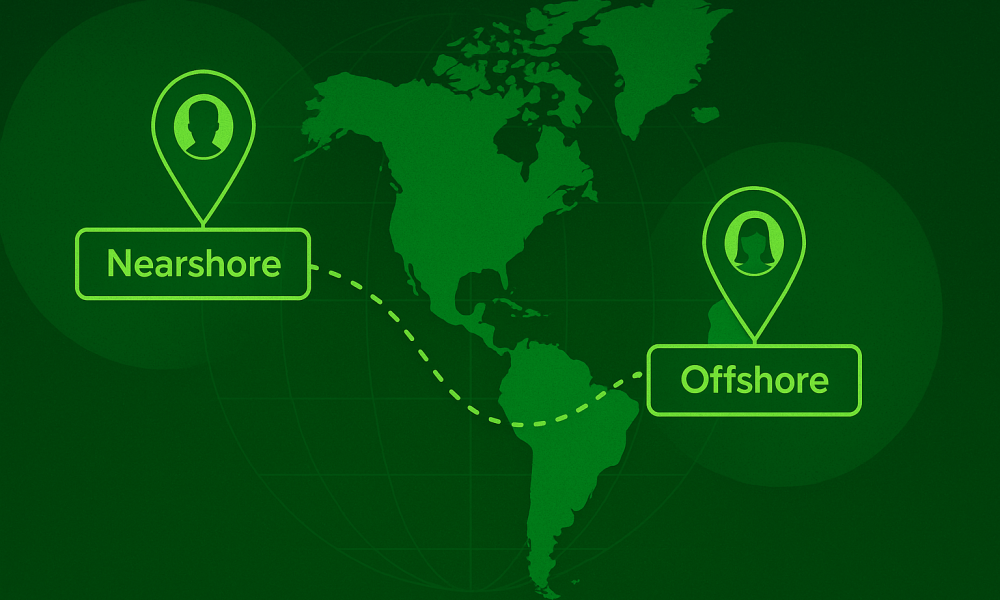
- Offshore: This is the classic model of IT outsourcing, typically involving partnering with a team in a country with a significant time zone difference and lower labor costs, such as India, the Philippines, or Eastern European nations like Ukraine. Think of it as a dedicated, asynchronous workforce. You send over a well-defined package of work, and through a structured process, they send it back completed. The primary lever here is maximizing cost-effectiveness on large, well-scoped projects.
- Nearshore: This model involves engaging talent in countries that are geographically and culturally closer, with minimal time zone differences. For a U.S.-based company, this often means looking to Latin America—countries like Mexico, Colombia, and Costa Rica. Think of this not as outsourcing, but as true team extension or staff augmentation. These are colleagues, just a few states away, who are logged in when you are, ready for a quick Slack huddle or a spontaneous brainstorming session.
The choice is no longer a simple binary. It’s about designing a global talent strategy that fits the specific needs of your projects, your culture, and your long-term goals.
The Strategic Decision Matrix: Beyond the Hourly Rate
To navigate this choice, you need to move past a simple cost-benefit analysis and evaluate each model across a spectrum of strategic factors.
1. Cost-Effectiveness vs. Total Cost of Ownership
The allure of offshore has always been its attractive hourly rate. On paper, the savings can look substantial, and for certain types of work, they are. If you have a large-scale, well-documented legacy system to maintain or a 24/7 support need, the math often works out in favor of an offshore team that can operate while your domestic team sleeps.
However, a savvy HR leader looks at the total cost of ownership. This includes:
- Management Overhead: Significant time zone differences (e.g., 10-12 hours) mean your domestic managers are either starting their days at dawn or ending them late at night to find a window of overlap. This management tax is a real and often un-costed expense.
- Rework and Delays: Miscommunication born from cultural or linguistic gaps can lead to rework. A feature that needs to be rebuilt because the requirements were misunderstood doesn’t just cost the developers’ time; it costs market opportunity.
- Travel Costs: While less frequent in a post-pandemic world, any essential in-person meetings with an offshore team involve expensive, multi-day international travel. A trip to a nearshore partner is often a shorter, cheaper flight.
Nearshore presents a different value proposition. While the hourly rate might be 20-40% higher than offshore, the total cost can often be lower due to the immense savings in management overhead and increased velocity from real-time collaboration.
2. The Collaboration Equation: Time Zones and Communication
This is where the distinction between the models becomes sharpest. Communication is the lifeblood of modern, agile development.
With an offshore team, communication is, by necessity, asynchronous and highly structured. It demands meticulous documentation, formal hand-offs, and a tolerance for a 24-hour feedback loop. For projects with a very stable roadmap and clearly defined tasks, this can work like a well-oiled machine.
Nearshore operates in a state of synchronous collaboration. With teams in the same or adjacent time zones, the dynamic shifts completely.
- A developer in Chicago can jump on a quick video call with a developer in Bogotá to pair-program a solution.
- A product manager in Austin can clarify a user story in real-time with their QA team in Mexico City.
- The entire team can attend the same daily stand-up meeting without anyone having to sacrifice their evening.
This real-time interaction dramatically accelerates problem-solving, reduces ambiguity, and fosters a genuine sense of one team—a critical component of successful staff augmentation.
3. The Culture Factor: Alignment, Integration, and Innovation
Cultural alignment is often dismissed as a “soft” metric, but it has hard consequences. It impacts how feedback is given and received, how team members challenge ideas, and their willingness to go beyond the written requirements of a task.
Western business culture, for example, often encourages direct, proactive communication and challenging the status quo. A nearshore partner in Latin America often shares these cultural touchpoints, making for a smoother integration. The language, pop culture references, and business etiquette are often closely aligned, reducing the friction of daily interactions.
This isn’t to say that offshore teams can’t be integrated, but it often requires a more deliberate and resource-intensive effort in cross-cultural training and setting explicit communication protocols. The risk is creating a transactional “us vs. them” dynamic, where the outsourced team is seen as a vendor rather than a true partner, stifling proactive contributions and innovation.
4. Project Management and Agility
Your choice of model must align with your project management methodology.
The asynchronous nature of offshore lends itself well to Waterfall-style projects or very structured Agile systems where work can be batched into well-defined sprints with minimal ad-hoc changes. It requires discipline and excellent documentation.
Nearshore is built for modern Agile. The ability for the entire team, including product owners and stakeholders, to collaborate in real-time is the essence of agile development. When a roadblock appears, it can be addressed in minutes, not days. This high-bandwidth communication makes the nearshore model incredibly resilient and adaptable to the fluid reality of software development, where requirements can and do change.
The HR Pro’s Playbook: Making the Right Call
So, how do you make the choice? It’s not about one model being universally better; it’s about which is better for a specific need.
Choose Offshore When:
- The project is large, mature, and highly documented with a low probability of change (e.g., legacy system maintenance).
- The work can be easily segmented into independent tasks that don’t require high-frequency collaboration.
- You are building a “follow-the-sun” model for 24/7 customer support or network operations.
- Your primary and overwhelming driver is achieving the lowest possible hourly cost, and you have the strong management processes to mitigate the risks.
Choose Nearshore When:
- You are practicing Agile or Scrum and require high-frequency, real-time collaboration.
- The project is in its early stages, with requirements that are still evolving and demand close interaction between developers and product owners.
- You are looking for true staff augmentation, where external developers need to be seamlessly integrated into your existing teams and culture.
- Your goal is to increase development velocity and speed to market, and you value the reduction in “collaboration tax.”
The future of global talent is hybrid. Many savvy organizations are building a blended strategy, using offshore teams for stable, long-term projects while leveraging nearshore partners for fast-moving, innovative R&D work.
As an IT HR leader, your role is to elevate the conversation beyond the spreadsheet. Guide your stakeholders to think critically about the nature of the work itself. Ask the right questions: Is this project about cost or speed? Does it require quiet execution or chaotic innovation?
By framing the Nearshore vs. Offshore debate in these strategic terms, you position HR not just as a facilitator of hiring but as a key architect of your company’s global engine for success.