

The landscape of pharmaceutical development and patient care is being fundamentally reshaped by nanomedicine, particularly in the realm of drug delivery. Leveraging materials and devices at the nanoscale (typically 1 to 100 nanometers), this revolutionary field promises unprecedented precision, efficacy, and safety in targeting diseases.
𝐐𝐮𝐢𝐜𝐤 𝐕𝐢𝐞𝐰 𝐌𝐚𝐫𝐤𝐞𝐭 𝐈𝐧𝐬𝐢𝐠𝐡𝐭𝐬:
https://www.alliedmarketresearch.com/request-toc-and-sample/A12299
The global nanotechnology drug delivery market, valued at approximately $108.08 billion in 2025, is projected to surge to an impressive $228.82 billion by 2032, exhibiting a robust Compound Annual Growth Rate (CAGR) of 11.3% from 2025 to 2032. This significant growth trajectory is a testament to the transformative potential of nanomedicine, driven by a wave of healthtech innovations.
Traditional drug delivery methods are often ineffective due to issues like poor solubility, low bioavailability, and an inability to cross biological barriers. These limitations can lead to suboptimal outcomes and severe side effects. Nanomedicine offers a powerful solution by using nanoparticles to encapsulate and precisely target drugs to specific diseased cells, maximizing therapeutic effects while minimizing adverse reactions.
Key Drivers Propelling Market Expansion:
Several factors are converging to accelerate the growth of the nanomedicine for drug delivery market:
- Rising Prevalence of Chronic Diseases: The escalating global incidence of chronic conditions such as cancer, cardiovascular diseases, neurological disorders, and infectious diseases creates an urgent demand for more effective and targeted therapies. Nanomedicine offers tailored solutions to combat the complexities of these illnesses.
- Limitations of Conventional Therapies: The inherent drawbacks of traditional drug delivery, including off-target toxicity and suboptimal drug concentrations at disease sites, highlight the critical need for more precise approaches that nanomedicine uniquely provides.
- Advancements in Nanotechnology: Continuous breakthroughs in materials science, imaging techniques, and nanotechnology fabrication are enabling the creation of increasingly sophisticated and functional nanocarriers.
- Growing R&D Investments: Significant investments from pharmaceutical companies, biotech firms, academic institutions, and governments are fueling research and development efforts in nanomedicine, accelerating the discovery and commercialization of new nano-based drug delivery systems.
- Shift Towards Personalized Medicine: The ability to engineer nanocarriers that can be customized to individual patient characteristics, including genetic makeup and disease specific biomarkers, aligns perfectly with the growing demand for personalized and precision medicine.
𝐆𝐫𝐚𝐛 𝐂𝐨𝐦𝐩𝐥𝐞𝐭𝐞 𝐑𝐞𝐩𝐨𝐫𝐭 𝐄𝐚𝐬𝐢𝐥𝐲 (𝐈𝐦𝐦𝐞𝐝𝐢𝐚𝐭𝐞 𝐃𝐞𝐥𝐢𝐯𝐞𝐫𝐲 𝐀𝐯𝐚𝐢𝐥𝐚𝐛𝐥𝐞):
https://www.alliedmarketresearch.com/checkout-final/9a18fbaa65a67b793659f022508aad15
Latest Healthtech Innovations in Nanomedicine for Drug Delivery:
The current wave of healthtech innovations is redefining the capabilities of nanomedicine:
- Sophisticated Nanocarriers:
- Liposomes: These spherical lipid vesicles remain a cornerstone, enhancing drug solubility, stability, and enabling targeted delivery. They are widely used in oncology and infectious disease treatments.
- Polymeric Nanoparticles: Biodegradable polymers are engineered to encapsulate drugs, offering controlled and sustained release, improved stability, and enhanced cellular uptake.
- Dendrimers and Micelles: These highly branched or self-assembled nanostructures provide precise control over drug loading and release, making them ideal for targeted delivery of both hydrophobic and hydrophilic drugs.
- Inorganic Nanoparticles (e.g., Gold, Iron Oxide): Beyond drug delivery, these are increasingly used for theranostic applications, combining diagnostic imaging with targeted therapy (e.g., photothermal therapy in cancer).
- Carbon Nanotubes and Quantum Dots: While still largely in research, these materials show promise for ultra-precise delivery and enhanced bioimaging due to their unique electrical and optical properties.
- Targeted and Responsive Delivery Systems:
- Active Targeting: Nanocarriers are modified with specific ligands (antibodies, peptides, aptamers) that selectively bind to receptors overexpressed on diseased cells (e.g., cancer cells), ensuring the drug is delivered primarily where needed.
- Passive Targeting (EPR Effect): Nanoparticles accumulate preferentially in tumor tissues due to their leaky vasculature and impaired lymphatic drainage, a phenomenon known as the Enhanced Permeability and Retention (EPR) effect.
- Stimuli-Responsive Nanocarriers: These “smart” systems are designed to release their drug payload only in response to specific internal or external stimuli, such as changes in pH (common in tumor microenvironments), temperature, light, magnetic fields, or enzyme activity. This ensures on-demand and precise drug release.
- Applications Across Therapeutic Areas:
- Oncology: Nanomedicine is revolutionizing cancer therapy by delivering highly toxic chemotherapy drugs directly to tumor cells, minimizing damage to healthy tissues, and reducing debilitating side effects. Innovations include immune-oncology approaches and targeted gene therapies for cancer.
- Neurological Disorders: A major hurdle in treating brain disorders is the blood-brain barrier (BBB). Nanocarriers are being engineered to successfully cross this barrier, enabling the delivery of therapeutic agents for conditions like Alzheimer’s, Parkinson’s, and brain tumors.
- Infectious Diseases: Nanomaterials are enhancing the efficacy of antibiotics against resistant bacterial strains, improving vaccine delivery by enhancing immune responses, and developing novel antiviral therapies.
- Gene Therapy: Nanocarriers provide a safe and efficient means to deliver genetic material (DNA, RNA, CRISPR components) into target cells for gene editing and correction, opening new avenues for treating genetic disorders.
- Regenerative Medicine: Nanofibers and nanocarriers are used as scaffolds for tissue engineering and to deliver growth factors, facilitating the repair and regeneration of damaged tissues.
- Theranostics: This cutting-edge field combines diagnostic imaging with targeted therapy within a single nanoplatform, allowing for simultaneous disease detection, treatment delivery, and monitoring of therapeutic response.
Impact and Future Outlook:
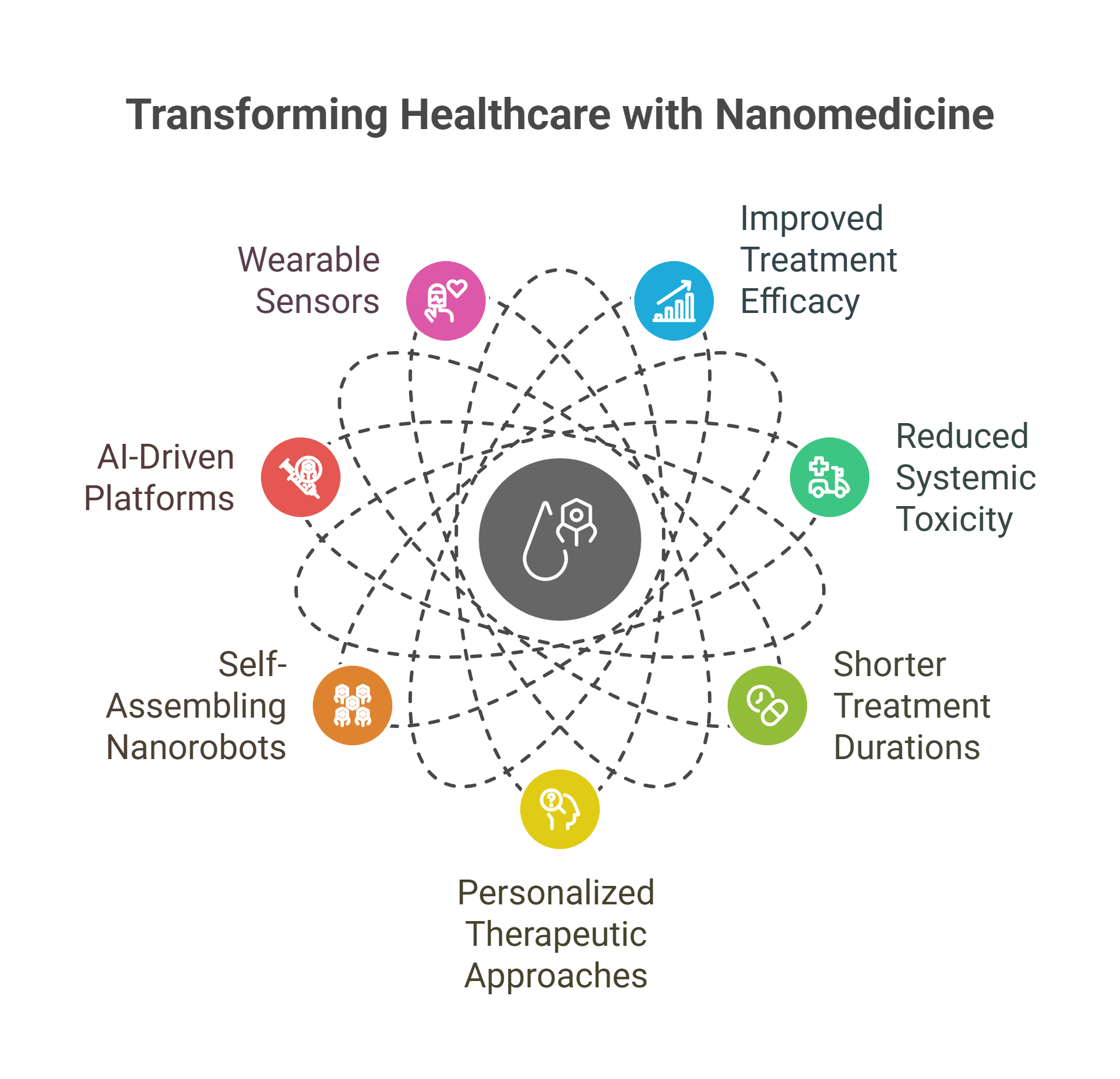
The advancements in nanomedicine for drug delivery are poised to transform healthcare by improving treatment efficacy, reducing systemic toxicity, shortening treatment durations, and enabling personalized therapeutic approaches. This will lead to better patient outcomes, reduced hospital stays, and overall lower healthcare costs in the long run.
The future of nanomedicine in drug delivery is incredibly promising. Emerging trends include the development of self-assembling nanorobots for highly precise drug delivery, advanced AI-driven platforms for designing and optimizing nanocarriers, and the integration of nanomedicine with wearable sensors for real-time monitoring and adaptive drug release. As research continues to unravel the complexities of nanoscale interactions with biological systems, nanomedicine will increasingly become a cornerstone of modern medicine, unlocking new possibilities for disease prevention, diagnosis, and treatment.
About Us –
Allied Market Research (AMR) is a full-service market research and business-consulting wing of Allied Analytics LLP based in Portland, Oregon. Allied Market Research provides global enterprises as well as medium and small businesses with unmatched quality of “Market Research Reports” and “Business Intelligence Solutions.” AMR has a targeted view to provide business insights and consulting to assist its clients to make strategic business decisions and achieve sustainable growth in their respective market domain.
Pawan Kumar, the CEO of Allied Market Research, is leading the organization toward providing high-quality data and insights. We are in professional corporate relations with various research data tables and confirms utmost accuracy in our market forecasting. Each and every us companies and this helps us in digging out market data that helps us generate accurate y data presented in the reports published by us is extracted through primary interviews with top officials from leading companies of domain concerned. Our secondary data procurement methodology includes deep online and offline research and discussion with knowledgeable professionals and analysts in the industry.
Contact Us:
United States
1209 Orange Street,
Corporation Trust Center,
Wilmington, New Castle,
Delaware 19801 USA.
Int’l: +1-503-894-6022
Toll Free: +1-800-792-5285
Fax: +1-800-792-5285
[email protected]




