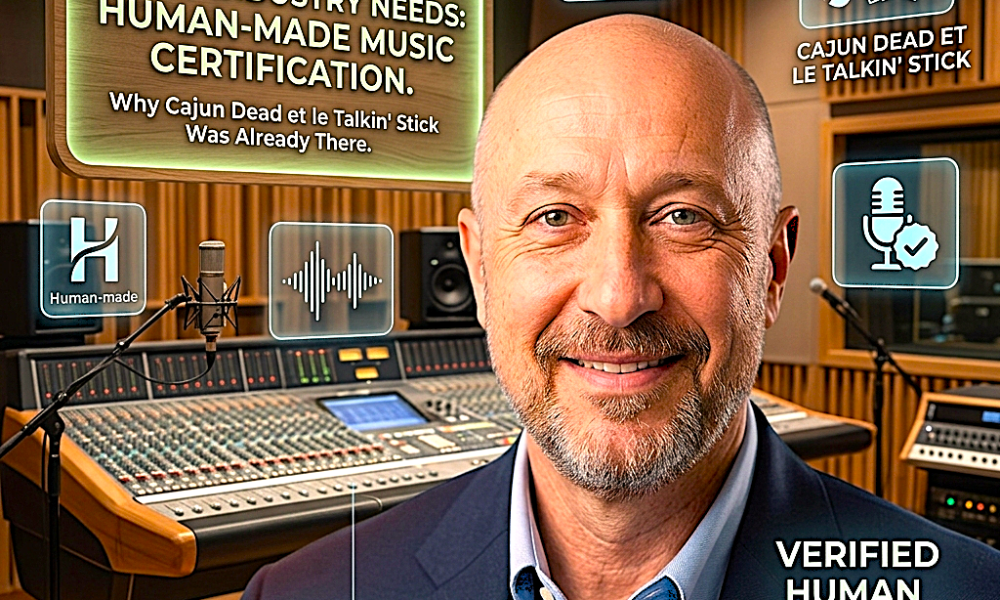
Music Industry Press release By Claude Edwin Theriault and Cajun Dead project | Claregyle, Nova Scotia
When the organic food movement began, the problem was not that all food had become poisonous. The problem was that consumers could no longer tell the difference between food that had been grown honestly and food that had been manufactured to resemble it. The nutritional label existed. The ingredient list existed. But neither told you the thing you actually needed to know: was a human being who cared about what they were producing responsible for this, or was it engineered in a facility optimized for volume and shelf life at the lowest possible cost?
The organic certification solved that problem not by banning the industrial alternative but by making the distinction legible. Once the distinction was legible, the market for the honest version grew steadily and has not stopped growing. The music industry is standing at the exact same threshold in 2026. Envato’s analysis of music trends named it directly: with AI-generated content becoming increasingly ubiquitous, a counter-movement is likely to emerge valuing human-made music, much like the organic food labelling movement—with new verification systems and metadata standards to certify levels of human involvement in music creation. The question the certification will answer is already the question the audience is asking: was a human being who meant it responsible for this, or was it engineered in a facility optimized for stream counts and playlist retention at the lowest possible cost per track?
AI-Generated Slop vs AI-Assisted Human Expression: The Cajun Dead Distinction the Music Industry Template Cannot Make
The cultural establishment—the grant committees, the heritage festival programmers, and the alt-folk scene operating on its comforting gigs-and-reels formula—is treating these two things as though they were the same thing. They are not the same thing. They are not in the same category. They are not even in the same conversation.
AI-generated music is what you get when a text prompt replaces the human act of artistic intention. The machine makes all the choices—melody, harmony, lyric, structure, and emotional register—and a human being presses approve. The result can be technically competent and emotionally vacant simultaneously. It is the musical equivalent of a stock photograph: correctly composed, correctly lit, and carrying exactly zero specific human experience. This is the slop. This is what filled the streaming platforms with fifty thousand tracks a day until the platforms started quietly removing them by the tens of millions.
AI-assisted human expression is something categorically different. It is what happens when a human being—with a specific identity, a specific moral position, a specific cultural location, and a specific set of things they cannot not say—uses machine learning tools to extend the range of what that specific human voice can produce. The voice comes first. The machine extends. The human remains fully responsible for every choice that matters: what the song is about, whose story it tells, what it refuses to make comfortable, and what it insists on naming even when the room would prefer silence. The AI is the instrument. The lyricist is the artist. As the iMusician State of the Music Industry 2026 report confirmed, fans are gravitating toward artists who convey authenticity—and the music industry will increasingly need to develop the infrastructure to make that authenticity verifiable. That infrastructure is the certification. And when the certification arrives, Cajun Dead et le Talkin’ Stick will not need to apply for it, because the proof is already in the archive.
The Lyricist the Industry Cannot Process: 1975 vs 2030 Operating Systems in the Music Industry
Let me describe what Cajun Dead et le Talkin’ Stick actually is, because the mainstream has not been able to categorize it, and the inability to categorize it is itself the most revealing thing about the mainstream’s limitations.
Cajun Dead et le Talkin’ Stick is not a band. It is a song lyric project in search of a band. Claude Edwin Theriault—neurodivergent, queer, Asperger’s, Acadian, and working entirely outside the institutional music system of Atlantic Canada—writes every lyric in the catalogue himself. Every word. Every image. Every bilingual French-English shift. Every moral position. Every song that names the specific weight of a specific injustice and refuses the comfortable, vague alternative. He is a lyricist of the first order, crafting songs that carry the full freight of the Acadian complainte tradition updated for the 2026 political and cultural landscape. He is, in the most precise available sense, exactly what the alt-folk scene in Canada claims to value: a songwriter with something genuine and uncompromising to say.
The problem is not the quality of the work. The problem is that every musician in the Canadian alt-folk ecosystem who might collaborate on these songs is, as musicians tend to be, primarily interested in being the lyricist themselves. The ego structure of the music industry world is built around the songwriter as the central creative identity. Hand a musician a song and tell them you wrote every word of it—that their job is to bring the sound and the arrangement—and watch the conversation end. This is not a personal failing. It is a structural one. The industry built around the singer-songwriter as a unified identity has no comfortable category for the lyricist who separates the words from the music and owns the words completely.
So Theriault did what neurodivergent super creatives do when the music industry system cannot accommodate their work: he found the tool that could. The LLM prompt skills he has developed are not a workaround. They are the evolution of the craft — the same evolution that moved folk from oral to print, from acoustic to electric, from analogue to digital. He provides the lyrics, the emotional architecture, the cultural specificity, and the moral freight. The AI provides the sonic framework around it. The result is a prolific output—EI-plus songs—that the Atlantic Canada music establishment, operating on what Theriault correctly names the 1975 template operating system, cannot process, classify, or accommodate. They are running software that was written before the internet existed and wondering why the new file format will not open.
Theriault is running the 2030 operating system. Not as a metaphor. As a description of where the collective mindset of the human creative spirit and its relationship with large language models is heading. The music industry will spend the next four years catching up to a position that he has already occupied. The conscious folk catalogue at moderncontemporaryartworktrends.com is the archive of what working on the 2030 operating system produced while everyone else was still patching 1975. And the Cajun Dead griot and complainte post is the theoretical framework that explains why the human voice at the origin of the AI-assisted production is the irreducible element—not a feature of the current technological moment, but the permanent condition of all authentic folk music in every era it has ever existed.
The certification movement will arrive. The metadata standards will be developed. The streaming platforms will begin requiring disclosure. And when they do, the artists who were already making the distinction clearly—human voice first, machine extending, lyricist fully responsible for every choice that matters—will discover that the certification simply names what they were always doing. That is the only place to build from. That is the 2030 operating system running on a Bay of Fundy coastline in 2026.
Claude Edwin Theriault is the founder of Cajun Dead et le Talkin’ Stick, an AI-assisted alt-folk lyric project based in Claregyle, Nova Scotia. All lyrics are human-written by Theriault. Music and video production are AI-assisted. The full 80+ song catalogue streams on Spotify, Boomplay, and YouTube. Full cultural commentary at moderncontemporaryartworktrends.com.