
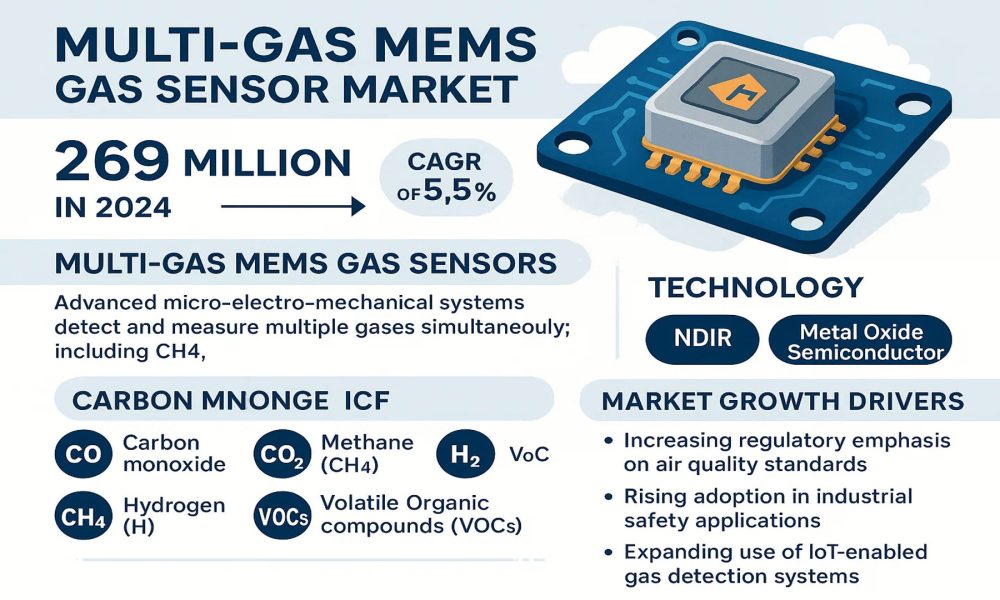
Multi-Gas MEMS Gas Sensor Market was valued at 269 million in 2024 and is projected to reach US$ 390 million by 2032, at a CAGR of 5.5% during the forecast period.
Multi-Gas MEMS Gas Sensors are advanced micro-electro-mechanical systems designed to detect and measure multiple gases simultaneously, including carbon monoxide (CO), carbon dioxide (CO2), methane (CH4), hydrogen (H2), and volatile organic compounds (VOCs). These sensors integrate MEMS technology with sophisticated gas detection mechanisms such as NDIR (Non-Dispersive Infrared) and Metal Oxide Semiconductor principles, offering advantages like compact design, energy efficiency, and real-time monitoring capabilities.
The market growth is driven by increasing regulatory emphasis on air quality standards, rising adoption in industrial safety applications, and the expanding use of IoT-enabled gas detection systems. However, challenges such as cross-sensitivity issues and calibration complexities persist. Key players like Amphenol, Senseair, and Figaro are actively innovating to address these challenges, with recent developments focusing on enhanced selectivity and integration with wireless networks for smarter environmental monitoring solutions.
Request Your Free Sample Report- Multi-Gas MEMS Gas Sensor Market
MARKET DRIVERS
Stringent Environmental Regulations to Drive Adoption of Multi-Gas MEMS Sensors
Increasingly stringent environmental protection regulations worldwide are creating significant demand for advanced gas detection technologies. Governments globally are implementing tighter emissions standards, particularly for industrial facilities and automotive applications. Multi-Gas MEMS sensors play a crucial role in monitoring volatile organic compounds, greenhouse gases, and other pollutants with high accuracy. The European Union’s recent Industrial Emissions Directive (IED) requires continuous monitoring of multiple gas emissions, creating immediate demand for sophisticated detection solutions. Similar regulations in North America and Asia are following suit, establishing a robust regulatory-driven demand environment for these sensors.
Growing Smart City Initiatives Accelerate Deployment Across Urban Infrastructure
The rapid expansion of smart city projects globally represents a major growth driver for multi-gas MEMS sensors. Municipalities are increasingly integrating these sensors into urban air quality monitoring networks, smart building systems, and transportation infrastructure. With over 1000 smart city projects currently underway worldwide, the need for compact, low-power sensors capable of detecting multiple gases simultaneously has surged. These sensors enable real-time environmental monitoring that helps cities manage pollution levels, optimize energy consumption, and improve public health outcomes through data-driven decision making.
Industrial Safety Requirements Fuel Demand in Manufacturing Sectors
Industrial applications remain the largest end-use segment for multi-gas MEMS sensors, driven by mandatory workplace safety regulations. The oil & gas, chemical processing, and manufacturing sectors require continuous monitoring for hazardous gases like methane, hydrogen sulfide, and carbon monoxide. Recent advancements in sensor miniaturization and selectivity have enabled their integration into personal protective equipment, fixed monitoring systems, and autonomous inspection robots. The global industrial safety equipment market’s projected growth underscores the expanding opportunities for gas detection technologies in occupational health and safety applications.
Recent Developments: Multi-Gas MEMS Gas Sensor Market
- Advancements in Smart Sensor Integration: Leading companies are increasingly integrating MEMS gas sensors with IoT platforms to enhance real-time air quality monitoring in smart homes, industrial safety, and automotive applications.
- Miniaturization and Low Power Consumption: Recent R&D efforts are focused on developing ultra-compact, energy-efficient multi-gas MEMS sensors that can detect multiple gases like CO₂, CO, CH₄, and VOCs simultaneously. This makes them suitable for portable and wearable devices.
- Automotive Sector Adoption: Major automotive manufacturers are adopting MEMS gas sensors for cabin air quality control and emission monitoring, supported by stringent government regulations on environmental safety.
- Healthcare Applications Expansion: Recent developments highlight the growing use of MEMS gas sensors in medical devices, especially for non-invasive patient monitoring and breath analysis.
- Collaborations and Partnerships: Sensor manufacturers are collaborating with semiconductor and IoT solution providers to co-develop AI-enabled gas sensing platforms, ensuring higher accuracy and predictive analytics.
- Environmental Monitoring Initiatives: Governments and organizations are increasingly deploying MEMS gas sensor-based monitoring systems in urban infrastructure to track pollution levels and ensure compliance with air quality standards.
MARKET OPPORTUNITIES
Emerging Applications in Electric Vehicle Battery Monitoring Present New Growth Frontiers
The rapid electrification of transportation is creating novel applications for multi-gas MEMS sensors in battery safety systems. Modern lithium-ion battery packs require continuous monitoring for thermal runaway precursors such as hydrogen, carbon monoxide, and volatile organic compounds. Automakers are increasingly incorporating these sensors into battery management systems as a critical safety feature. With electric vehicle production expected to grow substantially, this emerging application represents a significant expansion opportunity for sensor manufacturers to diversify beyond traditional markets.
Integration with IoT Platforms Expands Data Monetization Potential
The combination of multi-gas MEMS sensors with cloud-based IoT platforms unlocks valuable data analytics capabilities. Real-time gas concentration data, when combined with other environmental parameters, enables predictive maintenance models and process optimization algorithms. This creates recurring revenue opportunities for sensor manufacturers through value-added services, moving beyond hardware sales alone. Leading industrial companies are increasingly willing to pay premium prices for comprehensive monitoring solutions that deliver actionable insights rather than standalone sensor devices.
Miniaturization Breakthroughs Enable Wearable Health Monitoring
Recent advances in MEMS fabrication techniques have created opportunities in personal health monitoring applications. Compact multi-gas sensors capable of detecting biomarkers in human breath are being integrated into wearable devices for early disease detection. The potential to monitor multiple health indicators simultaneously – from metabolic byproducts to environmental exposures – represents a transformative application in preventative healthcare. While still in early stages, this segment could become significant as clinical validation progresses and regulatory approvals are secured.
Request Your Free Sample Report- Multi-Gas MEMS Gas Sensor Market
List of Key Multi-Gas MEMS Sensor Companies Profiled
- Amphenol Corporation (U.S.)
- Senseair AB (Sweden)
- smartGAS Mikrosensorik GmbH (Germany)
- Figaro Engineering Inc. (Japan)
- NISSHA Co., Ltd. (Japan)
- Veris Industries (U.S.)
- Dynament Ltd. (U.K.)
- Cubic Sensor and Instrument Co. (China)
Segment Analysis:
By Type
NDIR (Non-Dispersive Infrared) Sensors Dominate the Market Due to Their High Accuracy in Gas Detection
The market is segmented based on type into:
- NDIR (Non-Dispersive Infrared) Sensors
- Subtypes: Single-channel, Multi-channel, and others
- Metal Oxide Semiconductor Sensors
- Subtypes: Carbon-based, Tin oxide-based, and others
By Application
Industrial Segment Leads Due to Strict Safety Regulations and Demand for Continuous Monitoring
The market is segmented based on application into:
- Residence
- Business
- Industrial
By Detection Capability
Multi-Gas Detection Systems Gain Preference Over Single-Gas Detectors
The market is segmented based on detection capability into:
- Single-gas detectors
- Multi-gas detectors
- Subtypes: 2-gas, 4-gas, and 6-gas systems
By End-Use Industry
Oil & Gas Sector Remains Key Consumer of Multi-Gas MEMS Sensors
The market is segmented based on end-use industry into:
- Oil & Gas
- Chemicals
- Mining
- Environmental Monitoring
- Automotive
Other Topic- Medical RF Module Market
CONTACT US:
City vista, 203A, Fountain Road, Ashoka Nagar, Kharadi, Pune, Maharashtra 411014
[+91 8087992013]




