
The mosquito trap market is gaining increasing attention as governments, health organizations, and households focus on effective mosquito control solutions. Mosquito traps are widely used as preventive devices that capture or eliminate mosquitoes using light, carbon dioxide, heat, or attractant-based technologies. Growing awareness about mosquito-borne diseases such as dengue, malaria, and chikungunya has strengthened the demand for reliable mosquito control systems across residential, commercial, and public health settings. As urban areas continue to expand and population density increases, the risk of mosquito breeding in stagnant water sources and crowded living environments rises significantly, prompting the adoption of preventive technologies.
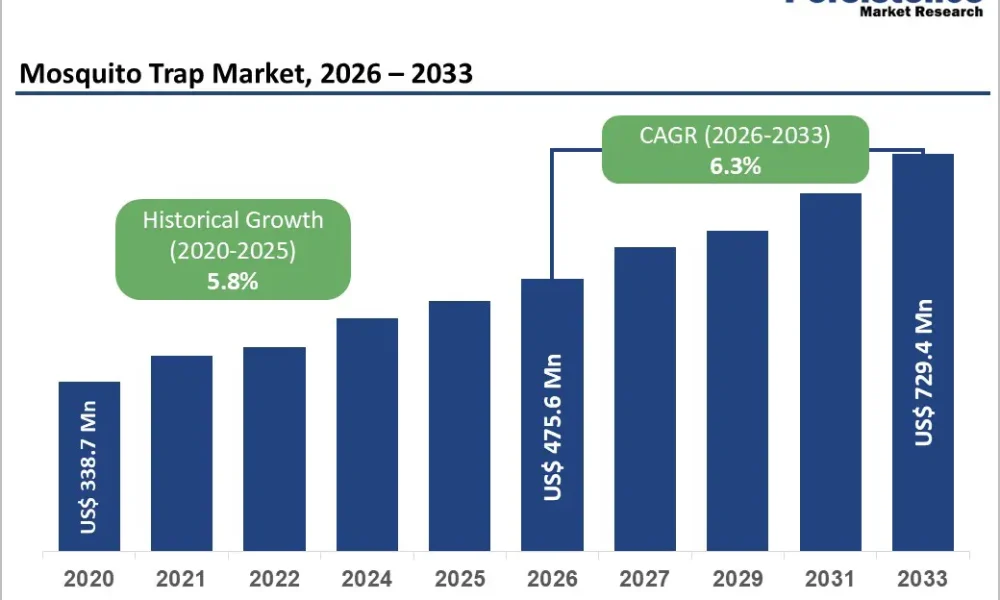
According to Persistence Market Research, the global mosquito trap market size is likely to be valued at US$475.6 million in 2026 and is projected to reach US$729.4 million by 2033, growing at a CAGR of 6.3% during the forecast period 2026–2033. Rising prevalence of vector-borne diseases is expected to drive adoption, prompting governments and healthcare agencies to implement mosquito control measures. Residential users represent a leading end-use segment due to increasing consumer awareness and preventive health practices. Regionally, Asia Pacific is expected to hold a prominent share due to high mosquito populations, tropical climates, and rising public health initiatives to control mosquito-borne infections.
Download Your Free Sample & Explore Key Insights : https://www.persistencemarketresearch.com/samples/34107
Key Highlights from the Report
➤ The global mosquito trap market is projected to grow from US$475.6 million in 2026 to US$729.4 million by 2033.
➤ Rising cases of vector-borne diseases are increasing demand for mosquito control solutions.
➤ Urbanization and growing residential density are contributing to higher exposure to mosquito breeding environments.
➤ Increasing adoption of eco-friendly and chemical-free mosquito traps is shaping product innovation.
➤ Government mosquito control programs and public health initiatives are supporting market growth.
➤ Technological advancements in light-based and attractant-based trapping systems are improving product effectiveness.
Market Segmentation
The mosquito trap market is segmented based on product type, application, and end user. Product types commonly include ultraviolet light traps, carbon dioxide traps, heat traps, and attractant-based traps. Among these, ultraviolet light traps are widely adopted due to their efficiency and relatively low maintenance requirements. Carbon dioxide traps are also gaining traction in outdoor applications because they mimic human breath and attract mosquitoes more effectively. Manufacturers are continuously developing advanced trapping technologies to improve capture rates and reduce energy consumption.
Based on application, mosquito traps are used in residential, commercial, and public health sectors. Residential applications dominate the market as homeowners increasingly invest in preventive pest control solutions to protect families from mosquito-borne diseases. Commercial establishments such as hotels, restaurants, and outdoor recreational facilities are also adopting mosquito traps to maintain safe environments for visitors. Public health organizations frequently deploy large-scale mosquito control systems in urban areas and public parks to reduce mosquito populations and minimize disease outbreaks.
Customize This Report for Your Exact Requirements : https://www.persistencemarketresearch.com/request-customization/34107
Regional Insights
Asia Pacific represents a significant market for mosquito traps due to climatic conditions that support mosquito breeding throughout the year. Countries in tropical and subtropical zones experience high incidences of mosquito-borne diseases, which has encouraged governments to introduce vector control initiatives. Rapid urbanization and expanding residential developments further increase the need for effective mosquito prevention technologies. As awareness grows, consumers across the region are adopting mosquito traps as a safer alternative to chemical repellents and sprays.
North America and Europe are also witnessing steady growth in the mosquito trap market. Increasing outdoor recreational activities and expanding suburban residential areas have increased exposure to mosquitoes in these regions. Consumers are actively adopting eco-friendly mosquito control solutions that minimize the use of pesticides. In addition, growing awareness about environmentally sustainable pest control technologies is encouraging manufacturers to introduce advanced traps designed for both indoor and outdoor environments.
Market Drivers
The most significant driver for the mosquito trap market is the rising prevalence of vector-borne diseases worldwide. Mosquitoes act as carriers of several life-threatening diseases, which has raised concerns among healthcare authorities and individuals alike. Governments and health organizations are implementing mosquito control programs that encourage the use of traps in residential and public environments. As people become more aware of the health risks associated with mosquito bites, preventive measures such as traps, repellents, and screening systems are gaining widespread adoption.
Another important growth driver is urban population growth and expanding residential settlements. As cities grow, construction activities and inadequate water drainage systems often create stagnant water bodies that serve as breeding grounds for mosquitoes. Dense residential communities are particularly vulnerable to mosquito infestations, increasing the demand for household mosquito traps. Technological advancements that make traps more efficient, portable, and energy-efficient are also contributing to their increasing adoption in both indoor and outdoor settings.
Market Restraints
Despite strong growth prospects, the mosquito trap market faces certain limitations. One of the key restraints is the relatively high cost of advanced mosquito trapping systems compared to traditional mosquito control methods such as sprays, coils, or repellents. In price-sensitive markets, consumers may hesitate to invest in technologically advanced traps, especially when lower-cost alternatives are widely available.
Another challenge is the limited effectiveness of some mosquito traps in large open environments. Outdoor spaces with large mosquito populations may require multiple traps or additional control methods to achieve optimal results. Environmental factors such as wind, temperature, and humidity can also influence the efficiency of certain trapping technologies. These factors sometimes reduce consumer confidence in traps and encourage the use of complementary mosquito control measures.
Market Opportunities
The mosquito trap market presents substantial opportunities through the development of eco-friendly and chemical-free pest control solutions. As consumers become increasingly conscious of environmental sustainability and personal health, there is growing demand for products that minimize chemical exposure. Manufacturers that focus on innovative attractant technologies and energy-efficient trap designs can attract environmentally conscious consumers and expand their market reach.
Another promising opportunity lies in smart mosquito traps integrated with digital monitoring systems. Emerging technologies allow traps to monitor mosquito populations, track capture data, and support large-scale mosquito control programs. Such solutions can be particularly useful for municipalities and public health agencies seeking data-driven approaches to vector control. Expansion into developing regions with high disease prevalence also offers significant long-term growth potential for mosquito trap manufacturers.
Checkout Now & Download Complete Market Report : https://www.persistencemarketresearch.com/checkout/34107
Company Insights
Key players operating in the mosquito trap market include:
- Woodstream Corporation, Inc.
- Aspectek
- Flowtron
- katchytrap.com
- Gardner Products
- BioTraptor
Recent Developments
- June 2024: Dynatrap introduced an advanced outdoor mosquito trap designed to improve insect capture efficiency using enhanced UV technology.
- October 2023: Woodstream Corporation expanded its mosquito control product portfolio with upgraded attractant-based trapping systems for residential use.
Future Opportunities and Growth Prospects
The mosquito trap market is expected to witness sustained growth as awareness about mosquito-borne diseases continues to increase worldwide. Governments and health agencies are expected to invest in preventive mosquito control strategies, encouraging the adoption of efficient trapping technologies. Growing urban populations and expanding residential developments will further strengthen the need for mosquito prevention solutions in both indoor and outdoor environments.
In the coming years, manufacturers are likely to focus on technological innovations such as smart mosquito traps, energy-efficient systems, and environmentally friendly attractants. Expanding product availability through online retail platforms and partnerships with pest control service providers will also contribute to market expansion. These developments will position mosquito traps as an essential component of modern vector control strategies across residential, commercial, and public health sectors.




