
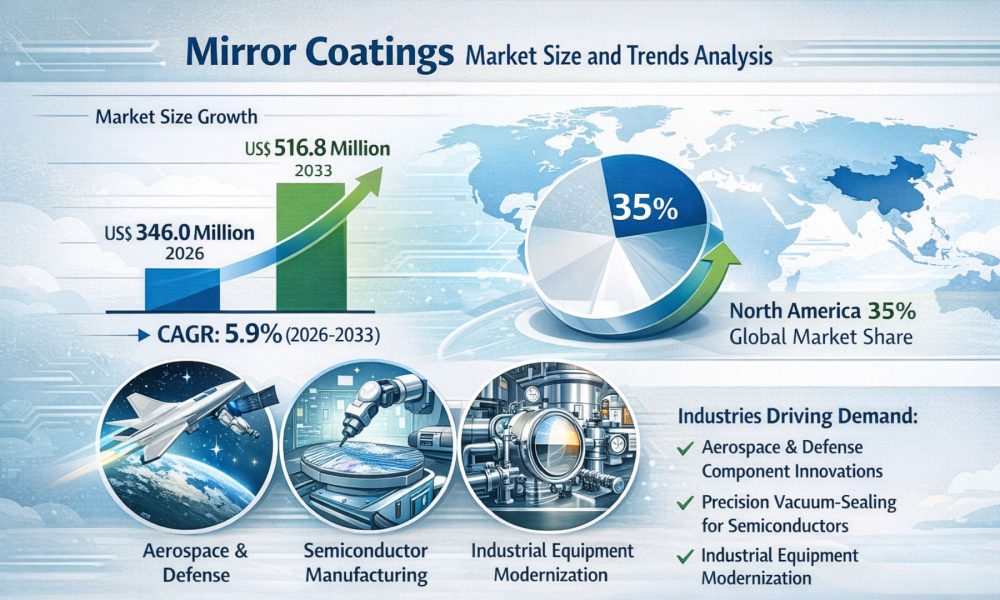
The Mirror Coatings Market is experiencing steady growth due to increasing demand for reflective surfaces across industries such as architecture, automotive, solar power, and decorative applications. Mirror coatings are specialized thin layers applied to glass or other substrates to enhance reflectivity, durability, and corrosion resistance. These coatings are widely used in mirrors, optical equipment, solar reflectors, and advanced industrial systems.
According to industry analysis, the global mirror coatings market is expected to reach around US$ 961.6 million in 2026 and expand to approximately US$ 1.55 billion by 2033, growing at a CAGR of about 7.1% between 2026 and 2033. The market growth is supported by increasing construction activities, expanding automotive production, and rising adoption of solar energy systems.
Get Your FREE Sample Report Instantly – Click Now: https://www.persistencemarketresearch.com/samples/34840
Market Overview
Mirror coatings play a crucial role in improving the performance and durability of mirrors used in various applications. These coatings typically consist of materials such as aluminum, silver, or other reflective metals protected by chemical-resistant layers. The coating process ensures that mirrors maintain high reflectivity and long service life even under harsh environmental conditions.
The rising demand for energy-efficient buildings, modern architectural designs, and smart mirrors is significantly contributing to market expansion. In addition, advancements in coating technologies such as nanotechnology and environmentally friendly formulations are improving coating efficiency and durability.
As industries continue to adopt high-performance optical and reflective materials, mirror coatings are becoming an essential component in modern infrastructure, consumer products, and renewable energy systems.
Key Market Drivers
Growth in Construction and Architectural Applications
One of the primary drivers of the mirror coatings market is the expansion of the global construction industry. Mirrors are widely used in residential and commercial buildings for both functional and decorative purposes. Architectural mirrors are integrated into building facades, interior designs, and energy-efficient glazing systems.
Rapid urbanization and infrastructure development in emerging economies are increasing the demand for decorative mirrors, reflective glass, and modern building designs. Mirror coatings also contribute to energy efficiency by reflecting solar radiation and improving indoor lighting conditions.
The adoption of green building standards such as LEED and BREEAM has further encouraged the use of reflective materials and advanced coatings that enhance building sustainability and reduce energy consumption.
Rising Demand from Automotive and Transportation Sector
The automotive industry is another major contributor to mirror coating demand. Vehicle side mirrors, rearview mirrors, and advanced optical components rely on high-quality reflective coatings to ensure clear visibility and durability.
With the growth of electric vehicles and advanced driver-assistance systems (ADAS), the need for durable and precise optical components is increasing. Automotive manufacturers are investing in improved mirror technologies that require coatings capable of withstanding temperature fluctuations, vibrations, and environmental exposure.
In addition, mirror coatings are used in transportation sectors such as railways, aerospace, and marine applications where reliable reflective surfaces are essential for safety and navigation.
Increasing Adoption of Solar Energy Systems
The expansion of renewable energy infrastructure, particularly solar power, is creating new growth opportunities for the mirror coatings market. Reflective coatings are widely used in concentrated solar power (CSP) systems, where mirrors reflect sunlight onto receivers to generate energy.
As governments worldwide invest heavily in renewable energy projects to reduce carbon emissions, the demand for highly reflective and durable mirror coatings is expected to rise. These coatings help improve solar energy efficiency by maximizing light reflection and minimizing energy losses.
Countries such as China, India, and the United States are rapidly expanding their solar energy capacity, further driving the need for advanced mirror coatings.
Market Restraints
Environmental Regulations and Compliance Challenges
Despite the positive outlook, the mirror coatings market faces challenges related to environmental regulations. Traditional mirror coatings often involve chemicals and heavy metals such as lead, cadmium, and chromium, which can pose environmental risks.
Regulatory authorities in regions such as Europe and North America have introduced strict standards to limit volatile organic compound (VOC) emissions and hazardous substances in coatings. Compliance with these regulations requires manufacturers to invest in research and development to create environmentally friendly formulations.
These regulatory pressures may increase production costs and create technical challenges for manufacturers, potentially slowing market growth in certain regions.
Resin Type Insights
Based on resin type, the mirror coatings market is segmented into polyurethane, epoxy, acrylic, and others.
Among these, polyurethane-based coatings dominate the market, accounting for approximately 46.4% of global revenue share. These coatings provide strong adhesion, flexibility, and durability, making them suitable for various applications such as architectural mirrors and automotive components.
Polyurethane coatings also offer excellent resistance to moisture, UV radiation, and temperature variations, which helps extend the lifespan of mirrors.
Meanwhile, the acrylic resin segment is expected to witness the fastest growth, driven by its low toxicity, eco-friendly nature, and cost-effectiveness. Acrylic coatings are particularly popular in decorative mirror applications.
Application Insights
Mirror coatings are used in several application types including water-based coatings, solvent-based coatings, and nanotechnology-based coatings.
Water-Based Coatings
Water-based mirror coatings currently hold a significant share of the market, accounting for over 40% of global demand. These coatings are widely preferred due to their low VOC emissions and compliance with environmental regulations.
They also provide safer working conditions for workers during manufacturing and application processes.
Solvent-Based Coatings
Solvent-based coatings offer superior reflectivity and durability compared to other formulations. These coatings are commonly used in high-performance applications such as automotive mirrors, aerospace components, and solar reflectors.
Due to their enhanced durability and optical performance, solvent-based coatings are expected to witness steady growth in specialized industrial applications.
End-User Insights
Mirror coatings serve multiple end-use industries including architecture, automotive and transportation, solar power, decorative mirrors, and others.
The architectural segment dominates the market, accounting for approximately 58.8% of global demand. This dominance is driven by extensive use of mirrors in residential interiors, commercial buildings, and large architectural projects.
Interior design trends increasingly emphasize reflective surfaces and modern aesthetics, which further drives demand for high-quality mirror coatings.
The automotive and transportation segment is expected to be the fastest-growing, supported by increasing vehicle production and the integration of advanced mirror technologies.
Regional Analysis
North America
North America holds the largest share of the mirror coatings market, accounting for approximately 35% of global revenue. The region’s dominance is supported by strong construction activities, advanced manufacturing infrastructure, and a well-established automotive industry.
The United States plays a significant role in the regional market due to its large number of architectural projects and growing renewable energy investments.
Europe
Europe represents a significant market for mirror coatings due to strict environmental regulations and a strong focus on sustainable construction practices. Countries such as Germany, France, Italy, and Spain are major contributors to regional demand.
Government programs aimed at improving building energy efficiency are driving the adoption of advanced mirror coatings in architectural and industrial applications.
Asia Pacific
Asia Pacific is the fastest-growing region in the mirror coatings market. Rapid urbanization, expanding construction activities, and growing automotive production are fueling demand in countries such as China, India, Japan, and South Korea.
The region is also witnessing strong growth in renewable energy infrastructure, particularly solar power installations, which further supports market expansion.
Get a Customized Market View in One Click: https://www.persistencemarketresearch.com/request-customization/34840
Competitive Landscape
The mirror coatings market is highly competitive, with several global and regional companies focusing on technological innovation and product development.
Key Market Players
Major companies operating in the market include:
- The Sherwin-Williams Company
- Casix
- Fenzi
- JENOPTIK AG
- Dynasil Corporation
- Ferro Corporation
- North American Coating Laboratories
- Reynard Corporation
- ZEISS International
- Tianjin Xin Lihua Color Materials
These companies focus on expanding production capacity, developing environmentally friendly coatings, and investing in advanced coating technologies to maintain their competitive position.
Future Outlook
The mirror coatings market is expected to witness strong growth over the next decade as industries increasingly adopt advanced reflective materials. Innovations such as nanotechnology-based coatings, smart mirrors, and self-cleaning reflective surfaces are expected to transform the industry.
In addition, the growing emphasis on sustainable construction, renewable energy generation, and advanced automotive technologies will continue to create significant opportunities for mirror coating manufacturers.
As global infrastructure development and solar energy adoption accelerate, mirror coatings will play an increasingly important role in improving optical performance, durability, and energy efficiency across multiple industries.
About Persistence Market Research:
Persistence Market Research delivers strategic research solutions that drive business growth. Founded in 2012 and registered in England and Wales in 2023 as Persistence Research & Consultancy Services Ltd., we have completed 3,600+ custom and syndicated studies and supported 2,700+ projects for leading research firms. Combining traditional methodologies with modern tools, we provide actionable insights to multinational corporations, consultants, investors, and government bodies, earning strong trust through long-term client relationships.
Contact Us:
Persistence Market Research
Second Floor, 150 Fleet Street,
London, EC4A 2DQ, United Kingdom
USA Phone: +1 646-878-6329
UK Phone: +44 203-837-5656
Email: [email protected]
Web: https://www.persistencemarketresearch.com




