
Microproppant Market Overview :
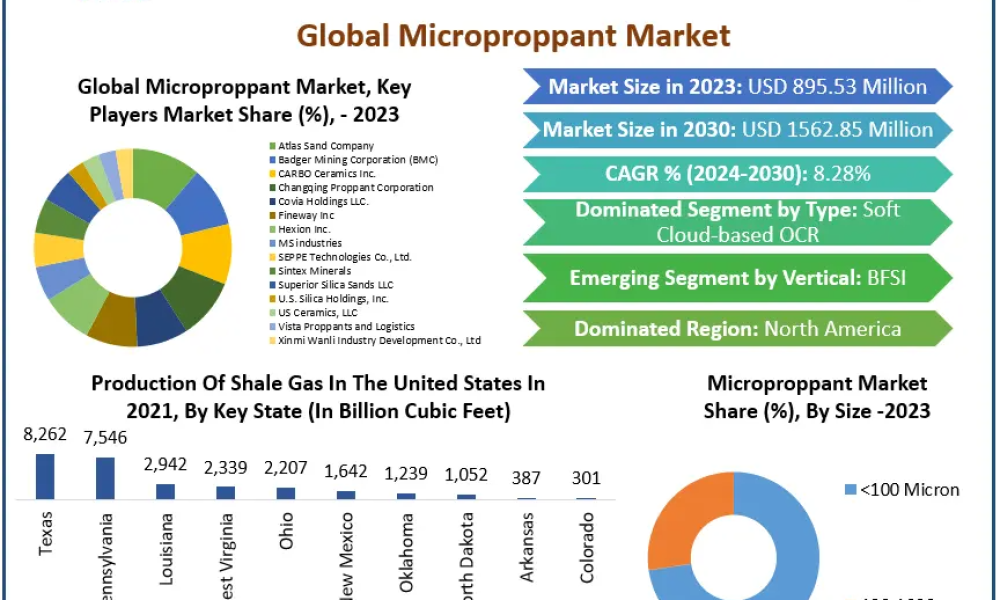
Microproppant Market Continues its strong upward trajectory, with valuation rising from USD 895.53 million in 2023 and poised to reach nearly USD 1,562.85 million by 2030, reflecting a CAGR of 8.28%. This surge is propelled by the rise in unconventional reservoir exploration, adoption of horizontal drilling and multistage fracturing, and the push for optimized oil and gas recovery—especially in North America’s prolific resource basins.
Key Highlights & Insights
Market Size & Growth: The market is expected to expand from USD 895.53 million in 2023 to USD 1,562.85 million by 2030, at a CAGR of 8.28% over the forecast period.
Dominating Region: North America commands the largest share—over 42% in 2023—and is forecast to retain its dominance. This is supported by high shale gas and tight oil activity in the US and Canada, plus the robust presence of leading microproppant producers and technological advancements.
Leading Segment: Oil & Gas holds a commanding 83.5% share by end-use, driven by the increased use of hydraulic fracturing in shale and tight formations. Microproppants, particularly of less than 1000 micron size, are preferred for their ability to access smaller fracture networks and sustain reservoir conductivity.
Key Driver: Accelerated global shift toward hydraulic fracturing and unconventional reservoirs, coupled with the push for higher production rates and well efficiency via advanced proppant technologies.
Recent Developments
Major industry players like U.S. Silica Holdings, Inc. (US), Atlas Sand Company, Badger Mining Corporation, and CARBO Ceramics are focusing on product launches, capacity expansions, and advanced resin/ceramic coatings to enhance microproppant performance.
In the Bakken and Barnett shale formations (USA), operators have successfully applied coated microproppants for fracture conductivity and reduced proppant flowback, directly boosting well output.
Argentina’s Vaca Muerta and China’s Sichuan Basin demonstrate adoption of ceramic- and resin-coated microproppants in shale stimulation, highlighting their importance in new energy frontiers.
Cuadrilla, in the UK, and leaders in Poland’s Baltic Basin have deployed microproppants to unlock lower-permeability shales, indicating rising European engagement.
Market Dynamics
Growth Drivers:
The mounting global demand for hydrocarbons, especially as conventional reservoirs decline.
Ongoing advances in fracturing methods—including horizontal drilling and multistage approaches—that demand specialized proppants to optimize extraction.
Development of engineered microproppants (coatings for durability, chemical resistance, embedment control) directly enhance fracture technologies and well longevity.
Increasing production and exploration activity in Europe, South America, and Asia Pacific add to global product uptake.
Challenges:
Volatility in oil prices and uncertainty in global energy markets.
Regulatory, environmental, and community pressures around hydraulic fracturing practices.
The need to balance proppant performance improvement with cost-competitiveness.
Regional Analysis
North America: Remains the largest and most mature market, thanks to the vast scope of shale plays, established industry supply chains, and continuous innovations. U.S. tight oil alone represents around 64% of the nation’s crude oil output.
Asia Pacific: Growing rapidly, led by China’s shale gas extraction in the Sichuan Basin, and with expanding interest in India and Australia.
Europe: Noticeable uptrend in exploration in UK, Poland, and Germany’s shale basins; microproppants play a key role in maximizing European unconventional resource recovery.
Other Regions: South America and MEA gradually increasing adoption due to large untapped resources in Argentina and Algeria.
Product Segmentation
By Size: <100 micron, 100–1000 micron—with the majority preference for ultra-fine grades for unconventional reservoir treatments.
By End-Use: Oil & gas (dominant), construction, healthcare, and others.
By Region: Segmented across major economic zones with focus on United States, Canada, China, Argentina, and regions with emerging unconventional hydrocarbon activity.
Key Trends
Widespread adoption of resin- and ceramic-coated microproppants for improved longevity and environmental resilience.
Investment in R&D for new proppant types tailored to basin/geology-specific requirements.
Integration of digital and real-time monitoring tech in fracturing to maximize proppant placement and effectiveness.
Microproppants are increasingly enabling exploitation of unconventional reserves in both established and emerging energy markets worldwide.
Quote
North America’s leadership in microproppant innovation is transforming global unconventional oil and gas extraction. As technology and materials science advance, microproppants are unlocking new reserves, maximizing well productivity, and ensuring the energy sector remains resilient and adaptive for the future.




