
Market Overview
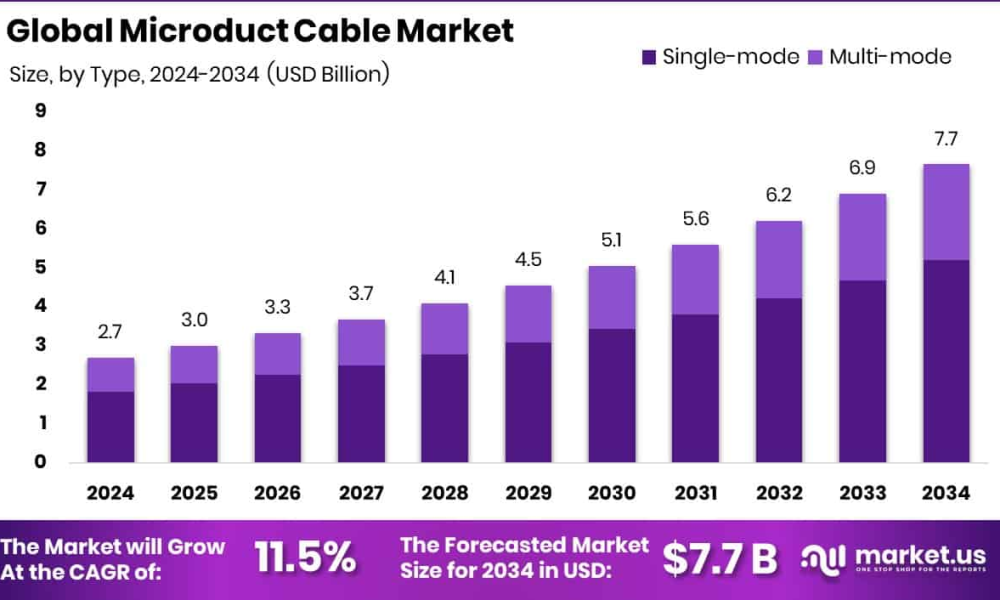
The Global Microduct Cable Market is projected to reach approximately USD 7.7 billion by 2034, rising from USD 2.7 billion in 2024. This growth reflects a compound annual growth rate (CAGR) of 11.5% between 2025 and 2034. North America continues to lead the market, accounting for 45.3% of total microduct installations.
The microduct cable market is witnessing strong growth, driven by the rising demand for high-speed internet, expanding telecommunications networks, and the increasing rollout of fiber-to-the-home (FTTH) infrastructure. Microduct cables, known for their compact size, flexibility, and ease of installation, have become a key solution for meeting modern connectivity needs.
The cables allow for faster and more cost-efficient deployments of fiber networks, making them especially attractive to network providers working across urban and rural settings alike. With growing digitalization in developing economies and the continued evolution of smart cities and connected infrastructure, the role of microduct cable systems is becoming more critical than ever before.
North America currently leads the market with a commanding 45.3% share, thanks to early adoption and continued upgrades of fiber networks across the region. Meanwhile, other regions are quickly catching up, fueled by government initiatives and the rising need for seamless digital communication in both commercial and residential spaces. As the world becomes more reliant on data and speed, microduct cable systems are expected to play an even larger role in shaping the digital backbone of future economies.
Important Revelation
- The global Microduct Cable Market is projected to reach approximately USD 7.7 billion by 2034, rising from USD 2.7 billion in 2024, with a CAGR of 11.5% between 2025 and 2034.
- In 2024, single-mode cables led the market, accounting for 68.4% of the global share.
- Flame retardant ducts were the most widely used duct type, making up 48.7% of total usage.
- Plastic was the leading material, contributing to 68.9% of the market demand.
- The blowing technique emerged as the most popular installation method, capturing 58.3% of the market share.
- Underground deployment dominated the application segment, representing a significant 74.6% of global usage.
- The telecommunication industry was the largest end-user, driving 61.2% of total demand.
- In 2024, North America led the global market with USD 1.2 billion in Microduct Cable demand.
Download Exclusive Sample Of This Premium Report (Including Full TOC, Table & Figures):
https://market.us/report/global-microduct-cable-market/free-sample/
Factors Affecting the Growth of Microduct Cable Market
Rising Demand for High-Speed Internet: The growing need for fast and reliable internet access, especially with the expansion of digital services and streaming platforms, is boosting the demand for microduct cable systems in both urban and rural areas.
Expansion of 5G Networks: The global rollout of 5G technology requires dense and high-capacity fiber networks. Microduct cables, being space-efficient and easy to install, are playing a critical role in supporting this infrastructure.
Urbanization and Smart City Projects: Increasing urban development and smart city initiatives are driving the installation of advanced telecommunication systems, which rely on microduct cable solutions for efficient and scalable network deployment.
Cost-Effective Installation Methods: Techniques like blowing and jetting used in microduct cable installation reduce labor time and costs, making it a preferred choice for telecom infrastructure projects.
Government Initiatives and Investments: Public sector investments in broadband expansion and digital connectivity programs, particularly in developing regions, are creating favorable conditions for the growth of the microduct cable market.
Report Segmentation:
By Type Analysis: In 2024, single-mode cables dominated the Microduct Cable Market’s “By Type” segment, holding a 68.4% share. This strong position is largely due to their ability to support high bandwidth and low signal loss, making them ideal for long-distance telecommunications. Their structure allows light to travel with minimal reflection, enabling faster and more efficient data transmission particularly useful in large-scale networks such as city infrastructure and university campuses. The growing demand for faster and more reliable communication systems, especially with the rise of 5G, has further increased the adoption of single-mode microduct cables. These cables serve as a critical component in modern telecom infrastructure, providing the stability and performance needed for advanced network operations. Continued advancements in fiber optics and network expansion are expected to keep driving this segment’s growth.
By Duct Type Analysis: In 2024, flame retardant ducts led the Microduct Cable Market by duct type, accounting for 48.7% of the share. This dominance is driven by growing safety regulations and construction standards that prioritize the use of fire-resistant materials. These ducts are widely used in urban infrastructure, commercial complexes, and industrial setups where minimizing fire risk is essential. Rising awareness of fire safety in telecom infrastructure has further increased demand for flame-retardant microducts. These ducts help prevent flame spread and reduce toxic smoke, making them vital in emergency scenarios. With continued growth in the construction sector and telecom upgrades, especially in developing regions, this segment is expected to maintain its strong position in the coming years.
By Material Type Analysis: In 2024, plastic emerged as the leading material type in the Microduct Cable Market, capturing a 68.9% share. This dominance is largely due to plastic’s affordability, flexibility, and durability, making it a preferred choice for cable installations. Its lightweight properties and ease of handling help reduce both installation time and costs, making it ideal for widespread deployment. Plastic materials also offer strong resistance to moisture, chemicals, and environmental stress, making them suitable for both underground and overhead applications. Advances in materials like high-density polyethylene (HDPE) have further enhanced performance, improving strength and longevity. With growing demands for faster, more resilient telecom infrastructure especially for 5G rollout plastic microducts remain a practical and cost-effective solution.
By Installation Technique Analysis: In 2024, the blowing technique was the most preferred installation method in the Microduct Cable Market, capturing a 58.3% share. Its popularity stems from its speed, efficiency, and lower installation costs. By using compressed air to push cables through microducts, this method enables quick deployment over long distances with minimal disruption to existing infrastructure, making it especially useful in complex urban environments. The blowing method also offers flexibility in various conditions and allows for future upgrades by enabling multiple cables to be installed in the same duct. It reduces the need for extensive digging or trenching, helping service providers cut down on both labor and maintenance costs. As the need for rapid telecom network expansion grows, this technique is expected to remain the go-to choice for efficient cable installations.
By Deployment Analysis: In 2024, underground deployment led the Microduct Cable Market with a 74.6% share, driven by the need for secure and space-efficient infrastructure. This method is preferred for its ability to protect cables from environmental exposure, physical damage, and vandalism, while also preserving the aesthetic appeal of urban areas. It’s especially beneficial in cities where maintaining a clean and unobtrusive landscape is important. The rise of smart city developments and increasing urbanization have further boosted the demand for underground microduct systems. These installations support the dense, high-performance networks required for services like high-speed internet and 5G. In addition to greater durability, underground deployment helps minimize service disruptions from weather-related events, offering long-term savings and reliability for telecom infrastructure.
By End-use Analysis: In 2024, the telecommunications sector dominated the Microduct Cable Market by end-use, accounting for a 61.2% share. This strong lead is driven by the rising demand for faster, more reliable internet services and the surge in global data consumption. Microduct cables are widely used for both upgrading existing telecom infrastructure and building new networks, thanks to their compact design and high capacity for data transmission. As the telecom industry rolls out next-generation technologies like 5G, the need for scalable and efficient cabling systems has grown significantly. Microduct cables offer quick, low-disruption installation, which is especially valuable in crowded urban environments. Additionally, efforts to expand connectivity into rural and remote areas have further increased demand, positioning telecommunications as the key growth driver in this market segment.
To Purchase this Premium Report@https://market.us/purchase-report/?report_id=146548
Market Key Segmentation:
By Type
- Single-mode
- Multi-mode
By Duct Type
- Flame Retardant
- Direct Install
- Direct Burial
By Material Type
- Glass
- Plastic
- HDPE
- PVC
- LDPE
- Others
By Installation Technique
- Blowing
- Pulling
- Plowing
- Directional Drilling
By Deployment
- Underground
- Underwater
- Aerial
By End-use
- Telecommunication
- Power Utilities
- Defense/Military
- Industrial
- Medical
- Others
Regional Analysis
In 2024, North America led the global Microduct Cable Market with a 45.3% share, valued at around USD 1.2 billion. This leadership is mainly due to rapid digital transformation, widespread fiber-to-the-home (FTTH) installations, and ongoing 5G infrastructure development. Strong investments from telecom companies and government-supported broadband initiatives have further accelerated market growth across the region.
Europe followed closely, driven by rising internet demand across both urban and rural areas, alongside smart city initiatives and industrial automation. Asia Pacific also held a notable share, supported by its large population, increasing internet penetration, and expanding fiber optic networks in emerging economies. Meanwhile, the Middle East & Africa are making steady progress in building digital infrastructure, while Latin America is seeing moderate growth through efforts to improve telecom coverage and urban network expansion.
Competitive Landscape
- Corning Incorporated
- Nestor Cables
- CommScope Holding Company, Inc.
- Sumitomo Electric Industries Ltd
- Prysmian Group
- Arabian Fiber Optic Cable Manufacturing LLC
- Briticom
- Orient Cables India Pvt. Ltd
- AFL
- Nexans S.A.
- Fujikura Ltd.
- SAMM Teknoloji
- Polycab Telecom
- OFS Fitel, LLC
- Other Key Players
Get in Touch with Us:
Market.us (Powered By Prudour Pvt. Ltd.)
Address: 420 Lexington Avenue, Suite 300 New York City, NY 10170, United States
Send Email: [email protected]



