
Methyl Ester Sulfonate Market Size, Trends, and Growth Outlook
The global Methyl Ester Sulfonate (MES) market is gaining strong momentum as industries increasingly adopt environmentally friendly surfactants. Methyl ester sulfonate is an anionic surfactant derived mainly from renewable vegetable oils such as palm oil and other natural fatty acids. Due to its superior detergency, biodegradability, and low toxicity, MES is widely used in household detergents, personal care products, and industrial cleaning formulations. Growing environmental concerns and regulatory restrictions on petroleum-based surfactants have accelerated the shift toward sustainable alternatives such as methyl ester sulfonate.
According to Persistence Market Research, the global methyl ester sulfonate market is expected to reach around US$ 1.7 billion in 2026 and is projected to grow to US$ 6.9 billion by 2033, registering an impressive CAGR of 22.0% between 2026 and 2033.
The market growth is largely driven by increasing demand for biodegradable surfactants, expanding detergent production, and growing consumer preference for eco-friendly cleaning and personal care products. As sustainability becomes a core focus for manufacturers and consumers alike, methyl ester sulfonate is emerging as a preferred alternative to traditional petrochemical-based surfactants.
Get Your FREE Sample Report Instantly – Click Now: https://www.persistencemarketresearch.com/samples/27244
Rising Demand for Biodegradable Surfactants
One of the most important factors driving the methyl ester sulfonate market is the rising demand for biodegradable surfactants. Environmental concerns regarding the use of petrochemical-based surfactants have led to stricter regulations and increased awareness among consumers. As a result, manufacturers are shifting toward bio-based ingredients that reduce environmental impact while maintaining performance.
Methyl ester sulfonate is considered highly biodegradable and environmentally friendly compared with traditional surfactants such as linear alkylbenzene sulfonates (LAS). Because it is derived from renewable vegetable oils, MES offers a sustainable alternative that aligns with global efforts to reduce carbon emissions and environmental pollution.
Many detergent manufacturers are reformulating their products to include MES in order to meet sustainability standards and consumer expectations. This shift toward eco-friendly formulations is particularly strong in developed markets where environmental regulations are strict. As a result, the demand for methyl ester sulfonate is expected to rise significantly across household cleaning, industrial cleaning, and personal care applications.
Strong Growth in Detergent Applications
Detergents represent the largest application segment for methyl ester sulfonate. MES is widely used in both powder and liquid detergent formulations due to its excellent cleaning performance, foaming properties, and compatibility with hard water conditions. Its ability to remove stubborn stains effectively makes it a preferred surfactant in laundry detergents.
The detergents segment accounts for a major share of the global methyl ester sulfonate market, with more than 62% of total demand coming from detergent applications.
One reason for this strong adoption is the increasing consumption of household cleaning products worldwide. Rapid urbanization, population growth, and rising living standards are driving higher demand for laundry detergents and dishwashing products. Additionally, the growth of modern retail channels and e-commerce platforms has made household cleaning products more accessible to consumers.
The increasing penetration of washing machines in emerging economies is also boosting demand for advanced detergent formulations, many of which incorporate methyl ester sulfonate for improved performance.
Expanding Use in Personal Care Products
In addition to detergents, methyl ester sulfonate is gaining popularity in personal care formulations such as shampoos, body washes, and facial cleansers. The personal care industry is undergoing a major transformation as consumers demand natural, gentle, and sulfate-free ingredients.
MES is considered a mild surfactant that provides effective cleansing while being less irritating to the skin compared with some conventional surfactants. This makes it particularly suitable for personal care products designed for sensitive skin.
The growing popularity of natural and organic cosmetics is further accelerating the adoption of methyl ester sulfonate in personal care applications. As consumers become more aware of ingredient safety and environmental impact, brands are increasingly incorporating bio-based surfactants into their formulations.
The expansion of the global personal care market, particularly in emerging economies, is expected to create significant growth opportunities for MES manufacturers in the coming years.
Environmental Regulations Encouraging Sustainable Surfactants
Government regulations aimed at reducing environmental pollution are playing a crucial role in shaping the methyl ester sulfonate market. Many regulatory bodies have introduced strict guidelines requiring detergents and cleaning products to use biodegradable surfactants.
For example, environmental regulations such as the European Union’s REACH framework and detergent regulations mandate the use of surfactants that meet strict biodegradability standards. These regulations encourage manufacturers to replace traditional petroleum-based surfactants with sustainable alternatives like MES.
As governments worldwide strengthen their environmental policies, the demand for eco-friendly surfactants is expected to rise significantly. Companies are therefore investing in research and development to produce high-performance MES formulations that comply with regulatory standards while maintaining cost competitiveness.
Asia Pacific Dominating the Global Market
Asia Pacific holds the largest share of the global methyl ester sulfonate market, accounting for approximately 55% of global consumption.
Several factors contribute to the region’s dominance. Countries such as China, India, Indonesia, and Malaysia have large populations and rapidly growing consumer markets for household cleaning and personal care products. Rising disposable incomes and improving living standards are increasing the demand for detergents and hygiene products across the region.
Additionally, Asia Pacific has abundant access to palm oil and other vegetable oil feedstocks used in the production of methyl ester sulfonate. This availability of raw materials helps reduce production costs and supports large-scale manufacturing.
The expansion of the detergent manufacturing industry and increasing awareness about sustainable products are expected to further strengthen the region’s leadership in the global MES market.
Technological Advancements in Surfactant Manufacturing
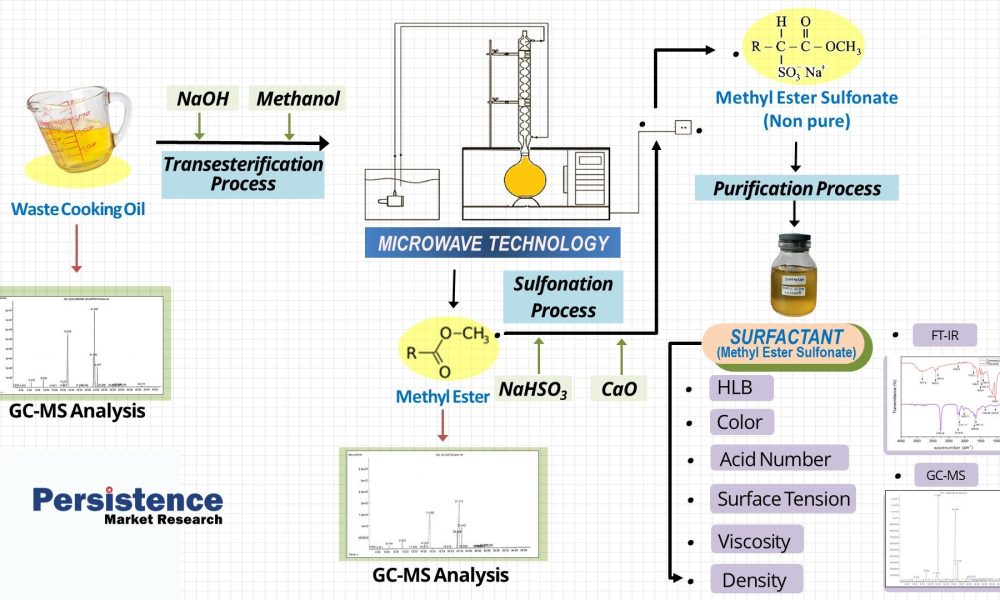
Technological advancements in surfactant production processes are significantly improving the efficiency and quality of methyl ester sulfonate. Manufacturers are investing in advanced processing technologies that enhance product stability, improve cleaning performance, and reduce production costs.
Modern manufacturing techniques allow producers to create MES with improved solubility and performance in various detergent formulations. These advancements enable the development of high-efficiency detergents that require lower quantities of surfactants while delivering superior cleaning results.
Research and development efforts are also focused on improving the sustainability of MES production by optimizing raw material usage and reducing energy consumption during manufacturing. Such innovations are expected to strengthen the competitiveness of methyl ester sulfonate in the global surfactants market.
Growing Opportunity from Replacement of Petroleum-Based Surfactants
One of the most significant opportunities for the methyl ester sulfonate market lies in replacing petroleum-based surfactants such as linear alkylbenzene sulfonates (LAS). As environmental regulations tighten and consumer awareness increases, manufacturers are exploring sustainable alternatives for traditional detergent ingredients.
Methyl ester sulfonate is emerging as a promising replacement due to its superior biodegradability and renewable raw material base. Analysts estimate that replacing LAS in detergent formulations across Asia Pacific could generate 150,000 to 200,000 metric tons of additional MES demand by 2030.
This shift toward bio-based surfactants represents a major growth opportunity for the industry. Companies that invest in scalable production technologies and sustainable supply chains will likely gain a competitive advantage as demand continues to rise.
For In-Depth Competitive Analysis, Buy Now: https://www.persistencemarketresearch.com/checkout/27244
Competitive Landscape and Key Market Players
The global methyl ester sulfonate market is moderately competitive, with several major chemical manufacturers and surfactant producers operating across different regions. These companies focus on product innovation, capacity expansion, and strategic partnerships to strengthen their market presence.
Key companies operating in the global methyl ester sulfonate market include:
- KLK Oleo
- Lion Corporation
- Stepan Company
- Wilmar International Ltd.
- Chemithon Corporation
- Zanyu Technology Group
- Jinchang Chemical
- KPL International Ltd.
- Henan Surface Chemical Industry Co., Ltd.
- Guangzhou Keylink Chemical Co., Ltd.
These companies are investing heavily in research and development to improve product performance and expand their global distribution networks.
Future Outlook of the Methyl Ester Sulfonate Market
The future of the methyl ester sulfonate market appears highly promising, driven by growing environmental awareness, expanding detergent demand, and supportive regulatory frameworks. The increasing shift toward sustainable chemicals and bio-based ingredients will continue to accelerate market growth in the coming years.
With strong demand from detergents, personal care products, and industrial cleaning applications, methyl ester sulfonate is expected to become a key ingredient in next-generation cleaning formulations. The continued replacement of petrochemical surfactants with biodegradable alternatives will further strengthen market expansion.
As industries worldwide prioritize sustainability and green chemistry, the methyl ester sulfonate market is poised for rapid growth, making it one of the most dynamic segments in the global surfactants industry.
About Persistence Market Research:
Persistence Market Research delivers strategic research solutions that drive business growth. Founded in 2012 and registered in England and Wales in 2023 as Persistence Research & Consultancy Services Ltd., we have completed 3,600+ custom and syndicated studies and supported 2,700+ projects for leading research firms. Combining traditional methodologies with modern tools, we provide actionable insights to multinational corporations, consultants, investors, and government bodies, earning strong trust through long-term client relationships.
Contact Us:
Persistence Market Research
Second Floor, 150 Fleet Street,
London, EC4A 2DQ, United Kingdom
USA Phone: +1 646-878-6329
UK Phone: +44 203-837-5656
Email: [email protected]
Web: https://www.persistencemarketresearch.com




