
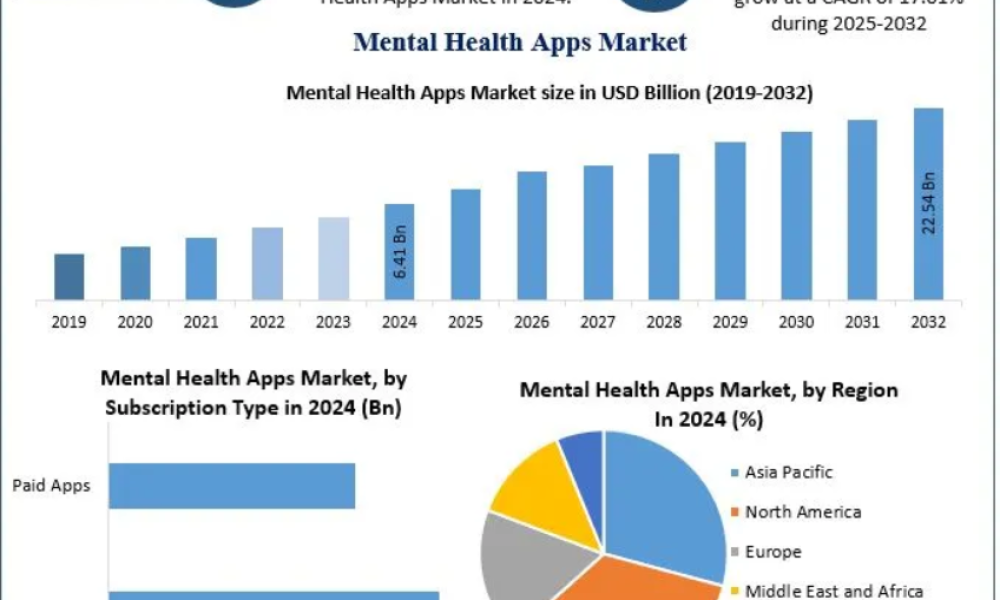
As per a recent study released by Maximize Market Research, titled, “Mental Health Apps Market,” In 2024, the global mental health apps market was valued at USD 6.41 billion, and it is projected to grow at a CAGR of 17.01 % to reach USD 22.54 billion by 2032.
Mental Health Apps Market Overview:
Mental health apps are mobile or web-based applications designed to support emotional well-being, psychological care, and mental health self-management. These apps typically offer features such as mood tracking, journaling, guided meditations, cognitive behavioural therapy (CBT) tools, reminders, content for stress and anxiety reduction, and often teletherapy or peer-support functions. They serve as accessible, often lower-cost complements (or entry points) to traditional mental health services.
The accelerating adoption of smartphones, growing mental health awareness, reduction of stigma around seeking psychological help, and rising demand for remote healthcare solutions have combined to drive expansion in this sector. As users increasingly look for convenient, anytime-anywhere support, mental health apps are becoming an integral part of digital health ecosystems.
Download a Free Sample Report Today :https://www.maximizemarketresearch.com/request-sample/213831/
Mental Health Apps Market Dynamics
One of the principal drivers behind market growth is the growing prevalence of mental health challenges globally—especially anxiety, depression, stress, and related disorders—and the urgent need for scalable, accessible support. Traditional in-person therapy is limited by cost, availability of professionals, and geographical barriers; digital apps offer a complementary avenue for broader reach and early intervention.
Technological advances also propel market dynamics. Increasing integration of AI and machine learning enables more personalized user experiences, smarter content recommendations, adaptive interventions, chatbots, sentiment analysis, and predictive analytics. Interoperability with wearable devices (e.g. detecting heart rate variability, sleep patterns) enhances real-time insight and responsiveness.
At the same time, the market faces nontrivial challenges. Data privacy and security are critical concerns: mental health apps often handle extremely sensitive personal data (emotions, behavior, thoughts), so any leaks or misuses could undermine trust. Moreover, many apps vary in quality, clinical validation, regulatory oversight, and evidence base, which raises questions about efficacy, safety, and standardization.
Another restraint is user engagement and retention: even if users download apps, sustaining usage over time is difficult. Without continuous motivation, fresh content, measurable benefits, and good user experience, drop-off rates can be high. Additionally, integration with healthcare systems, reimbursement models, and acceptance by clinicians remain obstacles in many regions.
Mental Health Apps Market Outlook and Future Trends :
Over the forecast period, the mental health apps market is expected to continue robust growth, driven by increasing demand for digital mental health services, further smartphone penetration, and evolving regulatory policies that support digital health. The projected trajectory—from USD 6.41 billion in 2024 to USD 22.54 billion by 2032—reflects the potential for transformative scale in this space.
Emerging trends likely to define the future include hybrid care models, where apps complement or interface with licensed therapists; AI-powered adaptive therapy that tailors interventions based on ongoing user data; gamification and engagement mechanics to boost retention; voice & conversational agents for conversational support; multi-modal sensing (wearables, passive data, biometrics) to infer emotional states; and platform consolidations or ecosystem bundling with broader digital health services.
Another trend to watch is regulation, certification & clinical validation: as the sector matures, users, payers, and health systems will demand proof of safety, efficacy, and privacy compliance. Standardization of outcome metrics, interoperability frameworks, and approvals or accreditation may distinguish leading apps.
Mental Health Apps Market Regional Insights:
The global mental health apps market is segmented across key regions: North America, Europe, Asia Pacific, Latin America, and Middle East & Africa.
North America commands a leading share, driven by high smartphone penetration, strong awareness of mental health, supportive healthcare infrastructure, broad investment in digital health, and established app development ecosystems. The U.S. and Canada act as innovation hubs, with many leading mental health app providers headquartered there.
Europe follows closely, with high regulatory focus (data privacy laws, health-app guidelines), rising acceptance of mental health support, and diverse multilingual populations requiring localized content. European nations with mature digital health strategies are likely adopters.
Asia Pacific is expected to be a high-growth region. Rapid digitalization, increasing mental health awareness, large populations, and growing smartphone use all drive appetite for mental health solutions. However, adoption may be uneven: developed East Asian markets (Japan, South Korea, Australia) may lead early, while emerging markets face cultural stigma, linguistic diversity, lower health infrastructure, and payment constraints.
Latin America and Middle East & Africa present growth potential, albeit from lower base levels. In Latin America, urbanization, mobile-first populations, and increased recognition of mental health are opening entry points. In Middle East & Africa, constraints such as digital infrastructure, regulatory frameworks, cultural acceptance, and affordability may slow adoption, though partnerships, public health initiatives, and NGO support may catalyze uptake.
Across these regions, success factors will include localization (language, cultural relevance), integration with local health systems, compliance with regional privacy and medical regulations, user trust, and partnerships with payers, governments, or healthcare providers.
Mental Health Apps Market Segmentation
By Platform Type
iOS
Android
Others
By Subscription Type
Free Apps
Paid Apps
By Accessibility and Engagement
Mobile Apps
Web-Based Apps
Gamified Apps
By Application
Depression & Anxiety Management
Meditation Management
Stress Management
Wellness Management
Addiction Disorder
Others
Some of the current players in the Mental Health Apps Market are:
North America
1. Calm (USA)
2. CVS Health (USA)
3. Happify Inc. (USA)
4. Talkspace Network (USA)
5. 7 cups of Tea (USA)
6. Sanvello (USA)
7. NOCD Inc. (USA)
8. Aurora Health Care (USA)
9. Headspace Inc. (USA)
10. BetterHelp (USA)
11. Woebot (USA)
12. Youper (USA)
13. Shine (USA)
14. Remente (Sweden)
15. Simple Habit (USA)
16. Moodfit (USA)
17. Mayo foundation for medical education and research (USA)
Europe
18. Silver Cloud Health, Inc (UK)
19. Daylio (Slovakia)
20. Other
Asia Pacific
21. Wysa (India)
22. Others
About Maximize Market Research:
Maximize Market Research is one of the fastest-growing market research and business consulting firms serving clients globally. Our revenue impact and focused growth-driven research initiatives make us a proud partner of majority of the Fortune 500 companies. We have a diversified portfolio and serve a variety of industries such as IT & telecom, chemical, food & beverage, aerospace & defense, healthcare and others.
Contact Maximize Market Research:
MAXIMIZE MARKET RESEARCH PVT. LTD.
⮝ 3rd Floor, Navale IT park Phase 2,
Pune Banglore Highway, Narhe
Pune, Maharashtra 411041, India.
✆ +91 9607365656
🖂 [email protected]




