

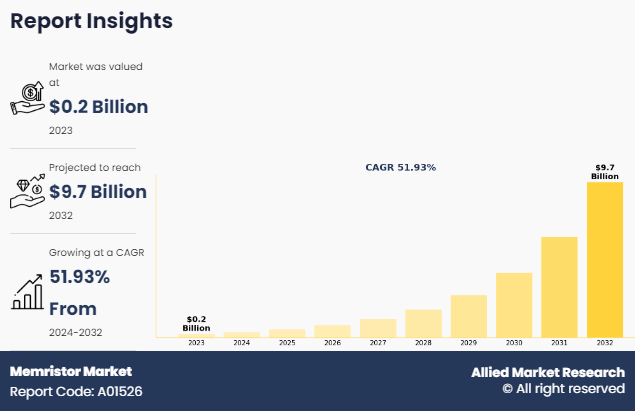
The Global Memristor Market was valued at $0.2 billion in 2023, and is projected to reach $9.7 billion by 2032, growing at a CAGR of 51.93% from 2024 to 2032. As per the report published by Allied Market Research Titled “Memristor Market Size, Share, Competitive Landscape and Trend Analysis Report by Type, by Industry Vertical : Global Opportunity Analysis and Industry Forecast, 2024-2032″
Download Research Report Sample & TOC :https://www.alliedmarketresearch.com/request-sample/1856
Memristors, also known as memory resistors, are unique electrical components that have the ability to store and process data. Unlike traditional resistors, which regulate current flow, memristors can retain electrical current even when the power is off. This memory-like behavior makes it useful for designing more efficient compact memory storage systems.
Although memristors were theorized in the 1970s, they only became a reality in 2008 when scientists successfully developed them. They have a unique property that allows them to change resistance based on the history of the current flow. This feature brings new possibilities for their use in superior computing systems, particularly in artificial intelligence, where they create more brain-inspired architectures. Because of their ability to store data with minimal power, memristors pave the way for energy-efficient computing technologies, potentially transforming data storage and memory.
Memristor Market Segment Overview
The memristor market is segmented into type, industry vertical, and region.
In the past few years, memristors have transformed the fields of IT and telecommunications by creating integrated circuit design and enhancing computing capabilities. These devices can be used in many applications, including supercomputers, servers, data centers, portable electronics, and industrial robotics. As a result, leading companies in the semiconductor and memory sectors are increasing their investments in the memristor industry, which is anticipated to experience substantial growth.
The electronic, IT, and telecommunications sectors are contributing to the growth of the global memristor market. This expansion is driven by increasing demand for high-speed performance, high processing power and memory density at a competitive price. In addition, the rise in the number of advanced graphics systems enhances the need for faster processing speeds, thus boosting the demand for memristors.
One notable advantage of memristors is their ability to support devices with neural architecture, aligning with trends which include Neural Architecture Search in the data center sector. This capability makes memristors a necessary component to realize the potential of these technologies. According to the European Commission, approximately 41% of businesses in the European Union used cloud computing in 2021. Finland’s top ranking in information technology innovation also creates a favorable environment for the growth of the memristor industry.
Request For Customization @ https://www.alliedmarketresearch.com/request-for-customization/1856
In February 2022, Rain Neuromorphics Inc., a company focused on developing brain-inspired chips for AI applications, received $25 million in funding. The company uses a special method called analog technology, which is different from traditional digital AI chips. Although digital chips process data as binary 1s and 0s, Rain’s analog technology is able to understand sensitive data such as sound waves. This brain-powered design provides better efficiency and scalability, making Rain Neuromorphics a leader in AI hardware innovation.
On the other hand, NVIDIA currently dominates the AI chip sector with its graphics processing units. Nevertheless, U.S.-based startups such as SambaNova Systems, Groq and Cerebras Systems are continuing to gain traction. Rain’s approach has attracted early investors, including excellent AI researcher Sam Altman. He believes that Rain’s neuromorphic design considerably reduces the costs of AI models and leads toward advancements in artificial general intelligence.
Rain’s chip uses a memristor circuit on a silicon wafer, an innovation initially developed by HP Labs. This technology combines memory and processing in a single unit and accelerates AI processing as well as reduces power consumption. The latest funding, led by Prosperity 7 Ventures under Aramco Ventures, is intended to help grow Rain’s engineering team and further enhance the prototype chip.
Memristors are advanced electrical components that store data even when it is turned off. This makes them valuable for efficient memory systems. They improve computing abilities in different fields by permitting faster operations and reducing power consumption, thereby driving the development of high-performance computing and AI technologies.
About Us:
Allied Market Research is a top provider of market intelligence that offers reports from leading technology publishers. Our in-depth market assessments in our research reports consider significant technological advancements in the sector. In addition to other areas of expertise, AMR focuses on analyzing high-tech and advanced production systems. We have a team of experts who compile thorough research reports and actively advise leading businesses to enhance their current procedures. Our experts have a wealth of knowledge on the topics they cover. Also, they use a variety of tools and techniques when gathering and analyzing data, including patented data sources.
Contact Us:
David Correa
1209 Orange Street,
Corporation Trust Center,
Wilmington, New Castle,
Delaware 19801 USA.
Int’l: +1-503-894-6022
Toll Free: +1-800-792-5285
Fax: +1-800-792-5285
[email protected]




