
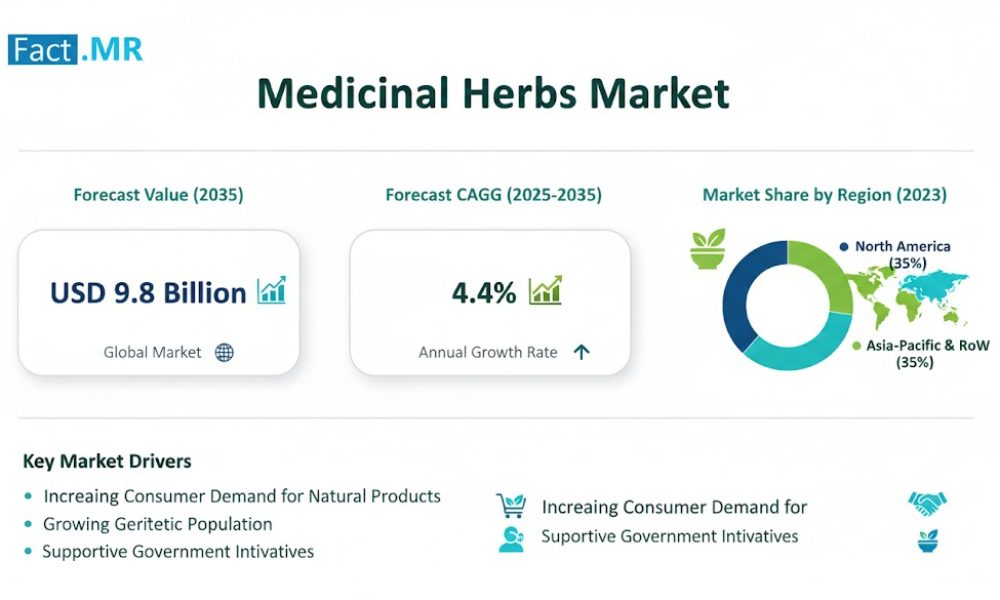
The global medicinal herbs market is poised for steady expansion over the next decade, with valuations expected to rise from USD 6.4 billion in 2025 to USD 9.8 billion by 2035, reflecting an absolute growth of USD 3.4 billion.
This represents a total market growth of 53.1%, with a compound annual growth rate (CAGR) of 4.4% during the forecast period, according to a new report by Future Market Insights (FMI). The growth trajectory is primarily driven by rising consumer preference for natural remedies, increasing awareness of herbal health benefits, and the integration of medicinal herbs into pharmaceutical, nutraceutical, and personal care products.
Strong Regional Momentum in North America, Europe, and APAC
The United States leads the market with a CAGR of 4.9% over the forecast period, fueled by growing adoption of herbal supplements, functional wellness products, and expanding retail and e-commerce channels. Mexico follows with 4.6% CAGR, reflecting a rising health-conscious population. In Europe, Germany (4.2%), France (4.0%), and the UK (3.8%) are driving growth through regulatory support, product innovation, and increased consumer acceptance of herbal health solutions. In the Asia-Pacific region, South Korea (3.6%) and Japan (3.4%) are witnessing steady uptake of herbal products, particularly in dietary supplements and traditional medicine formulations.
To access the complete data tables and in-depth insights, request a Discount On The Report here:
https://www.factmr.com/connectus/sample?flag=S&rep_id=4070
Medicinal Herbs Market Quick Stats:
| Metric | Details |
| Market Value (2025) | USD 6.4 billion |
| Forecast Value (2035) | USD 9.8 billion |
| Forecast CAGR (2025–2035) | 4.4% |
| Leading Type | Herbal Extracts & Powders |
| Key Growth Regions | North America, Europe, Asia-Pacific |
| Key Players | Martin Bauer Group, Naturex, Nexira, Starwest Botanicals, Indena S.p.A., Givaudan SA, GA Herb Co., Amega Sciences, Afriplex, Himalaya Wellness Company |
Driving Factors Behind Market Expansion
- Health and Wellness Trends: Increasing awareness of herbal efficacy, preventive healthcare, and natural remedies is driving global demand.
- Integration into Pharmaceutical & Nutraceutical Products: Medicinal herbs are increasingly incorporated into dietary supplements, functional foods, and personal care products.
- Regulatory Support and Standardization: Standards for herbal quality, labeling, and safety in North America and Europe enhance consumer trust.
- E-commerce and Retail Expansion: Online sales channels and specialty stores are boosting accessibility to medicinal herbs for consumers worldwide.
- R&D Investments: Companies are focusing on developing high-potency, allergen-free, and standardized herbal formulations to strengthen competitiveness.
Segment Overview
- By Type: Herbal extracts, powders, and teas dominate consumption, supporting pharmaceutical, nutraceutical, and personal care industries.
- By Application: Dietary supplements represent the largest segment, followed by functional wellness products and topical herbal formulations.
- By Distribution Channel: Online retail and specialty stores are the fastest-growing channels, driven by convenience and rising health-conscious consumer segments.
Competitive Landscape
Key players in the medicinal herbs market include:
- Martin Bauer Group
- Naturex (Groupe Roullier brand)
- Nexira
- Starwest Botanicals, Inc.
- Indena S.p.A.
- Givaudan SA
- GA Herb Co., Ltd.
- Amega Sciences, Inc.
- Afriplex
- Himalaya Wellness Company
These companies are leveraging product innovation, global distribution networks, and strategic partnerships to expand market share and meet increasing demand for natural remedies.
Regional Market Outlook
- North America: Growth fueled by herbal supplement consumption, functional wellness products, and e-commerce adoption.
- Europe: Germany, France, and the UK drive growth with regulatory support and product innovation.
- Asia-Pacific: Japan and South Korea show strong demand for herbal supplements and traditional medicinal formulations.
- Latin America: Mexico’s growing wellness-conscious population is contributing to increased adoption of herbal products.
For access to full forecasts, regional breakouts, company share analysis, and emerging trend assessments, you can purchase the complete report here: https://www.factmr.com/checkout/4070
Market Outlook: Towards a Health-Focused Future
The medicinal herbs market is expected to maintain steady growth over the next decade, reflecting rising global preference for natural, preventive healthcare solutions. Companies investing in product innovation, quality standardization, and online distribution are poised to capture significant market share.
“Medicinal herbs are evolving from niche natural remedies to mainstream wellness solutions,” said an Fact.MR analyst. “Manufacturers focusing on high-quality, standardized herbal products will capitalize on a market projected to reach USD 9.8 billion by 2035.
Have a specific Requirements and Need Assistant on Report Pricing or Limited Budget please contact us – [email protected]
About Fact.MR
Fact.MR is a global market research and consulting firm, trusted by Fortune 500 companies and emerging businesses for reliable insights and strategic intelligence. With a presence across the U.S., UK, India, and Dubai, we deliver data-driven research and tailored consulting solutions across 30+ industries and 1,000+ markets. Backed by deep expertise and advanced analytics, Fact.MR helps organizations uncover opportunities, reduce risks, and make informed decisions for sustainable growth.



