
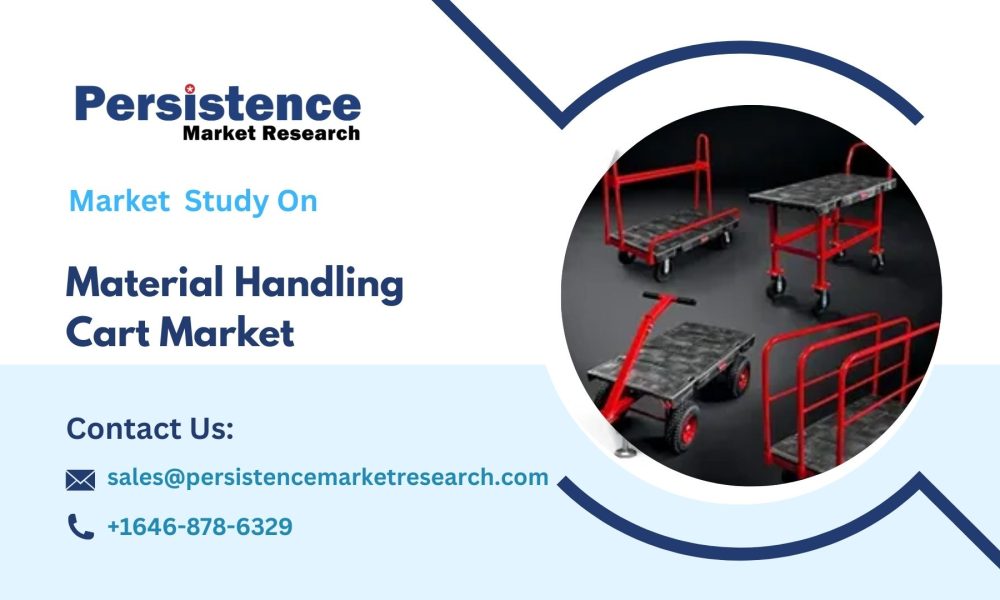
The global material handling cart market plays a critical role in modern industrial logistics, warehousing, manufacturing, and distribution operations by enabling the efficient movement of goods, components, and materials within facilities. Material handling carts—ranging from simple manual push carts to sophisticated powered and modular designs—are essential tools across industries seeking to improve workflow efficiency, minimize labor fatigue, and enhance workplace safety. As industrial ecosystems become increasingly complex and time-sensitive, the reliance on reliable internal transportation solutions continues to intensify. The market is closely linked to broader trends such as warehouse automation, supply chain optimization, and the rapid expansion of e-commerce fulfillment networks.
From a market size perspective, the global material handling cart market is likely to be valued at US$5.0 billion in 2026 and is projected to reach US$6.7 billion by 2033, expanding at a compound annual growth rate (CAGR) of 4.3% during the forecast period from 2026 to 2033. This steady growth trajectory is underpinned by rising warehouse automation initiatives, strong growth in e-commerce order volumes, increasing industrial activity in emerging economies, and sustained pressure on companies to reduce operational costs amid labor shortages. Among product categories, manual carts continue to represent the leading segment due to their affordability, versatility, and low maintenance requirements, particularly in small and medium-sized facilities. Geographically, North America dominates the global market, driven by advanced logistics infrastructure, early adoption of automation technologies, and the presence of large-scale e-commerce and third-party logistics (3PL) providers that prioritize material flow efficiency.
Key Highlights from the Report
• The global material handling cart market is projected to grow steadily at a CAGR of 4.3% between 2026 and 2033.
• Warehouse automation and e-commerce fulfillment expansion remain the primary demand drivers.
• Manual material handling carts continue to dominate due to cost-effectiveness and operational flexibility.
• North America leads the market owing to advanced logistics infrastructure and high automation adoption.
• Industrial manufacturing and warehousing represent the largest end-user segments globally.
• Product innovation focused on ergonomics and modularity is reshaping competitive differentiation.
𝐃𝐨𝐰𝐧𝐥𝐨𝐚𝐝 𝐅𝐫𝐞𝐞 𝐒𝐚𝐦𝐩𝐥𝐞 & 𝐂𝐡𝐞𝐜𝐤 𝐭𝐡𝐞 𝐋𝐚𝐭𝐞𝐬𝐭 𝐌𝐚𝐫𝐤𝐞𝐭 𝐀𝐧𝐚𝐥𝐲𝐬𝐢𝐬: https://www.persistencemarketresearch.com/samples/32224
Market Segmentation Analysis
The material handling cart market is segmented based on product type, load capacity, end-user industry, and application environment, reflecting the diverse operational needs across industries. From a product type perspective, the market includes manual carts, powered carts, platform carts, shelf carts, order picking carts, and specialized application-specific carts. Manual carts account for the largest share, particularly in warehouses, retail backrooms, healthcare facilities, and light manufacturing units, where ease of use and low capital investment are key priorities. Powered carts, although representing a smaller share, are witnessing growing adoption in high-throughput environments such as large distribution centers and automotive plants where heavy loads and long-distance material movement demand motorized assistance.
In terms of load capacity, carts are typically classified into light-duty, medium-duty, and heavy-duty categories. Light-duty carts are commonly used in offices, healthcare facilities, and retail settings for document transport and light inventory movement. Medium-duty carts dominate industrial and warehouse applications, while heavy-duty carts are designed for manufacturing plants handling bulky components, raw materials, or finished goods. End-user segmentation includes manufacturing, warehousing and logistics, retail, healthcare, automotive, food and beverage, and aerospace industries. Among these, warehousing and logistics remain the most significant end-user segment, driven by omnichannel retail operations and rising demand for faster order fulfillment. Manufacturing facilities also represent a substantial share, particularly in industries emphasizing lean manufacturing and just-in-time material flow.
Regional Insights and Market Dynamics
Regionally, North America remains the leading market for material handling carts, supported by a highly developed logistics ecosystem, strong presence of large-scale warehouses, and rapid adoption of material handling automation solutions. The United States, in particular, benefits from the dominance of major e-commerce players, extensive use of third-party logistics providers, and continued investment in smart warehousing technologies. The focus on worker safety and ergonomic compliance further fuels demand for high-quality carts with enhanced maneuverability and load stability.
Europe represents a mature but steadily growing market, driven by stringent workplace safety regulations, rising labor costs, and the adoption of lean manufacturing practices across industrial sectors. Countries such as Germany, the United Kingdom, and France exhibit strong demand from automotive, pharmaceutical, and food processing industries. The region also shows increasing interest in eco-friendly and recyclable cart materials, aligning with broader sustainability goals.
The Asia-Pacific region is expected to register the fastest growth during the forecast period, propelled by rapid industrialization, expanding manufacturing bases, and the proliferation of e-commerce platforms in countries such as China, India, and Southeast Asian nations. Growing investments in logistics infrastructure, coupled with rising awareness of operational efficiency, are accelerating the adoption of material handling carts across both organized and semi-organized sectors. Meanwhile, Latin America and the Middle East & Africa are witnessing gradual growth, supported by improving industrial activity and modernization of supply chains, particularly in retail and food distribution sectors.
𝐆𝐞𝐭 𝐚 𝐂𝐮𝐬𝐭𝐨𝐦𝐢𝐳𝐞𝐝 𝐌𝐚𝐫𝐤𝐞𝐭 𝐕𝐢𝐞𝐰 𝐢𝐧 𝐎𝐧𝐞 𝐂𝐥𝐢𝐜𝐤 : https://www.persistencemarketresearch.com/request-customization/32224
Market Drivers
The material handling cart market is primarily driven by the accelerating pace of warehouse automation and the exponential growth of e-commerce logistics. As companies strive to meet shorter delivery timelines and higher order accuracy, efficient internal material movement becomes essential. Material handling carts enable faster picking, packing, and replenishment operations while reducing manual handling risks. Additionally, rising labor costs and workforce shortages across developed and emerging markets are pushing organizations to invest in productivity-enhancing tools that reduce physical strain and improve throughput. The growing emphasis on workplace safety and ergonomic compliance further strengthens demand, as carts help minimize injuries associated with repetitive lifting and material transport.
Another critical driver is the expansion of industrial manufacturing activities across emerging economies. As new factories and production lines are established, the need for reliable and flexible material transport solutions grows proportionally. Material handling carts support lean manufacturing principles by facilitating smooth material flow and reducing downtime between production stages. Furthermore, increasing awareness of supply chain optimization and cost reduction encourages businesses to adopt standardized carts that enhance inventory visibility and operational consistency across facilities.
Market Restraints
Despite steady growth prospects, the material handling cart market faces certain restraints that may limit adoption in specific segments. One of the primary challenges is the availability of alternative automated material handling systems, such as automated guided vehicles (AGVs) and autonomous mobile robots (AMRs), which are increasingly being adopted in high-volume distribution centers. While carts remain cost-effective, some large enterprises prefer fully automated solutions to eliminate manual intervention entirely. Additionally, price sensitivity among small and medium-sized enterprises can restrict the adoption of premium or customized cart solutions, particularly in price-competitive markets.
Another restraining factor is the limited standardization across cart designs and load specifications, which can complicate integration into existing workflows. Inadequate maintenance practices in certain regions may also shorten product lifecycles, reducing long-term value perception. Furthermore, fluctuations in raw material prices, particularly steel and aluminum, can impact manufacturing costs and pricing strategies, potentially affecting demand stability.
Market Opportunities
The material handling cart market presents significant opportunities driven by innovation in design, materials, and functionality. The growing focus on ergonomics opens avenues for carts with adjustable heights, improved wheel systems, and enhanced maneuverability to reduce worker fatigue. Modular and customizable carts are gaining popularity as they allow organizations to adapt configurations based on changing operational requirements, particularly in dynamic warehouse environments. The integration of smart features, such as RFID tracking and IoT-enabled monitoring, represents an emerging opportunity to enhance asset visibility and optimize cart utilization.
Sustainability initiatives also create new growth prospects, as manufacturers develop carts using recyclable materials and lightweight composites to reduce environmental impact. Expanding industrial activity in emerging markets, coupled with government investments in logistics infrastructure, offers untapped potential for market players. Additionally, the rise of micro-fulfillment centers and urban warehouses increases demand for compact and highly maneuverable carts tailored for space-constrained environments.
𝐂𝐥𝐢𝐜𝐤 𝐭𝐨 𝐏𝐮𝐫𝐜𝐡𝐚𝐬𝐞 𝐭𝐡𝐞 𝐅𝐮𝐥𝐥 𝐑𝐞𝐩𝐨𝐫𝐭 & 𝐒𝐭𝐚𝐫𝐭 𝐄𝐱𝐩𝐥𝐨𝐫𝐢𝐧𝐠 : https://www.persistencemarketresearch.com/checkout/32224
Company Insights
The material handling cart market is moderately fragmented, with a mix of global manufacturers and regional players competing on product quality, customization, and distribution reach. Leading companies focus on expanding their product portfolios, improving ergonomic designs, and strengthening their presence in high-growth regions.
• Daifuku Co., Ltd.
• Toyota Material Handling
• Interroll Group
• SSI Schaefer
• Jungheinrich AG
• Godrej Material Handling
• Raymond Corporation
• Kion Group AG
Recent developments in the market include manufacturers introducing modular cart systems that can be reconfigured for multiple applications, enhancing versatility and cost efficiency for end-users. Additionally, several key players have expanded their production facilities and distribution networks in Asia-Pacific to capitalize on rising demand from emerging manufacturing and logistics hubs.
Future Outlook of the Material Handling Cart Market
Looking ahead, the material handling cart market is expected to maintain stable growth as industries continue to prioritize efficiency, safety, and cost optimization. While automation technologies will gain prominence, carts will remain indispensable due to their flexibility, affordability, and ease of deployment across diverse operational settings. Continuous innovation in ergonomic design, material durability, and smart functionality will shape the competitive landscape, enabling manufacturers to address evolving customer needs. As global supply chains become more complex and customer expectations for speed and accuracy rise, material handling carts will continue to serve as foundational tools supporting seamless internal logistics operations.
Conclusion
The global material handling cart market is positioned for sustained expansion, supported by rising warehouse automation, robust e-commerce growth, and increasing industrial activity worldwide. Valued at US$5.0 billion in 2026 and projected to reach US$6.7 billion by 2033, the market reflects the ongoing need for efficient, flexible, and cost-effective internal material transport solutions. While competition from automated systems presents challenges, continuous product innovation, ergonomic advancements, and expanding opportunities in emerging markets will ensure the long-term relevance of material handling carts across diverse industries.




