
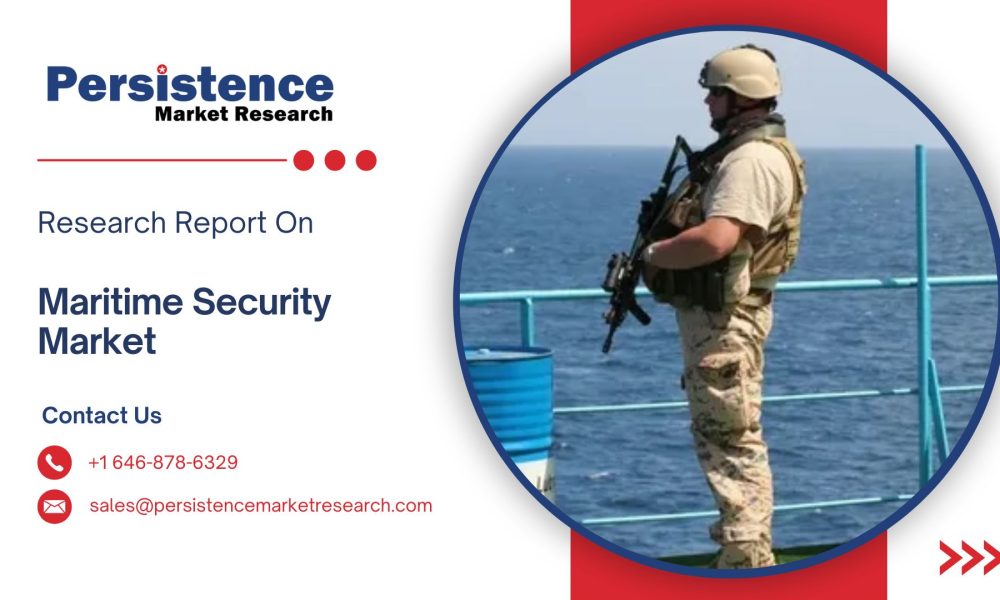
The global maritime security market is on a strong growth trajectory, projected to expand from a value of US$ 23.5 billion in 2025 to US$ 45.5 billion by 2032, reflecting a compound annual growth rate (CAGR) of 9.9% during the forecast period. This market plays a pivotal role in safeguarding international maritime trade, which, according to the United Nations Conference on Trade and Development (UNCTAD), accounts for over 80% of global trade by volume. As maritime transport remains the backbone of global commerce, ensuring the safety of ports, vessels, offshore infrastructure, and cargo has become a critical global priority.
The surge in maritime piracy, smuggling, illegal trafficking, and territorial disputes has prompted both governments and private operators to invest heavily in advanced maritime surveillance and protection systems. Additionally, geopolitical tensions, rising offshore oil and gas exploration, and the expansion of global trade routes—particularly across the Arctic and Indo-Pacific corridors—have amplified the demand for robust maritime security solutions. The integration of technologies such as artificial intelligence (AI), Internet of Things (IoT), and satellite-based monitoring systems is further fueling market expansion, enabling real-time intelligence and predictive threat analysis.
Request Sample Copy of Report: https://www.persistencemarketresearch.com/samples/3206
Segmentation Analysis
By Type
The maritime security market can be segmented by type into port and critical infrastructure security, vessel security, coastal surveillance, and maritime cybersecurity. Among these, coastal surveillance systems currently dominate the market, accounting for a significant share in 2025, due to the growing need for national border protection and the monitoring of exclusive economic zones (EEZs). Governments worldwide are deploying coastal radar systems, automatic identification systems (AIS), and long-range identification and tracking (LRIT) solutions to enhance maritime situational awareness.
However, the maritime cybersecurity segment is expected to record the fastest growth during the forecast period. The rapid digitalization of port operations, navigation systems, and logistics networks has exposed critical maritime assets to cyber threats. Consequently, ship operators and port authorities are prioritizing cybersecurity frameworks and adopting advanced software solutions to mitigate vulnerabilities in digital control systems. The growing adoption of integrated maritime domain awareness (MDA) platforms combining cyber and physical security functions underscores this segment’s potential.
By Product and Service Type
In terms of product and service offerings, the market includes surveillance and tracking systems, communication equipment, screening and scanning systems, access control, and risk management services. The surveillance and tracking systems segment holds the largest share, driven by increased investments in unmanned aerial vehicles (UAVs), autonomous surface vessels (ASVs), and satellite-based monitoring systems that provide enhanced visibility across maritime domains.
Meanwhile, risk management and consulting services are experiencing steady growth as maritime operators seek expert insights on threat assessments, compliance with international regulations, and the implementation of multi-layered defense strategies. Service providers are increasingly offering cloud-based security management platforms that integrate data from multiple sensors and devices, enabling faster decision-making and response coordination.
By Technology
Technological segmentation highlights the influence of AI, machine learning (ML), IoT, radar, sonar, and communication networks in modern maritime security. AI and ML are being utilized to analyze vast amounts of sensor data, detect anomalies, and predict potential security incidents before they occur. IoT-enabled devices and smart sensors provide continuous monitoring of ship parameters, cargo conditions, and perimeter security, ensuring proactive risk mitigation.
Furthermore, the advent of 5G communication technologies is revolutionizing maritime connectivity, facilitating real-time data transmission between offshore platforms, vessels, and command centers. This is enhancing the effectiveness of remote operations, surveillance, and emergency response, particularly in remote or high-risk maritime regions.
Regional Insights
North America
North America currently leads the global maritime security market, driven by substantial investments from the United States and Canada in advanced naval defense systems, coastal monitoring, and cybersecurity initiatives. The region’s strong defense infrastructure and extensive coastline necessitate comprehensive maritime domain awareness solutions. The U.S. Department of Homeland Security and the U.S. Navy are key proponents of maritime security modernization, integrating advanced technologies such as AI-enabled radar and autonomous patrol systems.
Europe
Europe represents another significant market, supported by strong regulatory frameworks, coordinated maritime safety policies, and the presence of major ports and shipping hubs. The European Union’s efforts to enhance maritime surveillance through the Common Information Sharing Environment (CISE) are fostering collaboration across member states. Countries such as the United Kingdom, France, Germany, and Norway are investing heavily in coastal surveillance and maritime cyber defense to protect their critical trade infrastructure and energy assets.
Asia-Pacific
The Asia-Pacific region is anticipated to emerge as the fastest-growing market during the forecast period. The region’s growth is underpinned by expanding naval modernization programs, the proliferation of cross-border maritime trade, and heightened territorial disputes in the South China Sea and the Indian Ocean. Nations such as China, India, Japan, and South Korea are increasing investments in maritime surveillance, port protection, and integrated command systems. The rapid expansion of regional trade routes and the establishment of new shipping corridors have intensified the need for enhanced maritime situational awareness across the region.
Middle East & Africa and Latin America
The Middle East & Africa region is witnessing rising demand for maritime security systems to safeguard offshore oil installations and critical trade chokepoints such as the Strait of Hormuz and the Red Sea. Similarly, Latin America is enhancing its maritime patrol and anti-piracy operations, particularly in regions prone to illicit trafficking and illegal fishing, such as the Caribbean and the Gulf of Mexico. Increasing regional cooperation and investments in maritime infrastructure are fostering steady growth in these emerging markets.
Request Customization of Report: https://www.persistencemarketresearch.com/request-customization/3206
Unique Features and Innovations in the Market
Modern maritime security solutions are increasingly defined by integration, automation, and intelligence. The fusion of satellite imagery, radar, sonar, and IoT sensor data into centralized platforms has revolutionized maritime domain awareness. AI-powered analytics now enable real-time threat detection, anomaly recognition, and predictive maintenance for maritime assets. These innovations are enhancing operational efficiency while minimizing human error.
The adoption of autonomous surveillance systems, including unmanned aerial and underwater vehicles, represents a significant technological milestone. These systems extend surveillance capabilities into remote or hazardous maritime zones, ensuring continuous monitoring without the need for constant human presence. Furthermore, the deployment of blockchain-based systems for cargo tracking and verification is improving transparency and reducing fraud in international shipping.
The integration of 5G and cloud-based command centers is another emerging trend, facilitating seamless communication between ships, ports, and authorities. These technologies enable faster decision-making during emergencies, such as piracy attacks or oil spills, and are crucial for managing complex maritime logistics networks.
Market Highlights
The primary drivers for adopting maritime security solutions include the rising incidence of piracy and terrorism, the need for regulatory compliance, and the demand for cost-effective security operations. Many countries are enforcing stricter maritime security protocols under international frameworks such as the International Ship and Port Facility Security (ISPS) Code and the Safety of Life at Sea (SOLAS) Convention, compelling both public and private stakeholders to invest in compliant security technologies.
Additionally, environmental and sustainability goals are influencing market trends. Modern systems are designed to reduce carbon emissions and optimize fuel consumption through AI-based route planning and predictive maintenance. Maritime security is thus becoming a cornerstone of sustainable maritime transport, balancing operational safety with environmental responsibility.
Key Players and Competitive Landscape
The maritime security market is characterized by a mix of global defense contractors, specialized technology providers, and cybersecurity firms. Leading players include BAE Systems, Thales Group, Saab AB, Raytheon Technologies, Northrop Grumman Corporation, Elbit Systems, and Honeywell International.
- BAE Systems continues to expand its maritime surveillance and threat detection portfolio, emphasizing AI-driven command and control systems for naval and commercial applications.
- Thales Group is investing in integrated maritime communication and radar technologies, with a strong focus on interoperability across defense and civilian networks.
- Saab AB has strengthened its position through innovations in coastal surveillance and autonomous systems, supported by its Sea Giraffe radar series and maritime traffic management solutions.
- Raytheon Technologies focuses on cybersecurity and missile defense integration for naval platforms, enhancing maritime defense readiness.
- Northrop Grumman is leveraging advanced sensor fusion and AI analytics to improve situational awareness across naval operations.
- Elbit Systems has broadened its market presence with multi-domain defense systems and smart surveillance technologies tailored for complex maritime environments.
- Honeywell International provides integrated port and cargo security systems, utilizing IoT and predictive analytics for improved asset monitoring and management.
Collaborative ventures between these companies and national governments are fueling innovation and ensuring the deployment of cutting-edge solutions across global maritime sectors.
For In-Depth Competitive Analysis, Buy Now: https://www.persistencemarketresearch.com/checkout/3206
Future Opportunities and Growth Prospects
The future of the maritime security market is poised for significant transformation, driven by the convergence of emerging technologies, evolving regulatory frameworks, and strategic geopolitical developments. As international trade volumes continue to grow, the need for robust and resilient maritime security systems will intensify. The integration of AI, quantum encryption, and advanced analytics will redefine threat intelligence and crisis management.
The growing importance of green shipping corridors, autonomous vessel navigation, and offshore renewable energy installations will introduce new dimensions of maritime risk, necessitating innovative security solutions. Moreover, as governments and private entities collaborate to build resilient maritime infrastructures, opportunities for technology providers, system integrators, and cybersecurity firms will expand across the value chain.
In conclusion, the global maritime security market is entering a new era of digital transformation and strategic expansion. With sustained investments, technological innovation, and cross-sector collaboration, the industry is well-positioned to ensure the safety, efficiency, and sustainability of global maritime operations through 2032 and beyond.




