
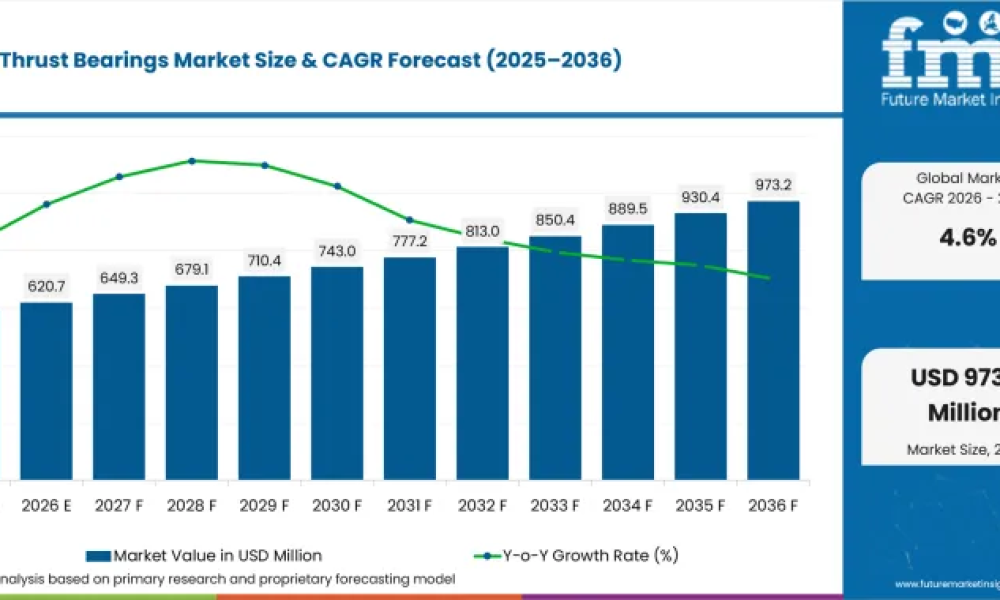
The global marine thrust bearings market is projected to expand from USD 620.7 million in 2026 to USD 973.2 million by 2036, advancing at a 4.6% CAGR during the forecast period. Demand is being supported by new vessel construction, repower programs, and propulsion-system modifications that require engineers to reassess axial-load transfer and shaftline performance.
Newbuild and repower projects can reopen thrust-bearing specifications when propulsion speed, shaft geometry, or propeller duty changes materially. The International Maritime Organization confirmed in October 2025 that adoption discussions for its Net-Zero Framework were adjourned for one year. Continued uncertainty around future fuel and machinery choices can affect newbuild design decisions and delay final shaftline specifications, including bearing selection.
Canada is projected to record stronger growth than Germany, with CAGRs of 5.9% and 4.6%, respectively. Canada’s Department of National Defence documented in April 2026 that Coast Guard recapitalization includes two polar icebreakers and up to sixteen multi-purpose icebreakers. This construction pipeline creates additional opportunities for bearing engineers to enter propulsion design programs during early specification stages.
What Are the Key Segments in the Marine Thrust Bearings Market?
- Hydrodynamic Thrust Bearings — 29.0% share: Hydrodynamic thrust bearings are projected to account for 29.0% share in 2026, supported by sustained axial-load duty in large marine rotating systems.
- Commercial Vessels — 30.0% share: Commercial vessels are estimated to hold 30.0% share in 2026 because high operating hours and costly propulsion downtime increase the importance of reliable thrust-bearing systems.
- Oil-Lubricated Designs — 46.0% share: Oil-lubricated designs are expected to lead material demand with 46.0% share in 2026, supported by established oil-film engineering practices in conventional shaftline systems.
- Shaftline Alignment Requirements: Alignment verification and class documentation influence bearing selection because replacement arrangements must preserve the accepted axial-load path.
- Propulsion System Integration: Bearings used within propulsion shafts, thrusters, gearbox assemblies, and auxiliary drives must be selected according to the applicable vessel load case and shaftline geometry.
Get detailed market forecasts, competitive benchmarking, and pricing trends:
https://www.futuremarketinsights.com/reports/sample/rep-gb-34926
How Is Propulsion Redesign Influencing the Marine Thrust Bearings Market?
Thrust bearings play an important role in transferring axial loads generated by marine propulsion systems. When a vessel undergoes repowering or receives a substantially different propulsion arrangement, the original bearing specification may no longer be sufficient for the revised operating conditions.
Changes in propulsion speed, propeller duty, shaft geometry, or drivetrain configuration can require engineers to revisit axial-load calculations. This creates design-entry opportunities for bearing manufacturers and propulsion-system suppliers during early engineering stages.
Newbuild programs can provide particularly valuable opportunities because bearing selection can be incorporated into the shaftline design before equipment is installed. Early involvement also allows suppliers to address alignment, lubrication, installation, and service requirements before the vessel reaches the final construction stage.
Which Countries Are Showing the Strongest Growth in Marine Thrust Bearings?
Canada is projected to record the highest CAGR among the profiled countries at 5.9% through 2036. Fleet renewal and Coast Guard recapitalization provide opportunities for marine bearing suppliers to participate in new propulsion-system specifications before construction.
Norway is expected to expand at a 5.6% CAGR. Its established maritime sector and vessel operating base support demand for propulsion components where reliability, shaftline alignment, and service availability influence purchasing decisions.
Australia is projected to grow at a 5.2% CAGR, supported by its maritime fleet and demand for propulsion and drivetrain components across commercial and specialized vessels.
Brazil is expected to record a 4.9% CAGR. Marine propulsion maintenance and vessel renewal activity provide opportunities for thrust-bearing suppliers serving shipyards, repair facilities, and propulsion-system channels.
Germany is projected to grow at a 4.6% CAGR. Its mature marine engineering ecosystem supports demand through existing fleet maintenance, overhaul, and propulsion-system refurbishment programs.
How Is Regional Demand Shaping the Marine Thrust Bearings Market?
Regional market performance depends on the balance between new vessel construction, fleet renewal, repowering, and maintenance activity. Markets with active fleet-renewal programs provide earlier opportunities for bearing manufacturers to participate in propulsion engineering and specification.
Mature maritime markets can generate consistent demand through repair and overhaul work. However, replacement bearing selection in existing vessels often has to work within established shaftline geometry, classification requirements, and fixed shipyard schedules.
What Is Changing the Competitive Landscape?
The competitive landscape includes Michell Bearings, Waukesha Bearings, Kingsbury, Inc., RENK Group AG, Thordon Bearings, Wärtsilä, The Timken Company, and Daido Metal Co., Ltd.
Competition is increasingly influenced by engineering support rather than bearing price alone. Suppliers must demonstrate that their products can accommodate the vessel’s load case, shaftline geometry, lubrication requirements, and alignment tolerances.
Newbuild programs provide opportunities for suppliers that can engage during propulsion-system design. Early specification involvement can allow manufacturers to influence bearing configuration before the shaftline is finalized.
Service capability also remains important in the aftermarket. Commercial vessels operate under demanding schedules, and bearing-related downtime can affect vessel availability. Suppliers with appropriate technical support can therefore differentiate their offerings through installation guidance, alignment verification, and service response.
What Does the Analyst Say About the Marine Thrust Bearings Market?
“Marine thrust-bearing selection should start with the vessel load case and shaftline geometry instead of catalog price. Commercial value depends on proving alignment tolerance and service response early enough to protect the confirmed installation window.”
— Nikhil Kaitwade, Principal Consultant, Future Market Insights
Drive Your Business Growth Strategy: Checkout the Report for Key Insights!
https://www.futuremarketinsights.com/checkout/34926
What Is Driving Demand for Marine Thrust Bearings?
Fleet Renewal Creates New Specification Opportunities
New vessel construction allows bearing suppliers to participate in propulsion-system engineering from an early stage. Fleet-renewal programs can therefore generate demand before vessels enter service.
Repower Programs Reopen Bearing Calculations
Repowering can alter propulsion speed, shaft geometry, or propeller duty. These changes can require engineers to recalculate axial-load requirements and reassess thrust-bearing specifications.
Commercial Vessel Downtime Raises Reliability Requirements
Commercial vessels often operate for long periods and depend on continuous propulsion availability. Bearing performance therefore becomes important where unplanned maintenance can disrupt vessel operations.
Shaftline Alignment Supports Technical Differentiation
Bearing arrangements must operate within appropriate alignment tolerances and preserve the intended axial-load path. Verification and documentation can become important parts of supplier qualification.
What Are the Key Challenges in the Marine Thrust Bearings Market?
One of the primary challenges is the technical complexity of bearing selection. Marine thrust bearings cannot be selected solely according to dimensions because axial loads, shaftline geometry, lubrication arrangements, alignment, and operating conditions all influence performance.
Replacement projects can also be constrained by existing vessel configurations. Engineers must often preserve established load paths while working within fixed installation windows and classification requirements.
Uncertainty around future propulsion technologies can create additional planning challenges for newbuild programs. Changes in fuel and machinery choices can affect propulsion architecture and, consequently, final shaftline and bearing specifications.
How Is the Marine Thrust Bearings Market Segmented?
The marine thrust bearings market is segmented by product type, boat type, material, sales channel, type, and region.
By Product Type: Hydrodynamic, rolling element, tilting pad, composite-lined, and integrated thrust blocks.
By Boat Type: Commercial vessels, workboats, fishing vessels, offshore support vessels, and yachts.
By Material: Oil lubricated, water lubricated, grease lubricated, and self-lubricating composite designs.
By Sales Channel: Propulsion OEMs, MRO or repair yards, shipyards, and bearing distributors.
By Type: Propulsion shafts, thrusters, gearbox assemblies, and auxiliary drives.
What Is the Marine Thrust Bearings Market Demand Outlook?
The marine thrust bearings market is expected to benefit from continued fleet renewal, propulsion upgrades, repower programs, and maintenance requirements across commercial and specialized vessels. Newbuild projects provide opportunities for early engineering involvement, while mature fleets sustain demand through overhaul and replacement activity.
Suppliers that demonstrate reliable alignment performance, appropriate axial-load handling, and responsive technical support can strengthen their position in both OEM and aftermarket channels. As propulsion architectures evolve, the ability to engage early in shaftline design can become an increasingly important source of competitive advantage.
About Future Market Insights
Future Market Insights (FMI) is a leading provider of market research and consulting services, offering syndicated and customized research across automotive, marine, energy, industrial, and other industries. FMI provides market forecasts, competitive intelligence, strategic analysis, and data-driven insights to support business decisions across global markets.



