
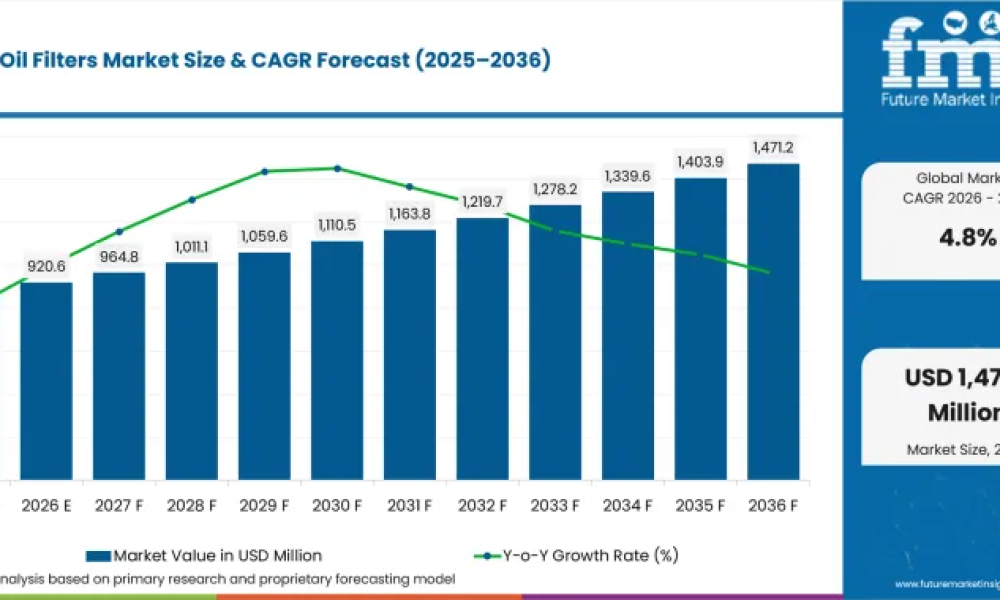
The global marine oil filters market is projected to expand from USD 920.6 million in 2026 to USD 1,471.2 million by 2036, advancing at a 4.8% CAGR between 2026 and 2036. Demand remains closely connected to marine engine maintenance because scheduled oil changes create recurring filtration requirements across eligible engines.
The installed vessel base provides an important foundation for replacement demand. The U.S. Coast Guard reported 10,852,992 mechanically propelled registered recreational vessels for 2024 in its June 2025 statistical release. This installed base keeps engine lubricants and filtration products connected to recurring service activity rather than depending exclusively on new vessel deliveries.
Marine oil filter purchasing is increasingly influenced by engine-specific fitment, operating conditions, and service availability. Filters that appear interchangeable may differ in thread dimensions, bypass settings, filtration characteristics, and pressure requirements. This makes application coverage and reliable inventory important considerations for distributors and marine service providers.
What Are the Key Segments in the Marine Oil Filters Market?
- Spin-on Oil Filters — 39.0% share: Spin-on oil filters are estimated to account for 39.0% of the market in 2026, supported by sealed construction and straightforward change-out procedures during routine engine servicing.
- Cellulose Media — 36.0% share: Cellulose media are expected to lead the media category with 36.0% share in 2026, supported by established pleating economics and widespread use in replacement filtration applications.
- Inboard Diesel — 31.0% share: Inboard diesel engines are projected to represent 31.0% share in 2026, reflecting recurring filtration requirements for engines operating under sustained loads.
- Engine-Specific Filtration: Marine filters require compatibility with individual engine lubrication circuits, making correct thread specifications, bypass settings, and filter dimensions important for replacement decisions.
- Recurring Replacement Demand: Oil filter purchases are tied to engine service intervals, creating recurring aftermarket opportunities across recreational vessels, workboats, and commercial fleets.
Get detailed market forecasts, competitive benchmarking, and pricing trends:
https://www.futuremarketinsights.com/reports/sample/rep-gb-34844
Which Countries Are Showing the Strongest Growth in Marine Oil Filters?
Finland is projected to record the highest growth among the profiled countries, expanding at a 6.1% CAGR through 2036. Demand is supported by maritime activity and vessel maintenance requirements across recreational and commercial applications. The country’s operating environment places importance on dependable filtration products that can support scheduled engine servicing and vessel availability.
Norway is expected to grow at a 5.8% CAGR, supported by its established maritime sector and continued utilization of commercial and recreational vessels. High vessel utilization can create recurring engine maintenance requirements, increasing the importance of dependable filter availability through marine distributors and service networks.
Brazil is projected to expand at a 5.4% CAGR. ANTAQ reported in February 2026 that Brazil’s waterborne transport sector moved 1.4 billion tonnes during 2025. While cargo throughput does not directly determine filter revenue, greater vessel activity can increase engine-hour exposure across commercial fleets and workboats, creating additional maintenance requirements.
Canada is expected to record a 5.1% CAGR. The country’s extensive waterways and broad recreational and commercial vessel base support recurring marine engine servicing. Filter suppliers with broad engine fitment coverage and distribution reach can benefit from maintenance demand spread across geographically diverse operating areas.
The United States is projected to grow at a 4.7% CAGR, the lowest among the profiled countries. Despite the comparatively slower growth rate, the country’s large installed recreational vessel base provides a substantial recurring replacement market. The high number of mechanically propelled registered recreational vessels supports ongoing demand for lubricants and compatible filtration products.
How Is Regional Demand Shaping the Marine Oil Filters Market?
Marine oil filter demand is closely connected to vessel utilization rather than new vessel production alone. Every eligible engine oil change can create a replacement filter requirement, giving the market a recurring aftermarket component.
This dynamic is particularly relevant in regions with large recreational vessel populations or high commercial vessel utilization. Distributors need to maintain sufficient product availability across engine applications because service operators typically require the correct filter during scheduled maintenance rather than at the point of initial vessel purchase.
Brazil demonstrates how vessel activity can influence the maintenance opportunity. The country’s 2025 waterborne transport volume of 1.4 billion tonnes indicates substantial activity across major port and commercial systems. Higher operating intensity can translate into more engine hours, although filter demand ultimately depends on engine type, service schedules, fleet composition, and maintenance practices.
What Is Changing the Competitive Landscape?
The competitive landscape includes MANN+HUMMEL, Atmus Filtration Technologies (Fleetguard), Parker Hannifin (Racor), MAHLE, Quicksilver / Mercury Marine, Yanmar, Volvo Penta, and Suzuki Marine. These companies compete through filtration performance, engine compatibility, product breadth, distribution coverage, and marine application expertise.
Engine-specific fitment is an important area of competition. Marine engines can require filters with different threads, dimensions, bypass-valve settings, and filtration characteristics. Suppliers therefore need broad application catalogs to serve mixed fleets and replacement markets.
Distribution proximity is also becoming important. Marine operators often work within defined service windows, and a missing filter can delay scheduled engine maintenance. Maintaining inventory near ports, marinas, service centers, and fleet operating areas can therefore strengthen aftermarket performance.
Filter construction and media selection provide another area of differentiation. Spin-on designs can simplify routine maintenance, while media characteristics influence filtration performance, pressure behavior, and operating suitability. Suppliers must balance filtration requirements with replacement economics.
What Is Driving Demand for Marine Oil Filters?
Scheduled Engine Maintenance Creates Recurring Demand
Marine oil filters occupy a recurring position in engine maintenance schedules. Unlike equipment purchased only when a vessel is delivered or upgraded, filters are replaced as part of routine lubrication-system servicing.
This creates a relatively predictable aftermarket demand cycle across vessels that accumulate sufficient engine hours or follow calendar-based maintenance programs.
Large Installed Vessel Bases Support Replacement Sales
The U.S. Coast Guard’s reported 10,852,992 mechanically propelled registered recreational vessels in 2024 demonstrates the scale of the installed recreational vessel base in the United States. Such installed equipment creates continuing demand for engine lubricants and compatible filters throughout the operating life of vessels.
The replacement opportunity can persist even when new vessel deliveries fluctuate because existing engines continue to require periodic servicing.
Commercial Vessel Utilization Increases Service Requirements
Commercial vessels and workboats can accumulate significant engine hours depending on their operating profile. Sustained engine operation increases the importance of scheduled oil and filter changes, particularly where vessel availability is directly connected to revenue generation.
Higher vessel utilization can therefore support recurring filter demand, provided distributors can maintain the required application coverage.
Engine-Specific Fitment Supports Premium Products
Marine oil filters cannot always be substituted solely on the basis of physical appearance. Thread specifications, bypass settings, pressure characteristics, dimensions, and filtration requirements can vary between engines.
This creates opportunities for suppliers with detailed application catalogs and accurate cross-reference information. Correct fitment reduces the risk of improper installation and helps service providers complete maintenance work efficiently.
What Are the Key Market Restraints?
One of the primary restraints is the complexity of engine-specific fitment. A filter that appears suitable may not meet the required lubrication-system specifications. Distributors therefore need accurate application information and broad inventory coverage, increasing catalog-management and stocking requirements.
Geographic dispersion can also create supply challenges. Marine vessels operate across ports, marinas, waterways, and remote coastal areas, making proximity to replacement inventory important. A service provider may face delays when the correct filter is unavailable locally.
Price sensitivity within routine maintenance can further influence purchasing decisions. Since oil filters are replaced frequently, fleet operators and recreational vessel owners may compare aftermarket alternatives closely, placing pressure on suppliers to demonstrate filtration performance and fitment reliability.
What Opportunities Exist for Marine Oil Filter Manufacturers?
The expansion of marine aftermarket servicing provides opportunities for manufacturers that can combine broad engine coverage with dependable distribution. Suppliers that maintain inventories near high-activity ports and marine service centers can reduce maintenance delays and improve customer retention.
Another opportunity lies in application-specific product development. Filters designed around particular marine engines, operating conditions, and maintenance intervals can provide clearer value than generic filtration products.
Digital fitment tools and cross-reference databases can also improve the replacement process. Accurate application lookup can help distributors and service providers identify the correct filter while reducing the risk of incorrect substitutions.
Drive Your Business Growth Strategy: Checkout the Report for Key Insights!
https://www.futuremarketinsights.com/checkout/34844
How Is the Marine Oil Filters Market Segmented?
The market is analyzed across filter type, media type, fuel type, sales channel, application, and region.
By Filter Type
Filter types include spin-on oil filters and other marine oil filter configurations. Spin-on filters lead with a projected 39.0% share in 2026, supported by sealed construction and efficient routine replacement.
By Media Type
The market includes filtration media categories such as cellulose media, with cellulose projected to lead at 36.0% share in 2026. Media selection influences filtration characteristics and replacement economics.
By Fuel Type
Fuel categories include inboard diesel and other marine engine configurations. Inboard diesel leads with a projected 31.0% share in 2026, supported by recurring filtration requirements in sustained-load marine applications.
By Sales Channel
Marine oil filters reach customers through marine service providers, distributors, engine-related channels, and aftermarket networks. Availability and application coverage remain important purchasing considerations.
By Application
Applications span recreational and commercial vessels, with filter replacement linked primarily to engine maintenance schedules and operating hours.
What Are the Drivers, Restraints and Opportunities in the Marine Oil Filters Market?
The marine oil filters market is fundamentally an aftermarket-driven business in which recurring engine servicing, application-specific fitment, and product availability determine replacement demand.
- Driver: Scheduled marine engine servicing creates recurring filter replacement requirements across recreational and commercial vessels.
- Restraint: Engine-specific threads, bypass settings, and lubrication requirements can limit direct substitution between filters.
- Opportunity: Strong application catalogs, local inventory, and digital fitment tools can help suppliers capture recurring replacement demand.
What Is the Marine Oil Filters Market Demand Outlook?
The marine oil filters market is expected to maintain steady expansion through 2036 as vessel owners continue to perform routine engine maintenance across recreational, workboat, and commercial fleets. The market’s 4.8% CAGR reflects the recurring nature of filtration purchases and the continuing operation of a large installed vessel base.
Replacement demand should remain less dependent on new vessel deliveries than many other marine equipment categories. Existing engines require regular oil servicing throughout their operating lives, creating a continuing aftermarket opportunity for filter manufacturers and distributors.
Service Intervals Remain Central to Demand
Oil filter replacement is closely linked to engine service intervals. As vessels accumulate engine hours, operators must maintain lubrication systems to protect engine performance and reliability. This recurring maintenance cycle supports predictable demand across suitable marine engines.
Distribution Can Determine Aftermarket Conversion
Marine operators frequently require replacement components within defined maintenance windows. Suppliers that maintain appropriate stock near ports, marinas, and service centers can convert regional vessel utilization into actual filter sales more effectively than suppliers relying on distant inventory.
Which Countries Are Growing Fastest in the Marine Oil Filters Market?
Finland is projected to lead the profiled countries with a 6.1% CAGR, followed by Norway at 5.8%, Brazil at 5.4%, Canada at 5.1%, and the United States at 4.7% through 2036. Finland and Norway benefit from established maritime activity and recurring vessel maintenance requirements. Brazil’s market is supported by substantial waterborne transport activity, while Canada’s demand reflects its broad marine operating base. The United States records the lowest CAGR among the profiled countries but retains a substantial recurring aftermarket opportunity because of its large installed recreational vessel population.
About Future Market Insights
Future Market Insights (FMI) is a leading provider of market research and consulting services, delivering data-driven insights, market forecasts, competitive intelligence, and strategic analysis across global industries. FMI supports manufacturers, investors, procurement leaders, and business decision-makers with research covering automotive, transportation, industrial automation, energy, maritime, and other technology-driven markets.



