
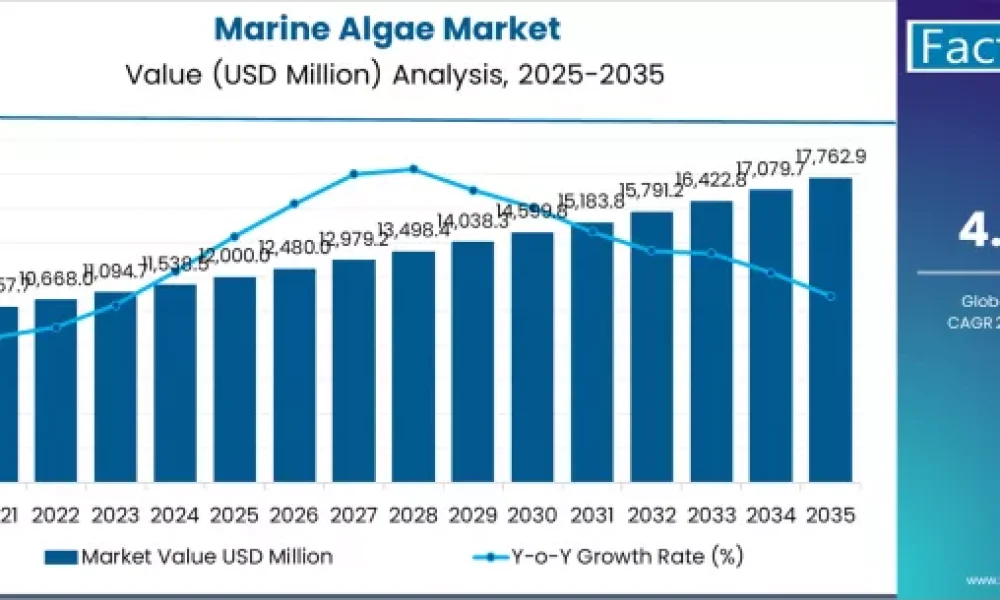
The global marine algae market is set to witness strong and sustained expansion between 2025 and 2035, driven by rising demand for natural ingredients, expanding applications across food, pharmaceuticals, cosmetics, and biofuel sectors, and increasing global focus on sustainable resource utilization. Marine algae—including red, green, and brown algae—play a crucial role in producing bioactive compounds, nutrients, hydrocolloids, and eco-friendly materials used across multiple industries.
This report explores the market size, growth drivers, regional dynamics (with emphasis on Europe and the U.S.), technological developments, challenges, and strategic implications for industry stakeholders.
To access the complete data tables and in-depth insights, request a Discount On The Report here:https://www.factmr.com/connectus/sample?flag=S&rep_id=8696
Market Size and Growth Projection
According to the latest analysis from Fact.MR, the global marine algae market is forecasted to grow from USD 12,000.0 million in 2025 to approximately USD 17,800.0 million by 2035, recording an absolute increase of USD 5,800.0 million during the assessment period.
This reflects a total growth of 48.3%, with the market projected to expand at a CAGR of 4.0% between 2025 and 2035.
This steady upward trajectory highlights the increasing reliance on marine algae as a sustainable source of nutrition, functional ingredients, and renewable biological materials.
Key Growth Drivers
- Rising Demand for Sustainable and Natural Ingredients
Consumers across Europe and the U.S. are shifting toward clean-label, plant-based, and natural products. Marine algae—rich in proteins, antioxidants, omega-3 fatty acids, and minerals—have become essential in food, nutraceutical, and cosmetic formulations.
- Expanding Applications Across Industries
Marine algae are now integral to:
- Functional foods and beverages
- Dietary supplements
- Pharmaceutical formulations (antiviral, antimicrobial, anti-inflammatory properties)
- Cosmetics and personal care
- Biofuel and biodegradable packaging innovations
Its versatility is a core driver of market expansion.
- Technological Advancements in Cultivation and Processing
Innovations such as photobioreactors, offshore cultivation systems, AI-linked biomass monitoring, and precision harvesting technologies are significantly improving algae yield, purity, and commercial scalability.
- Sustainability and Climate Commitments
Marine algae cultivation requires no freshwater, no farmland, and contributes to carbon sequestration, aligning with global decarbonization and resource-efficiency goals.
Europe and U.S. Market Insights
Europe
Europe continues to be a global leader in adopting marine algae solutions, supported by strong research ecosystems, clean-label preferences, and government backing for bio-based industries.
- France, Spain, Ireland, and Norway are significant producers.
- Algae-derived hydrocolloids (agar, alginate, carrageenan) dominate demand.
- Cosmetics and nutraceutical applications are expanding rapidly due to high demand for premium natural ingredients.
United States
The U.S. market is characterized by:
- Strong demand for algae-based nutraceuticals and alternative proteins
- Rapid development in algae-derived biofuels and bioplastics
- Expanding investments in marine biotechnology and synthetic biology
The U.S. food and beverage sector continues to incorporate algae-derived antioxidants, pigments, and emulsifiers.
Technology Trends and Competitive Landscape
The marine algae industry is witnessing significant transformation, driven by innovation in both cultivation and product development:
- Bioreactor-based algae farming for consistent, controlled biomass production
- AI-powered monitoring tools optimizing light, nutrients, and harvest cycles
- High-value extracts such as phycocyanin, fucoxanthin, and astaxanthin
- Algae-based packaging and biofilms replacing petroleum-derived plastics
- Customized algae strains engineered for higher nutritional or functional value
Competition involves global biotechnology firms, hydrocolloid manufacturers, specialty ingredient suppliers, and emerging clean-tech algae startups.
Challenges and Restraints
Despite its strong outlook, the marine algae market faces several challenges:
- High production and processing costs for certain high-value extracts
- Variability in yield due to climatic and environmental factors
- Fragmented regulatory environment for novel algae-based food and pharma ingredients
- Need for large-scale cultivation infrastructure to meet rising industrial demand
Addressing these constraints will be key to unlocking the full potential of algae-based value chains.
Strategic Implications for Stakeholders
For Manufacturers
- Invest in advanced cultivation systems, offshore farming, and scalable bioreactors
- Develop high-margin extracts and tailored ingredient solutions
- Strengthen sustainability positioning to meet regulatory and consumer expectations
For Food, Nutraceutical, and Cosmetic Companies
- Expand product portfolios with natural, algae-derived functional ingredients
- Leverage algae for clean-label, vegan, and fortified formulations
- Utilize algae-based pigments and antioxidants as natural replacements for synthetics
For Investors
- The market promises long-term growth, driven by sustainability mandates and expanding industrial applications
- High-potential areas include biofuels, bioplastics, nutraceuticals, and cosmeceuticals
Outlook Summary
Between 2025 and 2035, the global marine algae market is set to grow steadily, driven by a combination of sustainability imperatives, technological innovation, and rising consumer demand for natural and functional ingredients. Europe and the U.S. will continue to play pivotal roles in shaping market direction through research leadership, premium product development, and clean-label consumption trends.
Despite challenges associated with scaling production and navigating regulatory frameworks, the marine algae sector presents robust opportunities for biotechnology companies, ingredient manufacturers, food brands, and investors committed to advancing sustainable bio-based solutions.
Have a specific Requirements and Need Assistant on Report Pricing or Limited Budget please contact us – [email protected]
About Fact.MR
Fact.MR is a global market research and consulting firm, trusted by Fortune 500 companies and emerging businesses for reliable insights and strategic intelligence. With a presence across the U.S., UK, India, and Dubai, we deliver data-driven research and tailored consulting solutions across 30+ industries and 1,000+ markets. Backed by deep expertise and advanced analytics, Fact.MR helps organizations uncover opportunities, reduce risks, and make informed decisions for sustainable growth.



