
The long-acting drugs market has emerged as a critical pillar within the global pharmaceutical landscape, driven by the growing need to improve patient adherence, minimize dosing frequency, and enhance long-term treatment outcomes. Long-acting formulations are specifically designed to release active pharmaceutical ingredients steadily over extended periods, ranging from weeks to several months, thereby addressing one of healthcare’s most persistent challenges: poor compliance with daily or frequent dosing regimens. This advantage is particularly valuable in chronic and life-threatening conditions such as cancer, diabetes, cardiovascular diseases, psychiatric disorders, and infectious diseases like HIV, where treatment continuity directly influences outcomes. As healthcare systems worldwide shift toward patient-centric and value-based care models, long-acting therapies are increasingly viewed as essential tools for improving quality of life while reducing hospitalizations and overall healthcare costs.
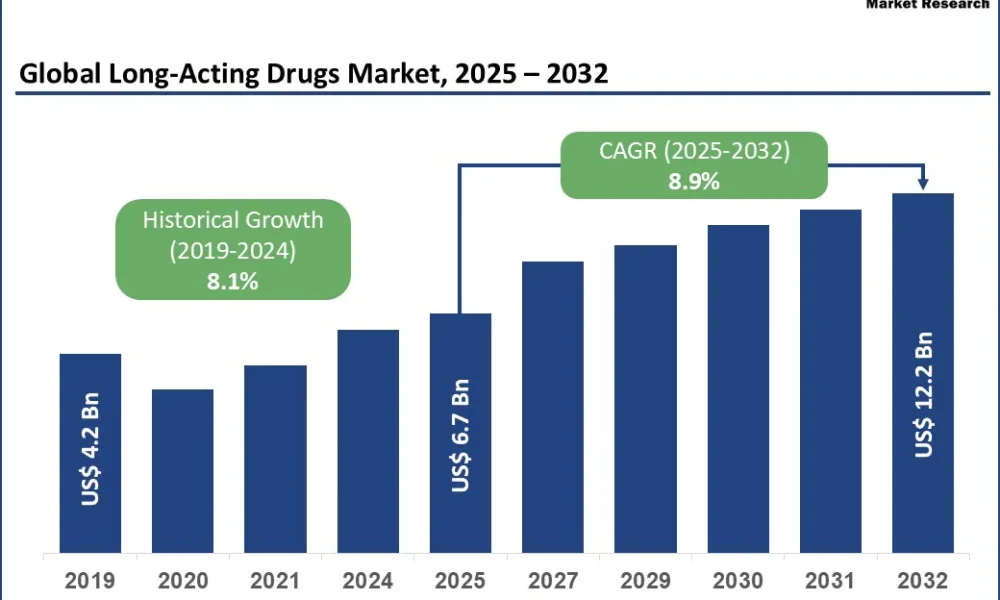
From a market perspective, the global long-acting drugs market is projected to reach approximately US$ 6.7 billion in 2025 and expand to nearly US$ 12.2 billion by 2032, registering a robust compound annual growth rate (CAGR) of 8.9% during the forecast period from 2025 to 2032. This growth is underpinned by several key drivers, including the rising prevalence of chronic diseases, advancements in sustained-release drug delivery technologies, and increasing regulatory approvals for extended-release formulations. Microsphere-based delivery systems currently dominate the market due to their ability to provide controlled and predictable drug release, while cancer has emerged as the leading therapeutic segment, accounting for more than 37% of total revenue. Geographically, North America leads the market with over 41% share, supported by advanced research infrastructure and favorable FDA approvals, while Asia Pacific is poised as the fastest-growing region due to expanding healthcare access, government initiatives, and a rapidly growing patient population.
Download Your Free Sample & Explore Key Insights: https://www.persistencemarketresearch.com/samples/34040
Key Highlights from the Long-Acting Drugs Market Report
• The global long-acting drugs market is projected to grow at a CAGR of 8.9% from 2025 to 2032, reflecting strong demand for sustained-release therapies.
• North America is expected to maintain market leadership with over 41% share in 2025 due to advanced healthcare infrastructure and regulatory support.
• Microsphere-based delivery systems dominate the market, capturing nearly 43.5% share owing to their versatility and controlled-release benefits.
• Cancer represents the leading therapeutic area, accounting for more than 37.7% of market revenue driven by high prevalence and long treatment durations.
• Asia Pacific is the fastest-growing region, fueled by rising chronic disease burden and expanding clinical trial activity.
• Innovation in polymer depots and long-acting injectables is significantly improving patient adherence and treatment outcomes across multiple indications.
Market Segmentation Analysis
The long-acting drugs market can be segmented based on delivery technology, therapeutic area, route of administration, and end-user. By delivery technology, microsphere-based systems represent the most prominent segment, as they utilize biodegradable polymers to encapsulate drugs and release them in a controlled manner over extended periods. These systems are widely used in oncology, hormonal therapies, central nervous system disorders, and infectious diseases, offering improved bioavailability, reduced side effects, and enhanced patient compliance. Other delivery technologies include polymer depots, liposomal formulations, in-situ forming gels, and implantable devices, each catering to specific clinical requirements and release profiles.
In terms of therapeutic area, cancer dominates the long-acting drugs market due to the chronic nature of oncology treatments and the need to reduce treatment burden for patients undergoing chemotherapy, targeted therapy, or supportive care. Psychiatric disorders such as schizophrenia and bipolar disorder also represent a significant segment, as long-acting injectables help maintain stable plasma drug levels and reduce relapse rates associated with non-adherence. Additionally, infectious diseases, particularly HIV, have witnessed growing adoption of long-acting formulations that reduce daily pill fatigue, while metabolic disorders such as diabetes and obesity are emerging as high-potential segments due to innovations in long-acting GLP-1 agonists and insulin analogs.
Regional Insights and Market Trends
North America continues to dominate the global long-acting drugs market, accounting for approximately 41.2% share in 2025. The region’s leadership is driven by high healthcare expenditure, a strong presence of major pharmaceutical companies, and a supportive regulatory environment that encourages innovation in extended-release formulations. The United States, in particular, faces a high prevalence of chronic diseases such as diabetes, schizophrenia, and HIV, creating sustained demand for long-acting therapies. Favorable reimbursement frameworks and rapid adoption of FDA-approved long-acting injectables further reinforce the region’s market dominance.
Europe holds a substantial share of the market, supported by an aging population, increasing chronic disease prevalence, and strong regulatory backing from the European Medicines Agency. The region has been proactive in approving innovative long-acting therapies for HIV, oncology, and central nervous system disorders, while funding initiatives such as Horizon Europe continue to support research into sustained-release technologies. Cross-border collaborations and streamlined clinical trial regulations have also enhanced Europe’s role as a hub for long-acting drug innovation.
Asia Pacific is emerging as the fastest-growing region in the long-acting drugs market, driven by expanding healthcare infrastructure, rising awareness of chronic disease management, and government initiatives to improve access to affordable therapies. Countries such as China, India, and South Korea are witnessing rapid growth in clinical trials and pharmaceutical manufacturing, while the increasing prevalence of diabetes, hypertension, and cancer is accelerating demand for long-acting treatments. Cost-effective production capabilities and large patient pools further position Asia Pacific as a key growth engine for the market.
Get Custom Insights Designed for Your Business: https://www.persistencemarketresearch.com/request-customization/34040
Market Drivers
The primary driver of the long-acting drugs market is the growing need to improve patient adherence and reduce the burden of frequent dosing, particularly in chronic and lifelong conditions. Technologies such as polymer depots and microsphere-based systems enable sustained and controlled drug release, ensuring stable plasma concentrations over extended periods. In central nervous system disorders and HIV, where adherence challenges are common, long-acting injectables have demonstrated significant reductions in relapse rates and improved clinical outcomes. Additionally, advancements in biodegradable polymers, customizable release profiles, and precision medicine approaches are expanding the application of long-acting formulations across multiple therapeutic areas, further driving market growth.
Market Restraints
Despite its strong growth potential, the long-acting drugs market faces notable challenges related to manufacturing complexity, sterility assurance, and suspension stability. Long-acting injectable formulations often require precise control over particle size, homogeneity, and release kinetics, making them more difficult and costly to manufacture than conventional drugs. Balancing sterility with physicochemical stability is particularly challenging, as terminal sterilization methods can compromise sensitive drug molecules, while aseptic processing increases operational costs and regulatory scrutiny. These technical and regulatory hurdles can delay product launches, increase development costs, and limit scalability, thereby restraining market growth.
Market Opportunities
Significant opportunities exist in the development of oral long-acting biologics and peptide-based therapies, particularly for metabolic disorders such as diabetes and obesity. Innovations in protective coatings, absorption enhancers, and controlled-release matrices are enabling oral delivery of peptides that were previously limited to injectables. Breakthrough examples such as oral semaglutide and emerging GLP-1 receptor agonists highlight the potential to combine long-acting efficacy with needle-free convenience. As patient preference increasingly shifts toward non-invasive and long-lasting treatments, these formulation advances present scalable commercial opportunities with strong adherence and market adoption potential.
Checkout Now & Download Complete Market Report: https://www.persistencemarketresearch.com/checkout/34040
Company Insights
Key Players Operating in the Long-Acting Drugs Market
• Janssen Pharmaceutica NV (Johnson & Johnson)
• Novartis AG
• Teva Pharmaceutical Industries Ltd
• ViiV Healthcare
• Alkermes
• Tolmar, Inc.
• Pacira Pharmaceuticals, Inc.
• Indivior PLC
• AstraZeneca
• Jazz Pharmaceuticals plc
• Ipsen Pharma
• Gilead Sciences, Inc.
• Organon USA Inc.
• Endo, Inc.
• Bristol-Myers Squibb Company
• Verity Pharmaceuticals, Inc.
Market Segmentation
By Delivery Technology
- Liposome-Based Systems
- Microsphere-Based Systems
- Polymer-Based Depots
- In-Situ Forming Gels
- Nanoparticle-based systems
By Route of Administration
- Injectable
- Implant
- Oral
By Therapeutic Area
- Cancer
- Central Nervous System (CNS) Disorders
- Hormone Disorders
- Infectious Diseases
- Pain Management
- Contraception
By Material Used
- Polymer
- Non-Polymer
By Distribution Channel
- Hospital Pharmacies
- Retail Pharmacies
- Online Pharmacies
- Specialty Clinics
By Region
- North America
- Europe
- East Asia
- South Asia & Oceania
- Latin America
- Middle East and Africa
Recent Market Developments
In July 2025, Novartis received FDA approval for Leqvio® (inclisiran) as a first-line monotherapy for LDL-C reduction, reinforcing its position as a pioneering long-acting siRNA therapy with twice-yearly dosing. In the same month, Pacira Pharmaceuticals entered a strategic co-promotion partnership with Johnson & Johnson MedTech for ZILRETTA®, an extended-release corticosteroid injection for knee osteoarthritis, significantly expanding patient access and strengthening its leadership in sustained-release, non-opioid pain management.
Conclusion
The global long-acting drugs market is poised for sustained expansion, driven by the convergence of rising chronic disease prevalence, patient-centric healthcare models, and continuous innovation in drug delivery technologies. With strong growth projections through 2032, the market reflects a clear shift toward therapies that prioritize convenience, adherence, and long-term outcomes. While manufacturing complexity and regulatory challenges remain, ongoing advancements in polymer science, oral biologics, and sustained-release systems are unlocking new opportunities across therapeutic areas and regions. As pharmaceutical companies, regulators, and healthcare providers continue to collaborate, long-acting drugs are set to play an increasingly vital role in shaping the future of chronic disease management worldwide.




