
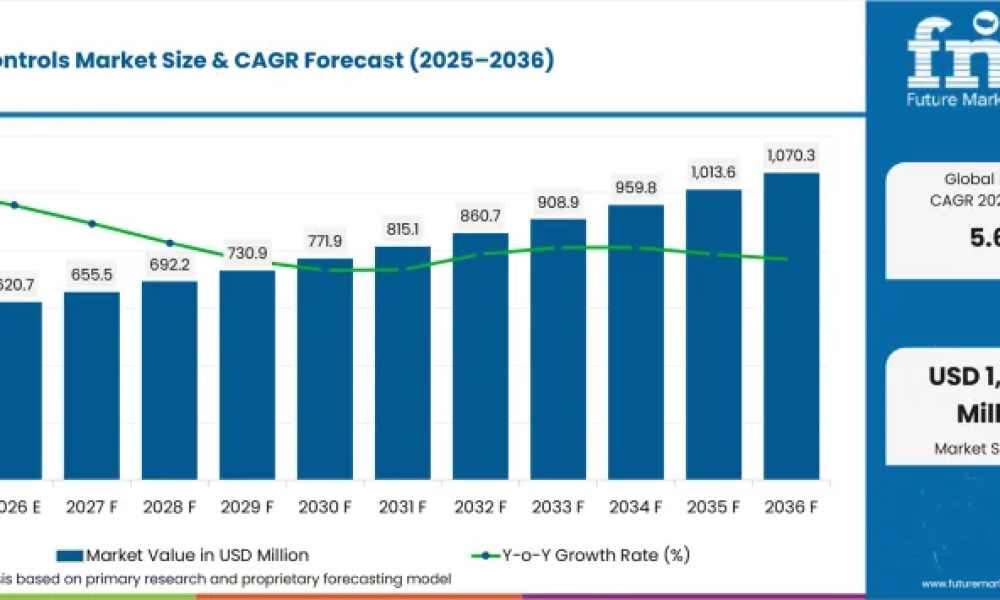
The global lift axle controls market is projected to grow from USD 620.7 million in 2026 to USD 1,070.3 million by 2036, advancing at a 5.6% CAGR from 2026 to 2036. Demand is being shaped by commercial vehicle operators seeking reliable axle-load management as trailers and vocational vehicles move between empty, partially loaded, and fully loaded operating conditions.
Air suspension systems remain the primary hardware base for lift valves operating through established pneumatic circuits in commercial trailers. As axle configuration and payload conditions change, lift axle controls help coordinate when auxiliary axles are raised or deployed, supporting vehicle operation within applicable load requirements.
Freight intensity continues to reinforce the relevance of axle-load management. Eurostat recorded 1,886 billion tonne-kilometres of EU road freight in 2025, demonstrating the scale of road-based freight activity across the region. High utilization of commercial trailers creates recurring requirements for suspension and axle-control components capable of operating through repeated lift and deployment cycles.
What Are the Key Segments in the Lift Axle Controls Market?
- Automatic Controls — 29.0% share: Automatic lift axle controls are projected to lead the control type segment in 2026 as defined load thresholds reduce dependence on driver judgement.
- Pneumatic Actuation — 43.0% share: Pneumatic systems account for the leading actuation share because they integrate directly with established commercial vehicle air suspension hardware.
- Trailers — 30.0% share: Trailers represent the leading vehicle-type segment as variable payloads create repeated requirements for auxiliary axle lifting and deployment.
- Suspension and Trailer OEM Channels: OEM-oriented supply remains important because lift axle controls must be matched with suspension geometry, axle configuration, and vehicle electronics during initial specification.
- Axle Lift and Lower Function: Lift and lower control remains central to the system because the function directly manages auxiliary axle deployment according to vehicle operating conditions.
Get detailed market forecasts, competitive benchmarking, and pricing trends:
https://www.futuremarketinsights.com/reports/sample/rep-gb-34946
Which Countries Are Showing the Strongest Growth in Lift Axle Controls?
Poland is projected to record the highest CAGR among the profiled countries at 6.3% through 2036. Market development is linked to commercial freight activity and the need for axle-load management across trailer and heavy vehicle applications. As fleets operate across varying payload conditions, reliable pneumatic and electronic lift control can support consistent axle deployment.
Mexico is expected to expand at a 5.8% CAGR, supported by cross-border truck activity and the increasing importance of commercial vehicle suspension systems. The country’s connection to North American freight corridors creates demand for components that can support repeated trailer utilization and varying operating loads.
The United States is projected to grow at a 5.1% CAGR. Applications span domestic trailer operations and vocational fleets, where suspension overhaul and axle-control requirements remain relevant across aging and actively utilized commercial vehicles.
Germany is expected to record a 4.9% CAGR, supported by its established commercial vehicle and freight transportation base. Vehicle manufacturers, trailer producers, and fleet operators require axle-control systems that can integrate with existing suspension and braking architectures while maintaining predictable operating behavior.
Japan is projected to expand at a 4.2% CAGR, representing the lowest growth rate among the profiled countries. Demand remains connected to commercial vehicle utilization and the need for dependable suspension control, particularly where packaging, calibration, and system compatibility influence component selection.
How Is Freight Activity Shaping the Lift Axle Controls Market?
Commercial freight patterns create different requirements for auxiliary axle systems from one market to another. Trailer operators may encounter varying payload profiles, road conditions, axle-load requirements, and vehicle configurations, making lift logic an important consideration during vehicle specification and maintenance.
Cross-border freight is particularly relevant to North American applications. The Bureau of Transportation Statistics reported in May 2026 that trucks carried 73.6% of United States-Mexico trade by value during 2025. The scale of truck-based trade reinforces the commercial importance of dependable lift axle control across fleets operating in demanding freight environments, although it does not imply identical adoption rates across the two countries.
What Is Changing the Competitive Landscape?
The competitive landscape includes SAF-HOLLAND SE, BPW Bergische Achsen KG, Haldex AB, ZF Friedrichshafen AG / WABCO, Hendrickson USA, L.L.C., Link Manufacturing, Ltd., JOST Werke SE, and Knorr-Bremse AG.
Competition is increasingly centered on the ability to integrate lift axle controls with existing commercial vehicle suspension architectures. Suppliers must address valve behavior, pressure thresholds, axle geometry, and electronic interfaces while maintaining serviceability for trailer and vocational vehicle operators.
Pneumatic actuation continues to hold a strong position because it can connect directly with established air suspension circuits. At the same time, electronic control approaches can support more defined calibration and integration with vehicle control systems, increasing the importance of compatibility between mechanical suspension components and electronic control logic.
Qualification requirements can also extend development cycles. Lift axle controls must work within local axle-load regulations while interacting with suspension, braking, and other vehicle electronics. This places greater emphasis on documented calibration, component fitment, diagnostics, and technician support.
What Does the Analyst Say About the Lift Axle Controls Market?
“Lift axle controls are expected to witness demand as engineers prove valve behavior against axle geometry, load thresholds and the vehicle electronics already specified. Commercial advantage comes from clear calibration records and technician support that restores lift logic without extending trailer or vocational-truck downtime.”
— Nikhil Kaitwade, Principal Consultant, Future Market Insights
What Is Driving Demand for Lift Axle Controls?
Variable Payloads Increase Axle-Control Requirements
Commercial trailers frequently operate across changing payload conditions. An auxiliary axle that is useful under heavy loads may not be required when a vehicle is empty or lightly loaded. Automated control systems can respond to defined thresholds, reducing reliance on manual decisions and supporting more consistent axle deployment.
Air Suspension Provides the Hardware Foundation
Lift axle valves operate within established pneumatic suspension architectures across commercial trailers. The continued use of air suspension creates an installed hardware base for lift-control solutions and allows suppliers to address replacement and retrofit demand alongside new vehicle programs.
Freight Utilization Supports Replacement Demand
High freight volumes increase the number of operating cycles experienced by suspension and axle-control components. Repeated lift, lower, loading, and unloading events can make durability and serviceability important purchasing considerations for fleet operators and maintenance providers.
Electronic Integration Is Raising Qualification Requirements
Modern commercial vehicles increasingly combine mechanical suspension systems with electronic controls. Lift axle systems therefore need to operate consistently with vehicle electronics, pressure sensing, braking systems, and other control functions. Calibration records and diagnostic support can help reduce downtime when systems require service.
What Are the Key Market Restraints?
One of the principal restraints is the complexity associated with integrating lift axle controls into different suspension and vehicle configurations. Axle geometry, pressure thresholds, vehicle electronics, and local load requirements can vary, limiting the extent to which one control configuration can be applied across multiple platforms without additional calibration.
Service and retrofit work can also become more difficult when replacement components must match existing pneumatic circuits and suspension layouts. Incorrect fitment or calibration can extend maintenance time, increasing the importance of accurate cross-referencing and technician support.
Drive Your Business Growth Strategy: Checkout the Report for Key Insights!
https://www.futuremarketinsights.com/checkout/34946
What Opportunities Exist for Lift Axle Controls Manufacturers?
The expansion of trailer and vocational vehicle fleets creates opportunities for suppliers that can combine control hardware with installation and calibration support. Products designed around clear pressure thresholds and documented vehicle compatibility can reduce integration work for OEMs and service providers.
Aftermarket opportunities are also supported by the need to maintain existing commercial vehicle suspension systems. Suppliers that provide replacement valves, sensing components, control modules, and technical documentation can support fleet operators seeking to restore lift functionality without extended vehicle downtime.
How Is the Lift Axle Controls Market Segmented?
The lift axle controls market is segmented by control type, actuation, vehicle type, sales channel, function, and region.
By Control Type
Control types include automatic controls, electronic control units, manual controls, pressure sensing controls, and integrated suspension control kits. Automatic controls lead with a projected 29.0% share in 2026.
By Actuation
Actuation includes pneumatic, electro-pneumatic, electronic valve manifold, and hydraulic systems. Pneumatic actuation is projected to account for 43.0% share in 2026, reflecting its compatibility with commercial vehicle air suspension.
By Vehicle Type
Vehicle types include trailers, heavy trucks, vocational trucks, refuse trucks, and concrete mixers. Trailers lead with an estimated 30.0% share in 2026, supported by variable payload conditions.
By Sales Channel
Sales channels include suspension OEMs, trailer OEMs, aftermarket retrofit, and fleet service channels. OEM channels remain important where axle-control systems are specified alongside suspension and vehicle platforms.
By Function
Functions include axle lift/lower, load sensing, pressure protection, and automatic compliance control. These functions collectively determine how auxiliary axles respond to payload and operating conditions.
What Are the Drivers, Restraints and Opportunities in the Lift Axle Controls Market?
The lift axle controls market is increasingly influenced by payload variability, pneumatic suspension integration, regulatory requirements, and the need to minimize commercial vehicle downtime.
- Driver: Variable freight loads increase demand for automated axle deployment and load-sensitive control.
- Restraint: Vehicle-specific geometry, pressure thresholds, and electronic integration can increase qualification and service complexity.
- Opportunity: Integrated control solutions with documented calibration and technician support can strengthen OEM and aftermarket positioning.
What Is the Lift Axle Controls Market Demand Outlook?
The market outlook remains closely connected to commercial trailer utilization and the continuing use of air suspension systems. As operators seek to manage axle loads across different freight conditions, lift and lower functionality remains a practical component of trailer and vocational vehicle configuration.
The next phase of market development is likely to place greater emphasis on control accuracy, electronic integration, service documentation, and compatibility with established suspension architectures. Suppliers that reduce calibration and installation complexity can improve their value proposition for both OEM and aftermarket customers.
How Fast Are Key Countries Growing in the Lift Axle Controls Market?
Poland is projected to lead the profiled countries with a 6.3% CAGR, followed by Mexico at 5.8%, the United States at 5.1%, Germany at 4.9%, and Japan at 4.2% through 2036. Differences in freight activity, trailer utilization, commercial vehicle configurations, and suspension-system requirements are expected to influence country-level demand.
About Future Market Insights
Future Market Insights (FMI) is a leading provider of market research and consulting services, delivering syndicated and customized research across automotive, industrial, energy, technology, and other global industries. FMI provides market forecasts, competitive intelligence, demand analysis, and strategic insights to support business and investment decisions.



