
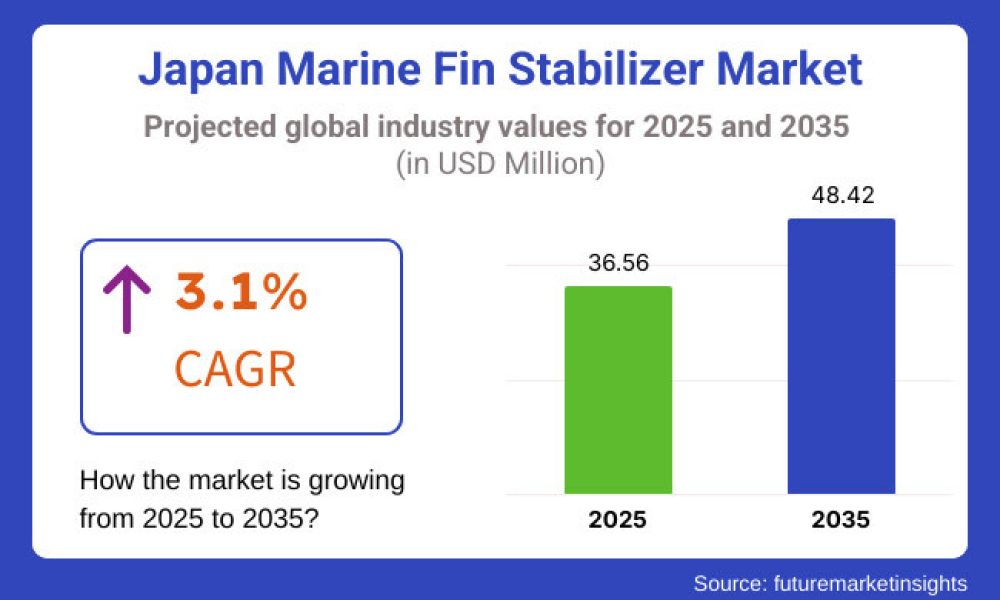
Japan’s marine fin stabilizer market is poised for steady growth, expanding from USD 36.56 million in 2025 to USD 48.42 million by 2035, reflecting a compound annual growth rate (CAGR) of 3.1%, according to Future Market Insights. This growth is propelled by Japan’s increasing focus on fuel-efficient, low-emission maritime technologies and the modernization of its shipbuilding sector to meet tightening environmental standards.
The market’s momentum is underpinned by a strong regulatory framework from Japan’s Ministry of Land, Infrastructure, Transport and Tourism (MLIT), which enforces carbon reduction and energy conservation laws aligned with IMO (International Maritime Organization) emission standards. This is driving widespread adoption of energy-efficient stabilizer systems across passenger ships, cruise liners, ferries, and naval vessels.
Sustainability and Efficiency at the Helm
Marine fin stabilizers play a critical role in ensuring smoother vessel operation, reducing roll, and improving onboard comfort while simultaneously enhancing fuel efficiency. The Japanese market has seen a significant transition toward smart, sensor-integrated stabilizers capable of real-time data monitoring and predictive maintenance.
In a 2025 industry survey by Future Market Insights, over 70% of shipowners and maritime technology experts emphasized sustainability and fuel efficiency as the top investment priorities. Respondents cited smart stabilization systems with predictive maintenance as key to reducing operational downtime and ensuring compliance with new IMO carbon intensity indicators.
Subscribe for Year-Round Insights → Stay ahead with quarterly and annual data updates
https://www.futuremarketinsights.com/reports/sample/rep-gb-18349
Furthermore, the cruise and luxury yacht sectors are driving premium demand for advanced stabilizers. Japan’s cruise shipbuilding segment — led by shipyards in Nagasaki, Kobe, and Yokohama — is expanding rapidly, with orders for next-generation vessels designed for passenger comfort and low emissions. As a result, stabilizers catering to the cruise segment are expected to grow at 8–10% annually over the next decade.
Technology and Innovation Anchoring Growth
Japanese companies are at the forefront of integrating AI and machine learning into marine fin stabilizers. Mitsubishi Heavy Industries (MHI) and Nabtesco Corporation are pioneering intelligent systems that predict wave patterns and automatically adjust fin angles, improving stability and reducing fuel use by up to 20%.
Meanwhile, Kawasaki Heavy Industries is advancing hybrid stabilizers compatible with electric propulsion systems, targeting LNG carriers and hybrid ferries under Japan’s Green Innovation Fund initiative. These technologies align with Japan’s national goal of achieving carbon neutrality by 2050.
In addition, Kongsberg Gruppen (Norway) and SKF Marine (Sweden) are collaborating with Japanese shipbuilders like Imabari Shipbuilding to develop high-performance stabilizers such as SKF’s “Blue Fin” system — purpose-built for Japanese LNG carriers and hybrid vessels.
Regional Insights: Shipbuilding Hubs Driving Demand
Kanto (Tokyo–Yokohama) remains the economic hub, with demand led by luxury yacht operators and passenger ferry services emphasizing fuel efficiency and low-emission operations.
Chubu (Nagoya region) continues to expand its shipbuilding and equipment manufacturing base, leveraging its strategic Pacific coast position to support exports.
Kinki (Osaka–Kobe) and Kyushu & Okinawa regions are emerging as innovation centers, focusing on sustainability-driven vessel retrofits and next-generation stabilizer systems for cargo and naval fleets.
Tohoku and other coastal regions are witnessing rising stabilizer adoption among small cargo and fishing vessels as operators aim to meet new energy-efficiency requirements.
Market Segmentation and Emerging Trends
By product type, retractable fin stabilizers are expected to dominate, accounting for nearly 65% market share by 2025, driven by their drag-reducing and fuel-saving capabilities. Non-retractable stabilizers will retain steady demand in commercial and fishing vessels due to their durability and lower cost.
By vessel type, passenger ships are projected to hold 76% of market share in 2025, reflecting Japan’s strong ferry and cruise operations. The retrofit segment is also gaining momentum as older fleets are upgraded to meet new emission standards, creating a retrofit market worth over USD 50 million over the next decade.
Competitive Landscape
| Company | Estimated Market Share | Key Focus |
|---|---|---|
| Mitsubishi Heavy Industries (MHI) | 25–30% | Advanced stabilizers integrated with AI and cyber-protected systems |
| Kawasaki Heavy Industries | 20–25% | Hybrid stabilizers for electric and LNG-powered vessels |
| Kongsberg Gruppen (Norway) | 15–20% | Smart stabilizer technologies and global collaborations |
| Nabtesco Corporation | 10–15% | Precision motion control and predictive maintenance integration |
| SKF Marine (Sweden) | 5–10% | High-performance stabilizers for LNG and cruise ships |
Japanese leaders such as MHI and Nabtesco are also ramping up local production to mitigate supply chain risks, while partnerships like MHI–Fujitsu are enhancing cybersecurity for networked stabilizer systems in smart shipping environments.
Buy Report Now – Click Here to Purchase the Report:
https://www.futuremarketinsights.com/checkout/18349
Macro Trends and Future Outlook
Between 2020 and 2024, Japan’s stabilizer market maintained steady growth, buoyed by demand for passenger comfort and fuel savings. From 2025 to 2035, growth will be defined by digitalization, sustainability, and hybrid propulsion integration.
The market will continue to evolve alongside major policy events, including Sea Japan Expo 2024 in Tokyo and the IMO MEPC 81 meetings, both of which influence emission compliance strategies and maritime technology standards.
Outlook: 2025–2035
As Japan advances toward a sustainable and digitally connected maritime future, the marine fin stabilizer market stands at the forefront of this transformation. With its projected value of USD 48.42 million by 2035, the market is poised to benefit from green policy incentives, rapid innovation, and the global shift toward smarter, cleaner, and more comfortable marine operations.
Have a specific Requirements and Need Assistant on Report Pricing or Limited Budget please contact us – [email protected]
About Future Market Insights (FMI)
Future Market Insights, Inc. (FMI) is an ESOMAR-certified, ISO 9001:2015 market research and consulting organization, trusted by Fortune 500 clients and global enterprises. With operations in the U.S., UK, India, and Dubai, FMI provides data-backed insights and strategic intelligence across 30+ industries and 1200 markets worldwide.



