
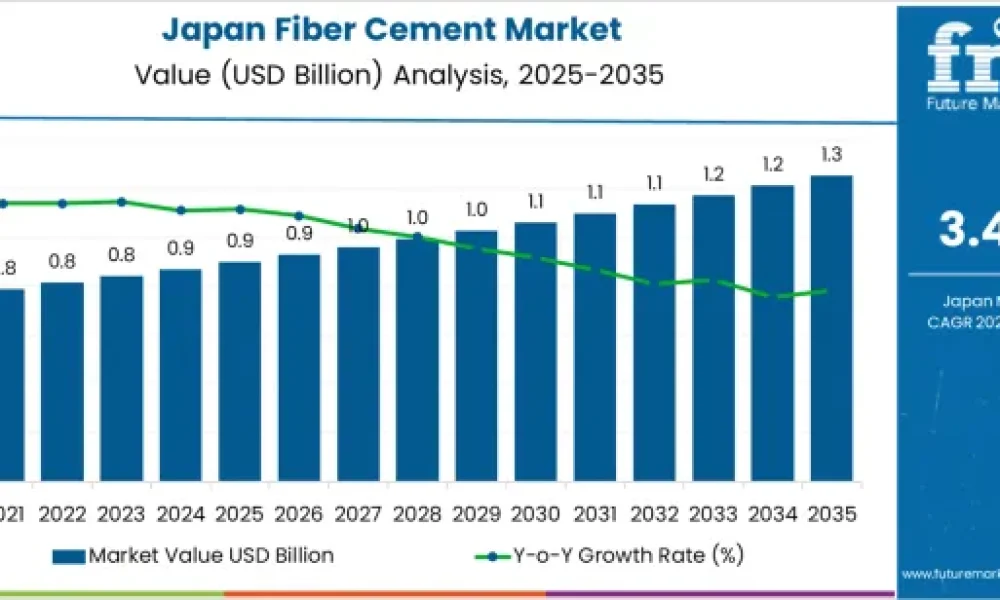
The Japan fiber cement market is on a sustained upward trajectory, projected to increase from an estimated USD 0.9 billion in 2025 to approximately USD 1.3 billion by 2035, reflecting a steady CAGR of about 3.4 percent over the assessment period. Growth is being fueled by nationwide urban renewal initiatives, increased remodeling of aging residential stock, and rising preference for resilient exterior materials that deliver long service life, fire resistance, and reduced maintenance costs in both residential and commercial applications.
Key Market Insights at a Glance
Fiber cement continues to gain traction as builders and developers prioritize materials engineered for seismic stability, moisture resistance, and performance under Japan’s varied climate conditions. Uptake is particularly strong in exterior cladding, façade systems, roofing, and interior partition boards, where fiber cement’s dimensional stability and lifecycle cost advantages support long-term asset value. The market’s forward momentum also reflects evolving building standards, retrofit investments for safety and resilience, and a shift toward sustainable construction materials with lower replacement frequency.
Segment Overview
Across product composition, Portland cement remains the dominant material input due to its structural reliability and compatibility with reinforcing fibers that enhance flexibility and weather tolerance. The integration of silica and cellulose fibers supports improved strength-to-weight balance and manufacturing consistency, enabling product formats tailored to renovation, prefabricated housing, and new construction projects.
By end use, the residential sector accounts for a leading share of consumption, driven by exterior siding upgrades, home remodeling cycles, and demand for modern aesthetic finishes that withstand environmental exposure. Non-residential applications — including commercial, institutional, and industrial buildings — are expanding as developers seek durable façade and roofing systems that minimize lifecycle maintenance and operational disruption.
Regional Overview
Regional growth dynamics indicate notable expansion across Kanto, Kinki, and Kyushu & Okinawa, supported by dense urban construction corridors and ongoing redevelopment programs. The Kanto region, anchored by Greater Tokyo, is characterized by sustained demand for high-performance siding and mid-rise building applications. Kyushu & Okinawa is emerging as one of the faster-growing markets through 2035, while Kinki continues to record stable adoption across residential refurbishment and public infrastructure renovation. Other regions, including Chubu and Tohoku, contribute steadily through localized housing renewal and essential structural maintenance demand.
To access the complete data tables and in-depth insights, request a sample report here
Competitive Landscape
Japan’s fiber cement market features a mix of established domestic manufacturers and global suppliers expanding their design and performance portfolios. Market participants are prioritizing innovation in fire-rated boards, lightweight siding solutions, and installation-efficient panel systems to support contractor productivity and architectural flexibility. Product differentiation increasingly centers on aesthetic versatility, surface finishing quality, and durability in high-humidity and coastal environments.
Market Outlook: Powering the Next Decade
Looking ahead, the market is expected to benefit from policy-aligned investments in resilient infrastructure, modernization of older housing, and accelerated adoption of modular and prefabricated construction methods. Rising labor costs and heightened focus on lifecycle value are reinforcing demand for materials with extended service life and minimal upkeep. The transition toward energy-efficient and disaster-ready building envelopes is anticipated to further strengthen fiber cement’s role as a preferred exterior solution across Japan’s urban and regional development pipeline.
Key Players of Sustainable Label Industry
Industry leaders are increasingly aligning product development with sustainability objectives, including exploration of lower-carbon cement blends, manufacturing efficiency improvements, and waste-reduction initiatives across production cycles. These efforts reflect a broader market commitment to delivering high-durability building materials while advancing environmental performance standards across the construction value chain.
Recent Strategic Developments
Recent strategic activity across the sector includes capacity expansion programs, distribution partnerships to enhance regional availability, and investment in automated production technologies to improve output precision and product uniformity. Companies are also intensifying collaboration with developers and design firms to co-engineer façade and siding systems optimized for seismic resilience, long-term weatherability, and architectural consistency in large-scale redevelopment projects.
As the Japan fiber cement market advances toward 2035, manufacturers, distributors, and construction stakeholders are well-positioned to leverage sustained demand for high-performance, low-maintenance building materials — supporting innovation, investment, and resilient growth across the nation’s built environment.
Have a specific Requirements and Need Assistant on Report Pricing or Limited Budget please contact us – [email protected]
About Future Market Insights (FMI)
Future Market Insights, Inc. (FMI) is an ESOMAR-certified, ISO 9001:2015 market research and consulting organization, trusted by Fortune 500 clients and global enterprises. With operations in the U.S., UK, India, and Dubai, FMI provides data-backed insights and strategic intelligence across 30+ industries and 1200 markets worldwide.
Why Choose FMI: https://www.futuremarketinsights.com/why-fmi



