
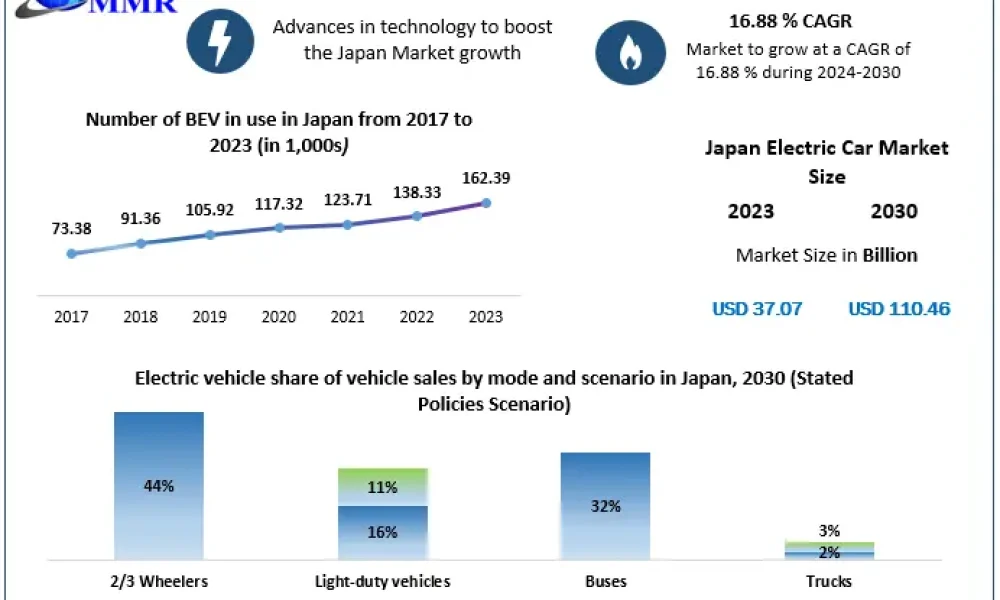
Japan Electric Car Market Overview:
Japan Electric Car Market valued at USD 43.22 billion in 2024, is projected to expand significantly, reaching USD 179.35 billion by 2033, at a compound annual growth rate (CAGR) of 17.2%. Fueled by supportive government policies, rising environmental awareness, urbanization, and continuous technological improvements in battery and vehicle design, Japan is rapidly advancing towards widespread electric vehicle (EV) adoption. The market landscape features dominant players such as Toyota, Nissan, Honda, Tesla, and BYD, with strong emphasis on mid-priced electric vehicles and kei EVs that cater to urban mobility needs.
Key Highlights & Insights
Market Size & Growth: Valued at USD 43.22 billion in 2024, expected to reach USD 179.35 billion by 2033, growing at a CAGR of 17.2%.
Dominating Region: The Kanto region leads with the highest market share due to favorable government incentives, well-established charging infrastructure, and high EV adoption levels.
Leading Segment: Mid-priced electric vehicles currently drive market revenue, supported by government incentives and consumer affordability.
Key Driver: Strong government commitment to carbon neutrality by 2050, incentives including subsidies and tax rebates, and increasing consumer preference for low-emission vehicles.
► Get a sample of the report:https://www.maximizemarketresearch.com/request-sample/64510/
Recent Developments
In 2024-2025, Nissan’s kei battery electric vehicles such as the Nissan Sakura have contributed significantly to market growth by appealing to city dwellers with affordability and compact design.
Toyota continues to expand hybrid and electric offerings while competing with foreign players like Tesla and BYD in the BEV segment.
The government has set ambitious targets for all new light-duty vehicle sales to be electric by 2035, with a CO2 emissions reduction target of 46% by 2030 relative to 2013 levels.
Charging infrastructure expansion and urban EV-friendly policies in metropolitan areas promote ease of EV use and ownership.
Market Dynamics
Growth Drivers:
Increased governmental support including subsidies, tax exemptions, and infrastructure investment.
Rising environmental awareness and consumer desire to reduce carbon footprint.
Technological advancements improving battery range, charging speed, and vehicle performance.
Growing urban population and mobility trends favoring compact EVs like kei cars.
Challenges:
Slow adoption in rural regions due to limited charging infrastructure.
Competitive presence of hybrid vehicles affecting pure BEV sales momentum.
Price sensitivity limiting high-end EV market penetration.
Regional Analysis
Kanto Region: Highest EV penetration supported by infrastructure and regulatory incentives.
Other Urban Centers: Increasing electric mobility adoption in Osaka, Nagoya, and emerging cities.
Rural and Regional Areas: Targeted infrastructure development required to enable wider EV uptake.
Product Segmentation
By Vehicle Type: Battery Electric Vehicles (BEVs), Hybrid Electric Vehicles (HEVs), Plug-in Hybrid Electric Vehicles (PHEVs), Fuel Cell Electric Vehicles (FCEVs).
By Price: Mid-priced EVs dominate due to affordability and government support.
By Size: Kei cars, compact cars, and passenger cars with expanding electric options.
Key Trends
Accelerated launch of affordable kei BEVs enhancing urban EV adoption.
Increasing availability of advanced battery technologies improving range and safety.
Growth of public and private investment in EV charging networks.
Rising collaboration between automakers and tech firms to develop smart, connected EVs.
Shift towards integrating hydrogen fuel cell vehicles as part of the zero-emission mobility portfolio.
FAQs
What is the expected market size of Japan’s electric car market by 2033?
USD 179.35 billion.
Which region dominates the market?
The Kanto region leads with the highest market share driven by infrastructure and incentives.
What vehicle segment drives growth?
Mid-priced and kei battery electric vehicles dominate in sales and adoption.
Who are the key players?
Toyota, Nissan, Honda, Tesla, BYD.
What are the main growth drivers?
Government incentives, technological advancements, consumer environmental awareness, urbanization.
Conclusion
Japan’s electric car market is on a steep growth trajectory due to supportive government policies, innovative automotive technologies, and changing consumer preferences favoring sustainable mobility. Key regions like Kanto are leading adoption backed by infrastructure and incentives. The expansion of affordable electric vehicle segments and advancements in charging technology will further unlock market potential. Stakeholders investing in innovative, cost-effective, and regionally tailored EV solutions stand to benefit tremendously as Japan progresses toward its carbon neutrality goals over the next decade.
◉ Get Market Research Latest Trends
♦ Business Processasaservice (BPaaS) Market
♦ Maximize Market Research is launching a subscription model for data and analysis in the MMR Statistics
Contact Maximize Market Research:
3rd Floor, Navale IT Park, Phase 2
Pune Bangalore Highway, Narhe,
Pune, Maharashtra 411041, India
[email protected]
+91 96071 95908, +91 9607365656
About Maximize Market Research:
Maximize Market Research is a multifaceted market research and consulting company with professionals from several industries. Some of the industries we cover include medical devices, pharmaceutical manufacturers, science and engineering, electronic components, industrial equipment, technology and communication, cars and automobiles, chemical products and substances, general merchandise, beverages, personal care, and automated systems. To mention a few, we provide market-verified industry estimations, technical trend analysis, crucial market research, strategic advice, competition analysis, production and demand analysis, and client impact studies.




