
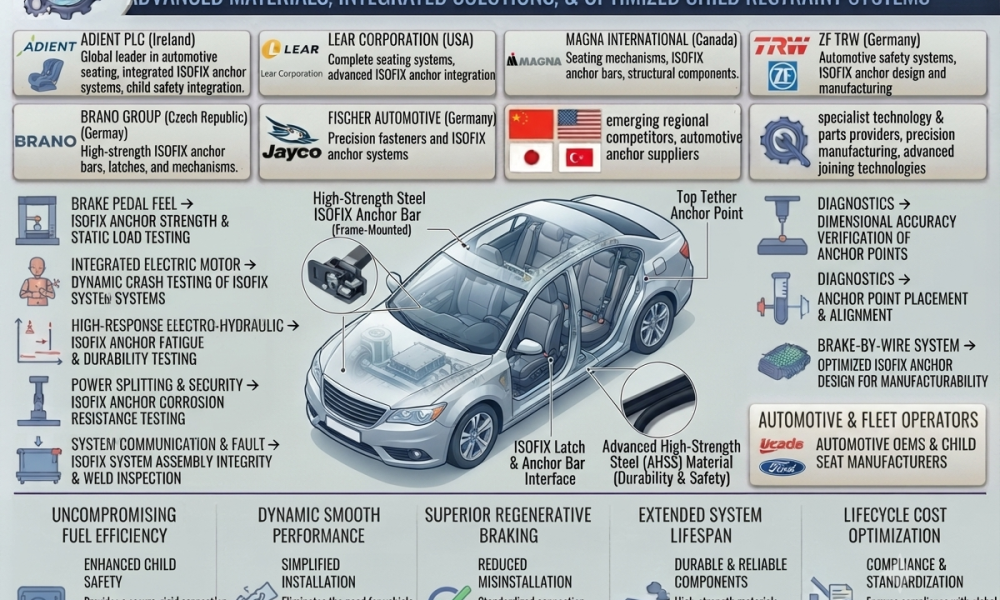
The global ISOFIX anchors market is projected to grow from USD 1.2 billion in 2026 to USD 2.1 billion by 2036, expanding at a 5.6% CAGR during the forecast period. Demand is supported by standardized child-restraint anchorage requirements, new-vehicle production, seat redesign cycles, and the need to integrate high-strength anchorage points into vehicle seat and body structures.
ISOFIX anchors are increasingly treated as structural safety components that require validation early in vehicle development. Anchor geometry, load performance, accessibility, and attachment to the seat or body structure can influence vehicle approval and seating design. This makes supplier qualification an important part of the vehicle program rather than a late-stage equipment decision.
Standardized child-restraint anchorage rules continue to connect ISOFIX demand with new-vehicle production. NHTSA’s FMVSS No. 225 establishes requirements covering the strength, location, and accessibility of lower anchor bars and top tether anchors. UN Regulation No. 145 addresses ISOFIX anchorage systems, ISOFIX top tether anchorages, and i-Size seating positions. These requirements reinforce the need for consistent structural performance and defined installation locations.
Accessibility remains important beyond regulatory compliance. Occupants must be able to identify and connect child-restraint hardware consistently, meaning trim interference, seat geometry, and anchor visibility can influence the practical performance of an ISOFIX system. Seat manufacturers and OEMs therefore need to consider anchorage access alongside structural strength during vehicle development.
What Are the Key Segments in the ISOFIX Anchors Market?
- Lower Anchor Brackets – 33.0% share: Lower anchor brackets are estimated to account for 33.0% of the market in 2026, reflecting their central role in standardized child-restraint attachment systems.
- Passenger Cars – 34.0% share: Passenger cars are projected to represent 34.0% of vehicle-type demand in 2026 as factory-installed child-restraint anchorages remain part of mainstream light-vehicle safety packages.
- High Strength Steel – 61.0% share: High strength steel is forecast to hold 61.0% share by material in 2026 because compact brackets require repeatable strength within welded seat and body structures.
- OEM Supply – 52.0% share: OEM supply is estimated at 52.0% in 2026, reflecting the importance of factory-installed anchorage systems and early vehicle-program validation.
- Factory Vehicle Seating – 43.0% share: Factory vehicle seating is projected to account for 43.0% of end-use demand in 2026, keeping ISOFIX integration closely connected with seat architecture and vehicle assembly.
- Integration Constraints: Anchor accessibility, trim interference, changing seat layouts, and structural packaging can restrict correct child-restraint installation even when basic load requirements are satisfied.
Get detailed market forecasts, competitive benchmarking, and pricing trends:
https://www.futuremarketinsights.com/reports/sample/rep-gb-34745
Which Countries Are Showing the Strongest Growth in the ISOFIX Anchors Market?
Mexico is projected to record the fastest growth among the profiled countries at 6.3% CAGR. Automotive manufacturing activity and integration of standardized safety systems into vehicle platforms support demand for qualified anchorage components. Suppliers that can meet OEM structural and fitment requirements can strengthen their position within vehicle seating programs.
Brazil is expected to expand at 5.9% CAGR. Demand is supported by vehicle production and safety-system integration, while manufacturers and seat suppliers need anchor systems that can be incorporated consistently into vehicle structures. High-strength materials and repeatable welding performance remain important considerations.
South Korea is projected to grow at 5.6% CAGR. Established automotive seating and vehicle manufacturing capabilities support demand for structurally validated child-restraint anchorage systems. Suppliers can benefit from early involvement in seat-frame development and platform qualification.
USA is forecast to register a 5.3% CAGR. Federal requirements covering anchor strength, location, and accessibility provide a defined framework for child-restraint anchorage. OEMs and seat suppliers must therefore maintain consistent structural performance and accessible installation points across vehicle programs.
Germany is expected to expand at 5.0% CAGR. Automotive manufacturers and seating suppliers place significant emphasis on structural validation, seat integration, and repeatable manufacturing. ISOFIX systems need to remain compatible with changing seat layouts while meeting applicable approval requirements.
France is projected to grow at 4.7% CAGR. Vehicle safety integration and standardized child-restraint systems continue to support demand. Suppliers with established seat-structure engineering capabilities can help reduce qualification complexity.
Japan is forecast to record a 4.4% CAGR. Mature automotive production and seating engineering practices support steady demand for validated anchorage systems. Consistent geometry, strength, accessibility, and integration with evolving seat architectures remain important purchasing factors.
How Is Regional Demand Shaping the ISOFIX Anchors Market?
Regional ISOFIX demand is closely connected to vehicle production, safety regulation, and seat redesign cycles. North American programs are influenced by federal requirements covering lower anchors and tether anchors, while European programs operate within UN regulatory frameworks covering ISOFIX and i-Size-related anchorage provisions.
Asian automotive markets combine high-volume vehicle manufacturing with continued development of standardized safety systems. South Korea and Japan emphasize manufacturing consistency and structural validation, while Mexico and Brazil provide additional opportunities through expanding vehicle production and localized assembly.
Across regions, the underlying procurement requirement remains similar: anchor systems must meet structural performance requirements while remaining accessible to occupants. This makes early collaboration between OEMs, seat suppliers, and anchorage manufacturers increasingly important.
What Is Changing the Competitive Landscape?
The ISOFIX anchors market includes automotive seating and vehicle-interior suppliers that participate through seat structures, anchorage hardware, and integrated seating systems. Adient plc, Lear Corporation, FORVIA SE, Toyota Boshoku Corporation, Magna International Inc., Brose Fahrzeugteile SE & Co. KG., TS TECH Co., Ltd., NHK SPRING CO., LTD., RECARO Automotive, and GRAMMER AG are among the companies participating through automotive seating, seat structures, or related integration routes.
Competition is increasingly focused on integration rather than anchor hardware alone. Suppliers must account for weld locations, seat-frame geometry, trim access, and child-restraint interface requirements during development.
High-strength steel remains important because anchorage brackets must deliver predictable load performance while fitting into compact seat and body structures. Manufacturing repeatability is therefore a key consideration when OEMs evaluate suppliers for high-volume vehicle programs.
The changing architecture of vehicle seats also creates additional engineering requirements. Seat layouts can evolve as OEMs introduce new interior configurations, electrified platforms, and flexible seating arrangements. Suppliers that can adapt anchorage geometry without compromising approval requirements can strengthen their position.
What Does the Analyst Say About the ISOFIX Anchors Market?
“ISOFIX anchor programs are decided at the interface between regulation and vehicle structure. Suppliers need to prove load performance, package access and repeatable geometry early in the seat or body design cycle because late changes can affect trim, welding and homologation within the same program.”
— Nikhil Kaitwade, Principal Consultant, Future Market Insights
What Is Driving Demand for ISOFIX Anchors?
Standardized Child-Restraint Requirements
Regulatory requirements create a consistent need for lower anchor bars and top tether systems on applicable vehicles. Compliance requirements make anchorage geometry, strength, location, and accessibility important engineering parameters.
New-Vehicle Production
Factory-installed ISOFIX systems connect demand directly with new vehicle production. Each new platform can require validated anchorage systems integrated into seats or body structures before production approval.
Seat Architecture Development
Changing seat layouts can affect anchor placement and accessibility. OEMs and seating suppliers therefore increasingly need to validate anchorage systems alongside seat-frame development rather than treating them as independent components.
Child-Restraint Accessibility
Structural compliance alone does not guarantee convenient installation. Anchor visibility, access, trim clearance, and consistent positioning influence whether occupants can connect child restraints correctly.
What Are the Key Market Restraints?
Platform-specific structural requirements can limit substitution because anchorage systems must align with approved seat or body structures. A change in bracket design can affect welding, trim, load paths, and homologation requirements.
Seat redesigns can also increase engineering and validation costs. As seating architectures evolve, previously approved anchor locations may require modification, creating additional testing requirements before production approval.
Accessibility presents another challenge. Even when an anchor meets structural requirements, trim interference or restricted access can make child-restraint installation more difficult and require design changes.
What Opportunities Exist for ISOFIX Anchor Manufacturers?
Suppliers can develop standardized anchorage components that accommodate multiple seat architectures while maintaining repeatable load performance. This can reduce engineering effort across vehicle programs and simplify sourcing.
There is also an opportunity to improve integration between anchorage hardware and seat structures. Suppliers that participate early in seat-frame development can help optimize bracket placement, welding, trim clearance, and occupant access.
High-strength steel solutions provide another opportunity for manufacturers seeking to reduce component size while maintaining required structural performance. Compact designs can support packaging flexibility within increasingly complex vehicle interiors.
Drive Your Business Growth Strategy: Checkout the Report for Key Insights!
https://www.futuremarketinsights.com/checkout/34745
How Is the ISOFIX Anchors Market Segmented?
The ISOFIX anchors market is segmented by anchor type, vehicle type, material, sales channel, end use, and region.
By Anchor Type: Lower anchor brackets, top tether anchors, integrated seat-frame anchors, retrofit anchor kits, and reinforced body-in-white anchor points.
By Vehicle Type: Passenger cars, SUVs/crossovers, MPVs, LCVs, and electric vehicles.
By Material: High strength steel, stainless steel, aluminum alloy, and composite reinforced brackets.
By Sales Channel: OEM supply, Tier-1 seat systems, aftermarket retrofit, and replacement/service parts.
By End Use: Factory vehicle seating, child safety seats, fleet/taxi retrofits, and specialty mobility vehicles.
By Region: North America, Latin America, Western Europe, Eastern Europe, South Asia and Pacific, East Asia, Central Asia and Russia, and Middle East and Africa.
Why Do Lower Anchor Brackets Lead the Anchor-Type Segment?
Lower anchor brackets are estimated to account for 33.0% share in 2026. Their position within standardized child-restraint attachment systems makes structural strength, geometry, and accessibility important considerations during seat and body development.
Why Do Passenger Cars Lead Vehicle-Type Demand?
Passenger cars are projected to represent 34.0% share in 2026. High passenger-vehicle production volumes create recurring opportunities for factory-installed child-restraint anchorage systems across new vehicle platforms.
Why Does High Strength Steel Dominate Material Demand?
High strength steel is forecast to hold 61.0% share in 2026. Its structural properties support compact anchorage brackets that can be integrated into welded seat and body structures while maintaining repeatable load performance.
What Are the Drivers, Restraints and Opportunities in the ISOFIX Anchors Market?
ISOFIX anchor demand is increasingly determined by the combination of regulatory compliance, structural integration, and practical child-restraint accessibility.
- Driver: Standardized child-restraint anchorage requirements connect ISOFIX demand with new vehicle production and seat redesign.
- Restraint: Structural packaging, trim interference, and homologation requirements can increase validation time and limit substitution.
- Opportunity: Early supplier integration into seat and body programs can improve geometry, accessibility, and manufacturing repeatability.
What Is the ISOFIX Anchors Market Demand Outlook?
The ISOFIX anchors market is expected to maintain steady growth as new-vehicle production and child-restraint safety requirements continue to support factory-installed anchorage systems. Passenger cars, lower anchor brackets, and high-strength steel are expected to remain important areas of demand.
The market will also benefit from recurring seat redesign and vehicle-platform development. As manufacturers introduce new seating configurations, anchorage systems must evolve without compromising approved load paths or occupant accessibility.
How Will Early Validation Influence Future ISOFIX Demand?
Early validation is likely to remain central to supplier selection because anchorage points interact directly with vehicle structures. Changes made late in the program can affect welding, trim, seat geometry, and homologation simultaneously.
Suppliers that support OEMs and Tier-1 seating companies during the early design stage can reduce these risks. Providing validated geometry and structural performance before final vehicle certification can strengthen long-term sourcing relationships.
Why Will Accessibility Remain Important Beyond Compliance?
Child-restraint anchorage must be usable as well as structurally compliant. Occupants need to locate and connect the hardware without excessive interference from seat trim or surrounding components.
This makes package access a continuing design consideration. Suppliers that combine reliable load performance with accessible anchor positioning can support both regulatory requirements and practical child-restraint installation.
How Fast Are Key Countries Growing in the ISOFIX Anchors Market?
Mexico is projected to lead country-level growth at 6.3% CAGR, followed by Brazil at 5.9%, South Korea at 5.6%, USA at 5.3%, Germany at 5.0%, France at 4.7%, and Japan at 4.4% CAGR through 2036.
About Future Market Insights
Future Market Insights (FMI) is a global market intelligence and consulting firm serving organizations across multiple industries with research, strategic analysis, and actionable insights. FMI’s research supports business leaders, investors, and decision-makers in evaluating market opportunities, competitive positioning, emerging trends, and long-term industry developments.



