
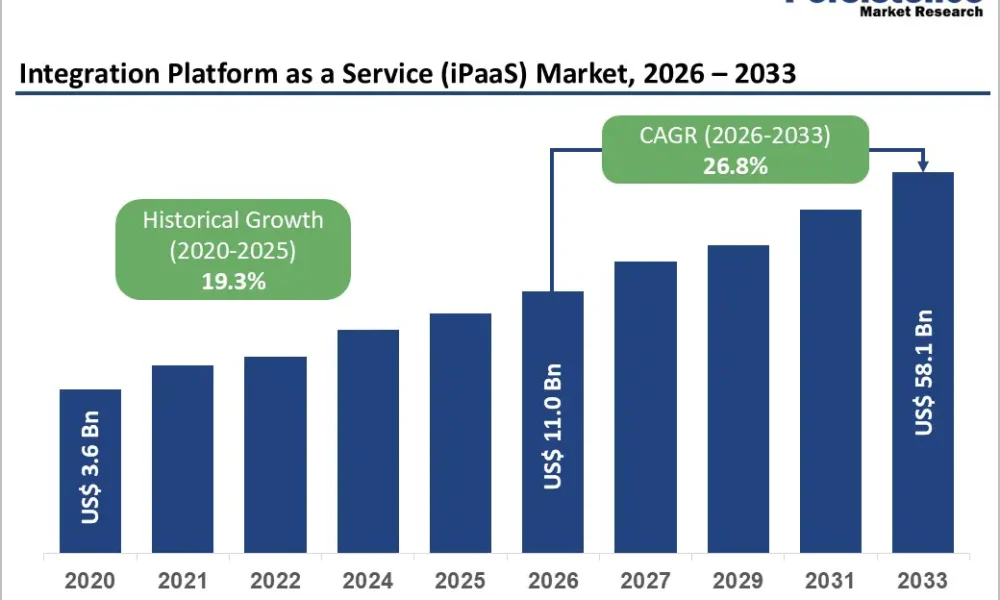
The global Integration Platform as a Service (iPaaS) market is experiencing explosive growth as enterprises accelerate digital transformation initiatives. Valued at US$11.0 billion in 2026, the market is projected to reach US$58.1 billion by 2033, expanding at an impressive CAGR of 26.8%.
This rapid expansion reflects a fundamental shift in how organizations manage data, applications, and workflows. As enterprises move toward cloud-native architectures, microservices, and API-driven ecosystems, iPaaS has emerged as a critical enabler of seamless connectivity across increasingly complex IT environments.
Market Overview
The iPaaS market sits at the intersection of cloud computing, enterprise software, and data integration. It provides a unified platform that connects applications, data sources, and processes across on-premises and cloud environments.
Key market metrics include:
- Market Size (2026): US$11.0 billion
- Forecast Value (2033): US$58.1 billion
- CAGR (2026–2033): 26.8%
- Historical CAGR (2020–2025): 19.3%
The surge in demand is driven by the need to modernize legacy systems, enable real-time data exchange, and support hybrid and multi-cloud strategies. With 85% of financial institutions already operating in hybrid environments, integration has become a strategic necessity rather than a technical option.
Key Growth Drivers
Accelerated Digital Transformation and Legacy Modernization
Enterprises worldwide are burdened by legacy IT systems that are costly to maintain and difficult to integrate. Nearly two-thirds of organizations spend over US$2 million annually on maintaining outdated infrastructure.
iPaaS solutions address this challenge by providing a scalable integration layer that connects legacy systems with modern cloud applications. This allows organizations to transition gradually to cloud-native architectures without disrupting existing operations.
By reducing integration timelines from months to weeks, iPaaS significantly enhances agility and operational efficiency, making it a cornerstone of digital transformation strategies.
Rise of Hybrid and Multi-Cloud Architectures
Modern enterprises operate in complex environments that span multiple cloud providers and on-premises systems. This shift toward hybrid and multi-cloud architectures is driven by the need for flexibility, resilience, and cost optimization.
iPaaS platforms enable seamless integration across diverse environments, including public clouds like AWS, Microsoft Azure, and Google Cloud, as well as private infrastructure.
These platforms provide centralized governance, security, and monitoring, ensuring consistent performance and compliance across distributed systems. As multi-cloud adoption continues to rise, the demand for iPaaS solutions will grow in parallel.
Demand for Real-Time and Event-Driven Integration
In today’s fast-paced digital economy, real-time data is essential for decision-making and operational efficiency. Businesses require instant access to synchronized data across applications, devices, and systems.
iPaaS platforms are evolving to support event-driven architectures, enabling real-time data flows and automated responses to business events. Organizations leveraging these capabilities report:
- 56% application integration usage
- 48% data sharing across systems
- 45% IoT connectivity
This shift toward real-time integration is particularly critical in industries such as healthcare, finance, and manufacturing, where delays can have significant operational and financial consequences.
Market Challenges
Implementation Complexity and High Project Risk
Despite its advantages, iPaaS adoption is not without challenges. Integration projects can be complex, particularly in organizations with legacy systems that lack standardized APIs.
Implementation timelines often range from 6 to 12 months, especially in industries with stringent regulatory requirements and complex data formats. These challenges can lead to cost overruns and delayed ROI.
Organizations must invest in skilled IT professionals and adopt structured implementation strategies to mitigate these risks.
Data Security and Compliance Concerns
As iPaaS platforms handle sensitive data across multiple environments, security and compliance become critical concerns. Enterprises must ensure that integration processes adhere to regulatory frameworks such as GDPR, HIPAA, and DORA.
Failure to comply can result in significant financial and reputational damage, making security a top priority for iPaaS vendors and users alike.
Emerging Opportunities
Healthcare and Life Sciences Transformation
The healthcare sector represents one of the most promising growth opportunities for the iPaaS market. With increasing regulatory requirements for interoperability and the rise of data-driven healthcare, integration has become essential.
Healthcare organizations face significant inefficiencies, with integration-related issues costing approximately US$300 billion annually. iPaaS solutions can address these challenges by enabling seamless data exchange across electronic health records, payer systems, and clinical applications.
Advanced platforms also support AI-driven analytics, enabling predictive modeling and improved patient outcomes.
Financial Services and Real-Time Payments
The BFSI sector remains the largest consumer of iPaaS solutions, accounting for 24% of the market. The rise of digital banking, fintech innovation, and real-time payment systems is driving demand for advanced integration capabilities.
iPaaS enables financial institutions to modernize legacy systems, enhance customer experiences, and accelerate product innovation. It also supports regulatory compliance and risk management, making it indispensable in the financial sector.
Expansion of API-Driven Ecosystems
APIs are the backbone of modern digital ecosystems, enabling seamless communication between applications and services. iPaaS platforms provide robust API management capabilities, allowing organizations to build scalable and flexible integration architectures.
As businesses increasingly adopt API-first strategies, the demand for iPaaS solutions will continue to grow.
Category-Wise Analysis
By Service Type
Application Integration: Dominant Segment
Application integration holds approximately 27% market share, making it the largest segment in the iPaaS market. It enables seamless connectivity between enterprise systems such as ERP, CRM, and supply chain platforms.
Organizations adopting application integration report up to 30% cost reductions and improved operational efficiency, highlighting its critical role in enterprise IT strategies.
Real-Time and Event-Driven Integration: Fastest Growing
This segment is experiencing rapid growth due to the increasing demand for real-time data processing and responsiveness. Event-driven architectures enable businesses to react instantly to changes, improving agility and competitiveness.
By End-Use Industry
BFSI: Largest Market Segment
The BFSI sector dominates the iPaaS market, driven by its reliance on complex, interconnected systems. Integration platforms support critical functions such as:
- Payment processing
- Regulatory reporting
- Risk management
- Customer data synchronization
The sector’s scale and complexity make it a key driver of market growth.
Healthcare and Life Sciences: Fastest Growing Segment
Healthcare is emerging as the fastest-growing vertical due to increasing demand for interoperability and data integration. iPaaS solutions enable healthcare providers to streamline operations, reduce costs, and improve patient care.
Elevate your business strategy with comprehensive market data. Request a sample report now: https://www.persistencemarketresearch.com/samples/13141
Regional Insights
North America: Market Leader
North America holds approximately 38% of the global market, making it the largest regional segment. The region benefits from:
- Advanced cloud infrastructure
- High digital transformation spending
- Strong presence of leading iPaaS vendors
Enterprises in the U.S. and Canada are early adopters of cloud technologies, driving sustained demand for integration platforms.
East Asia: Fastest Growing Region
East Asia accounts for around 16% market share and is the fastest-growing region. Rapid cloud adoption, digital transformation, and Industry 4.0 initiatives are fueling demand for iPaaS solutions.
Countries like China and India are witnessing significant growth in sectors such as manufacturing and financial services, further boosting market expansion.
Europe: Strong Regulatory-Driven Growth
Europe holds approximately 26% of the market, driven by stringent regulatory requirements such as GDPR and DORA. These regulations necessitate robust integration and data governance capabilities.
The region’s strong financial services sector also contributes significantly to iPaaS adoption.
Competitive Landscape
The iPaaS market is characterized by a mix of consolidation and fragmentation. Leading players dominate the enterprise segment, while smaller vendors focus on niche markets.
Major companies include:
- Informatica
- Boomi
- SAP
- Oracle
- Salesforce (MuleSoft)
- IBM
- Microsoft
These companies invest heavily in AI-driven automation, API management, and real-time integration capabilities to maintain competitive advantage.
At the same time, agile vendors like Workato, SnapLogic, and Zapier compete on flexibility, usability, and pricing, driving innovation across the market.
Key Industry Developments
Recent developments highlight the rapid evolution of the iPaaS market:
- Leading vendors are being recognized for innovation and execution in industry benchmarks.
- New AI-powered features are simplifying integration processes and enhancing efficiency.
- Platforms are expanding capabilities to support unified data, applications, APIs, and AI agents.
These advancements are shaping the future of integration technology and strengthening the value proposition of iPaaS solutions.
Future Outlook
The iPaaS market is poised for sustained growth as enterprises continue to embrace digital transformation. Key trends shaping the future include:
- Increased adoption of AI-powered integration platforms
- Expansion of low-code/no-code development capabilities
- Growing importance of real-time and event-driven architectures
- Integration of IoT and edge computing environments
As organizations strive to become more agile, data-driven, and customer-centric, iPaaS will play a pivotal role in enabling seamless connectivity and innovation.
Conclusion
The Integration Platform as a Service (iPaaS) market is entering a phase of exponential growth, driven by the convergence of cloud computing, data integration, and digital transformation.
With a projected value of US$58.1 billion by 2033, the market offers significant opportunities for businesses, technology providers, and investors. While challenges such as implementation complexity and regulatory compliance persist, the benefits of iPaaS far outweigh the risks.
As enterprises navigate increasingly complex IT landscapes, iPaaS will remain a foundational technology, enabling them to unlock the full potential of their digital ecosystems and maintain a competitive edge in the global marketplace.
Related Reports:




