
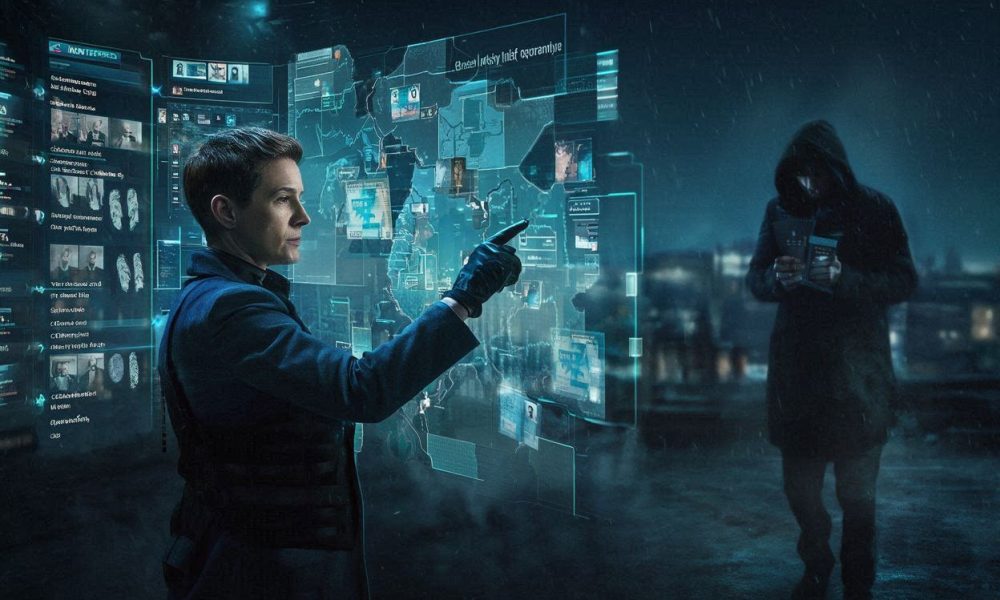
The man with a thousand faces meets his match in biometric border tech
WASHINGTON, DC, April 25, 2026, Viktor Sokolov, presented here as a fictionalized composite case study based on modern identity-fraud tactics, represents the new kind of international fugitive whose greatest weapon was never violence but the ability to cross borders under carefully manufactured names.
For years, the so-called Ghost of Prague survived inside the shadows of Europe’s fragmented identity economy, allegedly using forged passports, synthetic records, rented addresses, nominee accounts, and stolen personal details to stay ahead of investigators.
His method reflected a growing law-enforcement problem because the most sophisticated identity criminals do not simply invent fake names but build complete identity ecosystems that can withstand superficial inspection.
That playbook is now facing its strongest challenge yet, because biometric border systems are designed to connect the human body to a permanent digital record that aliases cannot easily escape.
Europe’s Entry/Exit System, described in recent international coverage of the biometric border rollout, has changed the fugitive equation by linking passport data, facial images, fingerprints, entry records, exit records, and refusal decisions.
The Ghost of Prague survived because documents moved faster than investigators
Sokolov’s fictional identity empire began with a simple insight, because passports, residence cards, utility bills, company filings, and bank records often moved through separate systems that did not always speak to each other.
A forged passport could open one door, a nominee company could open another, and a rented apartment under an alias could provide the residential footprint needed to support additional paperwork.
With each successful transaction, the false identity became more believable, because every new record appeared to confirm the last one inside an expanding circle of administrative trust.
That is how sophisticated identity thieves build credibility: not through a single perfect document, but through a chain of records that make the fake person appear increasingly real.
Sokolov’s advantage came from understanding that border officers, banks, landlords, online platforms, and local agencies often ask different questions at different points in the identity lifecycle.
When one alias became risky, he could abandon it, activate another, and continue moving through the administrative fog that surrounds fragmented cross-border verification.
Forged passports were once powerful because they exploited human pressure
A busy border desk is one of the most difficult places to detect carefully prepared identity fraud, because officers must balance security, processing speed, passenger volume, and limited inspection time.
A high-quality forged passport could give a fugitive enough confidence to pass through an airport, board a train, rent a vehicle, or reach another jurisdiction before questions emerged.
The document did not need to survive forever because it only needed to work long enough for the person using it to change location, discard the identity, and begin again.
This is why the forged passport became the classic tool of the fugitive economy, especially for criminals who needed mobility more than long-term security of citizenship.
Sokolov’s rotating portfolio of documents supposedly gave him precisely that advantage, allowing him to move through Eastern Europe while staying one step ahead of alerts tied to older aliases.
Yet that advantage depends on a border system that treats the passport as the central identity object, rather than treating the person’s biometrics as the anchor point.
Biometric borders attack the central weakness of the alias economy
The alias economy works because names can change, documents can be forged, companies can be created, and addresses can be rented under weak or manipulated verification standards.
Biometrics changes that calculation because facial geometry and fingerprints are tied to the person presenting the document, not merely to the name printed on the document.
Once a biometric profile is captured and associated with a travel event, a fugitive can no longer rely as easily on switching passports, spellings, nationalities, or supporting records.
The face at the kiosk becomes the constant, while every claimed identity becomes something that can be compared against that constant during later border encounters.
This is the concept that traps a figure like Sokolov, because his fictional empire depends on the freedom to become someone new whenever pressure builds around an old name.
When the system begins asking whether the same face or fingerprints appeared under another document, the criminal logic of the thousand faces starts to break down.
EES turns every crossing into a structured identity test
Europe’s Entry/Exit System is not simply a replacement for the old passport stamp, because it creates a structured digital record of non-EU nationals entering and leaving the Schengen Area.
For first-time registration, travelers may be required to provide fingerprints and a facial image, while later trips can use biometric comparison to confirm whether the same person is returning.
That process matters for ordinary visitors, but it matters even more for fugitives who previously relied on forged documents, altered names, or identity packages built around stolen data.
The United States has also explained how biometric border screening supports identity verification, document integrity, and border security through official government biometric travel guidance.
The lesson is global because modern border agencies increasingly want to know whether the person standing at the checkpoint matches the person associated with the travel record.
For an identity thief, that question is dangerous because the lie is no longer judged solely by paperwork but by physical identifiers that paperwork cannot easily control.
Interpol’s advantage grows when stolen identities meet shared databases
Interpol investigations depend on cooperation, alerts, data sharing, and the ability to connect crimes that may appear local until the same suspect pattern emerges across borders.
A person like Sokolov may steal identities in one country, obtain forged documents in another, move money through a third, and use a fourth jurisdiction as a temporary hiding place.
That fragmentation is the criminal’s advantage, because each country may see only one piece of the activity until databases, intelligence channels, and biometric records connect the pattern.
Once biometric border systems begin generating reliable identity anchors, international investigators can compare travel events against aliases, forged passports, known associates, and prior criminal intelligence.
The fugitive’s old strength becomes a weakness, because every border crossing under a different name may create evidence that the same person controlled multiple false identities.
This is why the phrase “man with a thousand faces” becomes less impressive in 2026, because one face can now betray a thousand names.
The forged passport market is losing value as verification deepens
Criminal document brokers sell confidence, but biometric systems are destroying the old confidence that a convincing booklet can defeat a modern border inspection.
A passport must now survive chip checks, database comparisons, facial matching, fingerprint registration, prior travel review, and secondary inspection when the system detects inconsistencies.
That does not mean forged documents have disappeared, because criminal markets adapt quickly whenever enforcement technology changes, especially where corruption and weak issuance controls remain.
It does mean the buyer’s risk has increased dramatically, because the document may fail not at the printing level, but at the identity level.
For Sokolov, the problem is not whether he can acquire another forged passport, because the deeper problem is whether his biometrics can escape the identity file already attached to him.
Once the system locks a real person to a digital profile, each new document becomes another chance for detection rather than another avenue of escape.
The identity thief becomes visible when the body contradicts the paper
The genius of identity theft lies in its ability to make institutions believe that paper, pixels, and supporting records represent a real and consistent person.
The weakness of identity theft is that the person using the identity must eventually appear somewhere physical, whether at a border, bank, hotel, consulate, rental office, or police checkpoint.
Biometric borders exploit that moment of physical presence, because the fugitive can no longer hide entirely behind documents prepared by brokers and intermediaries.
If the fingerprints match an older alias, the new passport may become evidence rather than protection, even when the document appears convincing to the naked eye.
If the face connects to a prior refusal, surveillance image, or watchlist record, the fugitive’s carefully constructed identity may collapse before entry is granted.
This is why biometric border technology does not simply detect false documents, because it forces false identities to confront the one thing they cannot fully replace.
Lawful identity planning must never be confused with criminal identity fraud
The Sokolov case study also highlights a critical distinction between lawful identity restructuring and illegal identity theft, because the two are often wrongly confused by people seeking privacy.
Lawful identity planning is based on government authority, verified documentation, eligibility, due diligence, and a coherent record that can withstand inspection by border and banking authorities.
Criminal identity fraud depends on stolen data, forged documents, false applications, synthetic records, manipulated passports, and the exploitation of weaknesses inside public or private verification systems.
That distinction is central to legal identity planning, where privacy and relocation strategies must be built around compliance rather than concealment.
A lawful identity can be explained, renewed, verified, and supported with records, while a criminal identity survives only until the first serious database comparison exposes the contradiction.
In the biometric era, that difference is no longer theoretical, because the border itself is becoming the place where legal structure and criminal disguise separate.
Second passports remain powerful only when they are clean
A second passport can still be an important tool for mobility, family security, emergency relocation, and international planning, but it must be obtained and used lawfully.
The problem begins when criminals treat passports as interchangeable disguises rather than legal documents tied to nationality, rights, obligations, and government-issued identity records.
A legitimate second passport strategy enhances mobility by creating lawful options, while a forged passport weakens the traveler by exposing them.
People who hold more than one citizenship may legally travel with different documents, but they must understand how those documents interact with visas, residency records, taxes, banking, and biometrics.
Careless document use can create confusion even when the citizenships are lawful, especially if the traveler cannot explain which passport was used for entry and exit.
For fugitives, however, the problem is worse because a forged or fraudulently obtained document may become the evidence that connects multiple crimes across multiple jurisdictions.
Why the Ghost of Prague is forced into hiding
Sokolov’s fictional collapse begins when his greatest strength becomes unusable, because the rotating passport portfolio only works if every document can be treated as a separate identity.
Once biometric border systems connect his face and fingerprints to a permanent digital file, each attempted crossing risks exposing another layer of the network.
A passport issued under one name may no longer protect him if the system detects that the same biometric profile was previously entered under another nationality.
A carefully altered appearance may no longer be enough if facial geometry still connects him to earlier records, surveillance material, or known travel events.
A new forged document may no longer create freedom, because it may instead provide investigators with the latest proof that the same person is still moving.
That is why the Ghost of Prague is forced into hiding, not because every hiding place has vanished, but because every border has become more dangerous.
The wider lesson is that identity fraud now creates a longer trail
Identity criminals once benefited from the belief that false names could fragment their activities into separate stories that investigators would struggle to connect.
Digital borders, banking compliance, beneficial ownership rules, airline data, hotel records, device tracking, and biometric systems are making that fragmentation harder to maintain.
Every forged document used at a border can create a travel record, every bank onboarding attempt can create a due diligence file, and every alias can leave a digital residue.
The result is a new enforcement reality in which the identity thief does not simply disappear when the name changes, because the surrounding data may still point back to the same person.
This trend affects criminals most directly, but it also affects ordinary travelers whose inconsistent records can create delays, refusals, or deeper questioning.
The safest path is clean documentation, lawful status, consistent records, and professional planning before border systems raise questions that cannot be answered quickly.
The age of the thousand faces is ending at the scanner
The fictional Viktor Sokolov represents a broader criminal archetype, not a verified public defendant, and his story shows why identity fraud is entering a more dangerous phase for fugitives.
The forged passport once promised movement, but biometric border systems now test whether the person, document, history, and database record can all withstand comparison.
For Interpol and national police agencies, this creates a stronger investigative environment in which aliases can be pierced by fingerprints, facial scans, shared alerts, and travel histories.
For criminals, it means the border is no longer just a place to pass through, because it has become a machine designed to remember the body behind the name.
For lawful travelers, the same lesson carries a quieter warning, because privacy and mobility now require discipline, documentation, and compliance rather than improvisation.
The Ghost of Prague may have built his legend on borrowed faces, but the biometric border has made one fact unavoidable, because every fugitive eventually has only one face to lose.




