
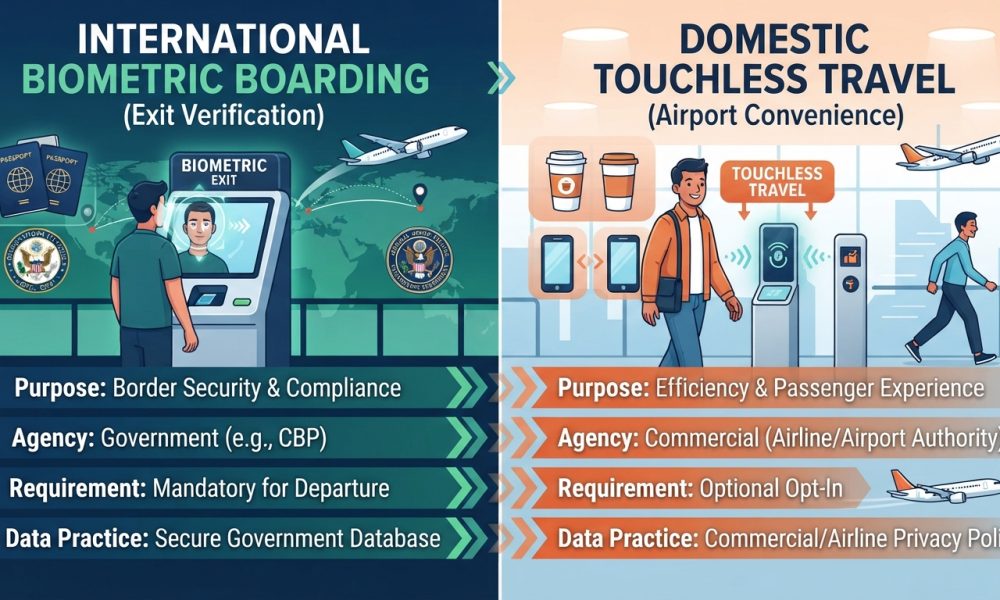
Border exit verification and optional airport convenience programs can involve different agencies, eligibility requirements, and data practices.
WASHINGTON, DC, October 7, 2026 — Facial recognition is becoming increasingly visible throughout major airports. Still, travelers who encounter a Camera at an international departure gate and passengers who voluntarily use a touchless identity lane for a domestic journey may actually be participating in programs created for substantially different governmental, operational, and security purposes.
Although both systems can rely on facial comparison technology and may even use portions of the same government identity infrastructure, international biometric boarding generally supports border management and departure verification. At the same time, domestic touchless programs primarily seek to streamline identity checks that passengers already encounter during baggage acceptance and aviation security screening.
Understanding that distinction has become increasingly important as airlines, airport operators, border agencies and transportation security authorities introduce biometric technology across different stages of the passenger journey, creating airport experiences that can appear nearly identical even when the legal authority, enrollment requirements, government responsibilities and information practices behind them remain considerably different.
Similar Cameras Can Support Very Different Government Functions
A passenger approaching an international boarding gate might see a Camera positioned beside an airline podium, briefly face that Camera and receive authorization to board without presenting a passport to an employee, while another traveler elsewhere in the same terminal might complete an almost identical facial comparison before entering an expedited domestic security lane.
The physical experience can therefore make these programs appear interchangeable. Still, the underlying transaction can involve different government agencies, databases, passenger populations, and regulatory objectives, meaning facial recognition technology alone does not explain exactly what government process is occurring behind the Camera.
International biometric departure processing in the United States developed primarily from longstanding congressional requirements for an integrated entry and exit system that can record the arrival and departure of certain foreign travelers, with facial comparison becoming an important technological mechanism for completing that mission at airports and other ports of departure.
U.S. Customs and Border Protection describes its biometric air exit program as part of a broader entry and exit framework that lets government systems compare a newly captured traveler photograph with photographs linked to government travel records, helping authorities verify identity during international departure procedures.
Domestic touchless identity programs, however, generally focus on aviation security and passenger convenience rather than recording a person’s departure from the United States, so their primary function is to verify that a traveler arriving at a checkpoint matches the identity and reservation information expected for that journey.
International Biometric Boarding Supports Border Exit Verification
International biometric boarding supports a government objective that existed long before facial recognition cameras became common inside airport terminals, because immigration authorities have long needed reliable methods to determine whether foreign nationals who entered the United States subsequently departed within the conditions established by their immigration status.
Airline departure manifests already provide substantial information about outbound passengers. Still, biometric comparison adds another identity-verification mechanism that can help establish whether the individual physically appearing for an international departure corresponds with the government records associated with the traveler expected to leave the country.
Rather than relying exclusively on an airline employee visually comparing a passenger to a passport photograph, biometric boarding can capture a live facial Image and submit it for automated comparison against an appropriately assembled gallery of government photographs associated with travelers expected aboard the departing flight.
When the system determines that the live photograph matches an expected passenger record, the traveler can often proceed through boarding without repeatedly presenting the physical passport. However, travelers should continue carrying all travel documents required by the airline, destination country, and applicable immigration authorities.
The resulting process combines an airline operational event, which is boarding a commercial aircraft, with a government border-management function, which is confirming the departure and identity of travelers whose exit may need to be recorded within the country’s immigration system.
Domestic Touchless Travel Has a Different Starting Point
Domestic touchless identity programs begin from another operational problem, because transportation security personnel routinely need to verify passenger identity before allowing travelers into secure airport areas, even though passengers traveling exclusively within the United States are not completing an international border departure procedure.
Traditional checkpoint processing normally requires a traveler to present acceptable Identification. At the same time, security personnel or automated equipment verifies the document, confirms identity, and establishes the passenger’s eligibility to continue through the appropriate screening process before proceeding toward the departure gates.
Touchless identity technology attempts to automate part of that familiar process by using facial recognition as an identity credential, allowing eligible travelers to establish who they are without necessarily retrieving a driver’s license or passport at every participating checkpoint.
The Transportation Security Administration’s TSA PreCheck Touchless ID program requires travelers to meet specific eligibility requirements and voluntarily participate through a supporting airline, showing how a convenience-oriented domestic program can differ substantially from biometric systems tied to international border processing.
For eligible passengers, the attraction is straightforward: travelers can move through participating airport processes with fewer physical document exchanges, potentially reducing repetitive identity checks while allowing transportation security authorities to perform the verification required before admitting the traveler into the secure portion of an airport.
Participation Rules Help Reveal the Difference
Eligibility is one of the clearest distinctions between domestic touchless identity programs and international biometric exit processing, because domestic programs generally require passengers to meet enrollment conditions that have little connection to whether the traveler is legally required to have an international departure recorded.
TSA PreCheck Touchless ID, for example, is designed for eligible TSA PreCheck participants traveling with participating airlines, and travelers generally must have the required identity information associated with their airline profiles before they can use a designated touchless identity experience.
That arrangement makes the program fundamentally different from an international departure system, whose relevant population is determined by immigration status, statutory requirements, and border-processing rules rather than membership in an expedited airport screening program offered to eligible travelers.
A traveler could therefore encounter biometric technology on both domestic and international trips while participating under completely different conditions, despite seeing similar cameras and experiencing a similarly rapid facial comparison each time.
Voluntary Convenience Should Not Be Confused With Border Requirements
Another important distinction concerns the meaning of voluntary participation, because an optional biometric convenience feature at a security checkpoint should not automatically be interpreted as operating under the same participation rules that apply during an international immigration or border-processing encounter.
Domestic touchless programs often emphasize voluntary enrollment because eligible travelers can generally choose whether to use facial recognition to replace certain document checks. At the same time, passengers who decline can continue through established Identification procedures using acceptable physical credentials.
International biometric processing requires more careful analysis because applicable rules can depend on citizenship, immigration status, traveler category, and the specific border process being performed, meaning passengers should not assume that an opt-out policy that applies in one airport environment necessarily extends unchanged to another.
The distinction demonstrates why travelers should identify which agency operates a biometric process before evaluating its privacy implications, because a Camera associated with airline convenience, transportation security, or immigration enforcement can perform superficially similar facial comparisons under materially different legal and administrative frameworks.
The Same Technology Does Not Mean the Same Data Flow
Facial comparison systems generally require a newly captured photograph and some form of reference Image against which that photograph can be evaluated, but how those images are assembled, transmitted, processed, retained, and ultimately deleted can vary depending on the program involved.
During international biometric boarding, government systems can use photographs already associated with passports, visas, immigration encounters, or previous government records to prepare galleries matching passengers expected to depart on a particular international flight.
At a domestic touchless checkpoint, the passenger may have previously supplied passport information and enrollment details through an airline profile, allowing participating systems to prepare an expected traveler population and perform facial comparison when the enrolled passenger reaches the designated Camera.
This similarity helps explain why travelers sometimes conclude that domestic touchless identity and international biometric boarding are part of a single unified surveillance program. However, shared technical infrastructure does not eliminate differences in governmental purpose, statutory authority, program eligibility, or retention policies.
Airlines Can Participate Without Becoming Border Authorities
The increasing involvement of commercial airlines further complicates public understanding because passengers often interact with airline employees, airline applications and airline-branded equipment even when a government agency performs the underlying biometric identity comparison.
In international biometric boarding, airlines and airports can provide cameras, boarding infrastructure,, and operational support. In contrast, government biometric services perform the comparison needed to confirm whether the live passenger matches records associated with the expected international traveler.
Domestic touchless programs can similarly involve cooperation among airlines, airport authorities and government agencies, particularly when passengers establish eligibility through airline profiles and subsequently use dedicated identity lanes during baggage acceptance or security screening.
An airline logo therefore does not necessarily mean the airline independently performs every biometric operation, just as a government-supported facial comparison service does not necessarily mean government personnel physically operate every Camera passengers encounter inside the terminal.
Facial Comparison Does Not Replace Every Travel Requirement
The increasingly seamless appearance of biometric travel can also create the mistaken impression that a successful facial match somehow replaces the broader set of documentation, immigration, customs and security requirements surrounding commercial aviation.
A facial comparison primarily addresses an identity question by determining whether the person standing before a Camera sufficiently resembles an expected reference Image. At the same time, airline systems and government authorities may separately evaluate reservation status, passport validity, visa requirements, travel authorization, immigration conditions, security screening, and destination entry rules.
International passengers should therefore continue carrying their physical passports and any required immigration documentation even when airports advertise biometric boarding, because airlines and government officials can still request documents whenever automated processing fails, operational circumstances change, or additional inspection becomes necessary.
Domestic passengers using touchless identity should also keep acceptable Identification on hand because technical interruptions, eligibility changes, airline system problems, or unsuccessful facial comparisons can cause personnel to revert to traditional document verification.
Privacy Questions Depend on the Program Being Used
Travelers concerned about biometric privacy should examine individual programs rather than treating every airport Camera as part of a single universal system, because retention periods, access rules, Image transmission procedures, and responsibilities can differ considerably among participating agencies and commercial partners.
A program designed to expedite TSA PreCheck identity verification may use different image-handling practices than a border agency system responsible for confirming international arrivals and departures, even when both programs use comparable facial-recognition algorithms or interact with related government identity resources.
Travelers should also distinguish between the photograph captured during a particular airport transaction and the government photograph already associated with their passport or other identity record, since deleting a newly captured Image does not necessarily mean the underlying government identity record has also been erased.
The difference matters when evaluating privacy statements from airlines, airports, or technology providers, because a commercial operator can accurately say it does not retain a biometric Image. At the same time, another participating government system remains responsible for its own independently governed records.
Passport Security Remains Central to Both Environments
Even as facial recognition reduces the number of times travelers physically hand passports to airport personnel, the passport remains an important trusted source of identity information because government systems commonly rely on authoritative photographs and biographical records from properly issued travel documents.
Modern electronic passports provide additional security through digitally signed chip information, specialized printing, tamper-resistant materials, and other Authentication mechanisms that help authorities distinguish legitimate documents from altered or counterfeit credentials during physical and electronic inspection.
Amicus International Consulting has previously examined how these layered protections operate in its detailed explanation of modern passport security and counterfeit detection, including the relationship between physical security features, electronic information, and identity verification technologies increasingly encountered throughout international travel.
Biometric systems should therefore be viewed as another identity-verification layer rather than a complete replacement for secure travel documents, because border agencies still depend on trustworthy identity records. At the same time, airlines remain responsible for determining whether passengers have the documentation required for their particular international journeys.
A Facial Match Answers a Narrow Question
The underlying technology also becomes easier to understand when travelers recognize that facial comparison generally answers a relatively narrow question: whether a live photograph appears sufficiently similar to an expected reference Image, according to the algorithm and acceptance threshold used by the particular system.
That comparison does not independently establish whether a passenger holds a valid visa, has met immigration conditions, appears on a government watchlist, has a valid reservation, or meets every legal requirement associated with the planned journey.
Additional databases and government systems can perform those functions separately, which is why a successful biometric comparison should not be interpreted as a universal governmental clearance or proof that every other travel requirement has been satisfied.
Likewise, an unsuccessful automated comparison does not, by itself, prove identity fraud, because variations in lighting, Camera position, appearance changes, Image quality, or other technical factors can lead to travelers being directed to conventional document inspection or additional manual verification.
Airports Are Becoming Layered Identity Environments
The modern airport increasingly operates as a sequence of identity checkpoints rather than one single verification event, with passengers potentially encountering airline check-in systems, automated baggage facilities, transportation security checkpoints, immigration controls, biometric boarding gates and destination border systems during a single journey.
As these stages become more automated, the physical differences between them can become less obvious because travelers may stand before another Camera each time. At the same time, sophisticated information systems determine which agency, database, and verification process should operate behind the scenes.
That convergence makes public education increasingly important because passengers need to understand that technology describing itself as biometric, facial, touchless, or digital does not automatically reveal the governmental purpose or privacy framework controlling the particular transaction.
The relevant questions therefore extend beyond whether facial recognition is being used and should include who operates the process, why identity verification is occurring, whether participation is optional, what reference records support the comparison, and how newly captured information is handled afterward.
The Destination of the Flight Can Change the Purpose of the Camera
Two passengers standing in the same airport on the same morning can consequently encounter nearly identical biometric equipment while participating in fundamentally different processes, particularly when one traveler is departing internationally and another is moving through a voluntary domestic touchless security program.
For the international traveler, facial comparison can support a border exit system intended to confirm that the person associated with a government travel record actually departed the United States aboard the expected flight.
For the domestic traveler, the technology can instead streamline a security identity check that would otherwise require conventional Identification, allowing an eligible passenger to use facial comparison as a faster way to establish identity before screening.
Both experiences demonstrate how biometric technology can reduce document handling and automate identity verification. Still, their similarity at the Camera should not obscure the considerably different governmental purposes, eligibility rules, and data practices operating behind the screen.
As airports continue expanding digital identity services, understanding those distinctions will become increasingly important for travelers who want to know not merely whether aCameraa is scanning their face, but exactly which identity process that Camera has been designed to perform.




