
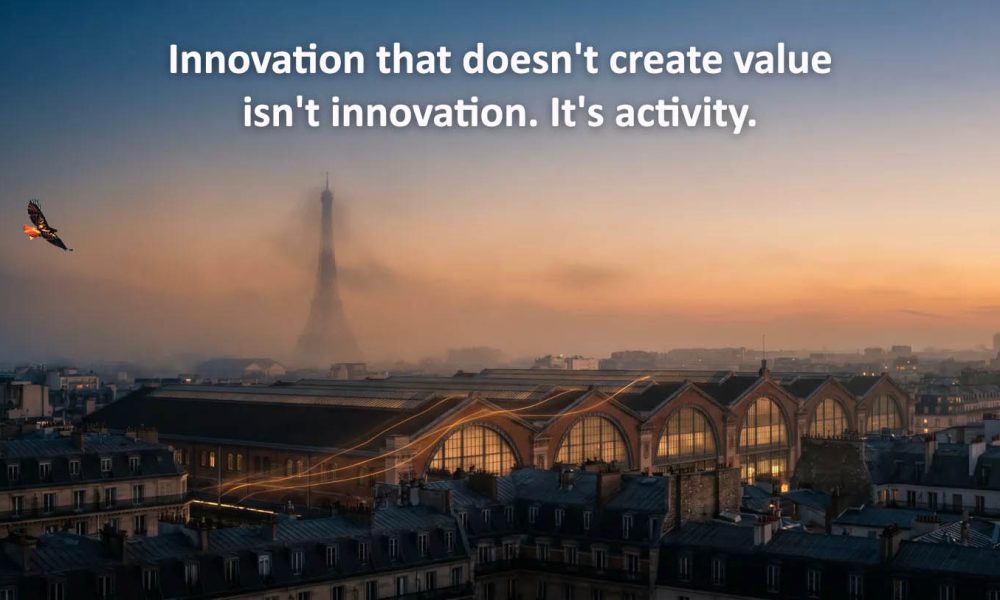
In the 13th arrondissement of Paris, a 1920s freight depot sat largely unused for decades – too historic to demolish, too awkward to repurpose. Today that same building houses Station F, the largest startup campus in the world and the home of a real innovation ecosystem: roughly 1,000 startups, deeply embedded capital, and an outsized share of Europe’s emerging AI economy.
The easy story is adaptive reuse at scale. The real story is more complex and more useful to anyone who has spent years trying to figure out where capital actually creates value.
I’ve spent decades inside that question, as a founding executive of one of the country’s largest unregulated energy providers, as the CEO of a genomics company, as managing partner of a life science venture fund, and now as the founder of Redtail Capital. I’ve also been close to the regional and global efforts to spark innovation ecosystems for most of that time. So when I look at Station F, I’m not looking at it as a curiosity. I’m looking at it as evidence about what actually causes an ecosystem to take hold, and what doesn’t.
The Mistake Most Regions Make
Station F didn’t succeed because someone built a big building, it succeeded because someone designed a system. That distinction sounds small, but it isn’t.
Most regions trying to build innovation hubs assume the answer is real estate plus programming. Open a campus, run an accelerator, host events. Wait for compounding to kick in. It usually doesn’t, because the components don’t reinforce one another. The capital is somewhere else, the talent is somewhere else, or the corporates are somewhere else. The programs operate in silos. The result is activity without architecture, which leads to frustration and failure.
Station F’s actual achievement is architectural. Workspace, embedded capital, more than thirty acceleration programs, founder housing, and dense daily collisions between founders, investors, and operators – all engineered to compound. Each piece makes the others more useful. That’s what an ecosystem actually is. That is also how businesses create value.
It’s also what most regions (and too many companies) don’t have.
Density Is an Input, Not a Win
Roughly 70% of the startups on the Station F campus are AI-focused. Mistral and Hugging Face both came out of this ecosystem. Nearly 40% of France’s AI startups now spin out of programs tied to the campus. Meta, Google, Microsoft, OpenAI, and Anthropic, companies that compete fiercely everywhere else, collaborate inside the same accelerator framework.
The headline read on this is that proximity beats exclusivity. True, and worth saying, but the more important point is what density is for. Density isn’t the win, it’s the input. The win is what density produces: companies that solve real problems, generate real revenue, create real jobs, and return real capital to the people who funded them. Companies that succeed in building their own ecosystem that create value.
This is where most innovation ecosystem conversations go wrong. They measure the input and call it the outcome. Square footage, membership counts, event attendance – none of those are value. Value is what gets created when the system actually compounds, and the only way to know whether that’s happening is to measure outcomes, not activity. These measurements must be made continually in order to prevent drift and to continue the compounding effect.
If an innovation ecosystem isn’t producing companies that create durable value for founders, investors, employees, customers, and the surrounding community, it isn’t an innovation ecosystem. It’s just another networking calendar, and we already have more than enough of those.
The Translation Problem
There’s a subtle lesson inside Station F that’s easy to miss: it works because the translations work. Capital is more useful when the founder is in the same room. Acceleration is more useful when the next round of capital is too. Talent is more useful when it’s colliding across stages and sectors. Each translation in that chain makes the others more valuable. Break any translation, and the whole thing degrades.
The translation work is where the value actually lives. Between a founder’s vision and an investable thesis. Between an early business and a durable enterprise. Between a thoughtful idea and a financeable outcome. That’s not ecosystem decoration, it is the realization of value.
It’s also the work I’ve chosen to focus Redtail Capital around. The Investment Lens objectively scores investor pitch decks against criteria that actually predict success. The Enterprise Value Creation Roadmap (EVCR) translates founder intent into the operating strategies that build durable enterprise value. Research Lens, in early development, will translate innovative ideas into investable signal. Different tools, same discipline: do the translation work where it actually matters, deal by deal, founder by founder.
What Station F Doesn’t Tell You
Station F took a decade of intentional design, hundreds of millions of euros of patient capital, and a French national strategy to scale. Most regions aren’t going to replicate that. They shouldn’t even try, but the underlying lesson translates. Innovation ecosystems are built, not discovered. They don’t emerge from real estate or from announcements. They emerge from architecture — from a system designed so that every participant has to win for the model to work, and so that every component compounds the others.
That’s the architectural standard. It’s also the standard I want Redtail Capital held to. Not as a convening platform or an ecosystem theory. As a direct value-creation engine working alongside founders in the US, Europe, Asia, India, and Africa, on terms where everyone in the deal has to come out ahead for the work to count.
The discipline is the same one Station F built into its design: every participant has to win, or the model isn’t working. The scale is smaller, the reach is more global, but the orientation is the same.
Innovation that doesn’t create value isn’t innovation. It’s activity. The next generation of innovation ecosystems, wherever they get built. will be measured by the value they actually produce, for founders and funders and the communities around them.
Innovation ecosystems will be built intentionally, not discovered. The only question is whether we build with the discipline the work actually requires.