

Industrial Ceramics Market: Comprehensive Analysis and Forecast (2022–2031)
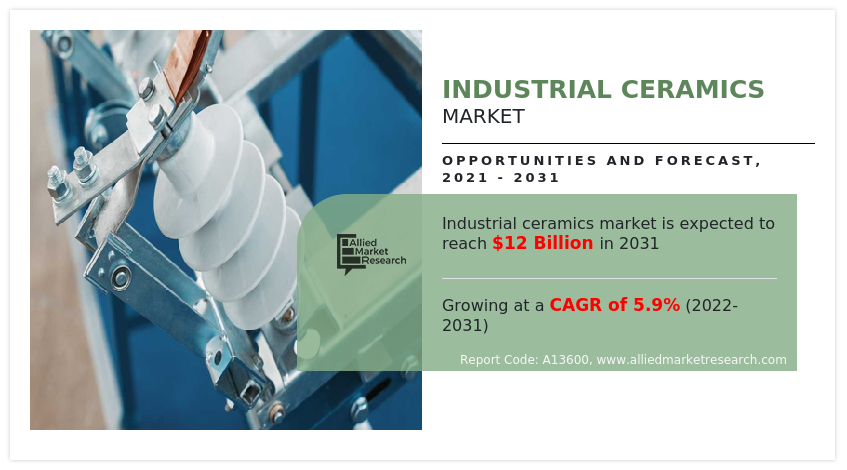
The global industrial ceramics market size at USD 6.7 billion in 2021, is projected to reach USD 12 billion by 2031, growing at a compound annual growth rate (CAGR) of 5.9% from 2022 to 2031. Industrial ceramics are inorganic, nonmetallic materials known for their high strength, hardness, high melting temperatures, chemical inertness, and low thermal and electrical conductivity. Despite their advantages, they are brittle and sensitive to defects. This report provides a detailed analysis of the market’s drivers, challenges, opportunities, segmentation, regional dynamics, and competitive landscape, offering actionable insights for stakeholders.
𝐃𝐨𝐰𝐧𝐥𝐨𝐚𝐝 𝐏𝐃𝐅 𝐒𝐚𝐦𝐩𝐥𝐞@ https://www.alliedmarketresearch.com/request-sample/A13600
The industrial ceramics market is propelled by the increasing substitution of metals and plastics with ceramic materials across various industries. Ceramics offer superior hardness, wear resistance, compressive strength, electrical resistance, and corrosion resistance, making them ideal for demanding applications. For instance, silicon carbide produced via chemical vapor deposition (CVD) provides both electrical and high thermal conductivity, enhancing its utility in advanced applications. The automotive industry is a significant driver, as ceramics are used in sensors, mechanical seals, bearings, and valves due to their thermal and electrical properties. Ceramics are more durable than plastics and more cost-effective than metals, making them a preferred choice.
The growing demand for electronic ceramics in consumer electronics, such as smartphones, computers, and controllers, is another key factor. These ceramics are used in sensors, LEDs, laser lighting systems, and antenna components, driven by their lightweight, high-performance properties. The expansion of the electronics industry also fuels market growth, as ceramics require precise functionality in robotic surgical tools and diagnostic imaging equipment. For example, Murata’s USD 49 million investment in a new 16,600-square-meter facility in Jiangsu, China, announced in January 2023, underscores the increasing use of electronic ceramics in advanced applications. Additionally, the rise of advanced ceramics in power, energy, and aerospace sectors further supports market expansion.
Industrial Ceramics Market Challenges
The high cost of industrial ceramics, driven by labor-intensive manufacturing processes such as raw material processing, extraction, sintering, and extrusion, is a major challenge. These processes require specialized machinery and expensive materials, increasing overall production costs and limiting adoption in cost-sensitive industries like electronics and chemicals. The COVID-19 pandemic also disrupted the market, as lockdowns in major manufacturing countries like China, the U.S., Germany, Italy, and India halted production and reduced demand for industrial ceramics in 2020. Recovery began by the end of 2022, as manufacturing resumed full-scale operations, but the disruptions highlighted the market’s vulnerability to global supply chain issues. Additionally, thermal expansion in ceramics, which can lead to component breakage under high temperatures, poses challenges in energy and power applications, necessitating advanced solutions.
𝐄𝐧𝐪𝐮𝐢𝐫𝐞 𝐁𝐞𝐟𝐨𝐫𝐞 𝐁𝐮𝐲𝐢𝐧𝐠@ https://www.alliedmarketresearch.com/purchase-enquiry/A13600
Industrial Ceramics Market Opportunities
The development of advanced ceramics with improved thermal and electrical conductivity, such as CeramTec’s AIN (aluminum Nitride) HP substrate launched in 2022, presents significant opportunities. These ceramics exhibit lower thermal expansion than metals and alloys, making them suitable for power converters and other high-performance applications. The growing adoption of ceramics in emerging technologies, such as 3D printing and e-mobility solutions, also drives market potential. For instance, CeramTec’s ROCAR 3D printing process, introduced in February 2021, enables cost-effective production of technical ceramic components. The expansion of the medical and defense sectors, where ceramics are used in body armor and diagnostic equipment, further supports market growth. Strategic investments, such as Oerlikon Balzers’ new customer center in Vietnam in April 2021, highlight opportunities in Asia’s booming markets.
Industrial Ceramics Market Segmentation
The industrial ceramics market is segmented by material, product, end user, and region, providing a comprehensive view of its dynamics.
By Material
The market is divided into oxide and non-oxide ceramics. Oxide ceramics, used in automotive, aerospace, and energy applications, dominated in 2021 due to their versatility. Non-oxide ceramics, composed of materials like boron, silicon, and aluminum with covalent bonds, are expected to register the highest CAGR, driven by their use in high-performance applications requiring chemical and thermal stability.
By Product
The market is categorized into composite and monolithic ceramics. Composite ceramics, which include ceramic fibers in a ceramic matrix, offer crack resistance, corrosion stability, and thermal shock resistance. They are expected to exhibit the highest CAGR due to their advanced properties. Monolithic ceramics, known for reliability, durability, and high-temperature resistance, led in revenue in 2021 and are critical for demanding applications like power generation.
By End User
The market is segmented into automotive and aerospace, energy and power, and others (including medical and defense). The automotive and aerospace segment held the largest revenue share in 2021, driven by the use of ceramics in components like sensors and bearings. The “others” segment, encompassing military and medical applications, is expected to grow at the highest CAGR, fueled by demand for ceramic armor and diagnostic equipment.
By Region
The market is analyzed across North America, Europe, Asia-Pacific, and LAMEA. Asia-Pacific led in revenue in 2021, driven by rapid industrialization and electronics manufacturing in China, Japan, and India. LAMEA is expected to register the highest CAGR, supported by infrastructure development and energy projects in Latin America and the Middle East.
𝐔𝐩𝐝𝐚𝐭𝐞 𝐎𝐧 𝐃𝐞𝐦𝐚𝐧𝐝@ https://www.alliedmarketresearch.com/request-for-customization/A13600
Competitive Landscape
The industrial ceramics market is competitive, with key players adopting acquisitions, product launches, and business expansions to strengthen their positions. Major companies include Kyocera, Anderman Industrial Ceramics, Elan Technology, Khyati Ceramics, Industrial Ceramic Products, Inc., AGC Ceramics Co., Ltd., Carborundum Universal Limited, CM Cera Co. Ltd., LSP Industrial Ceramics, Inc., and Schaefer Industrial Ceramics. Notable developments include SCHOTT AG’s acquisition of Applied Microarrays Inc. in September 2021 to expand its diagnostic business and CeramTec’s collaboration with Fraunhofer Institute in April 2021 to develop ceramic power modules for e-mobility. In December 2022, AGC Ceramics partnered with AMSKY Technology to expand 3D printing material sales in China.
Regional Insights
Asia-Pacific’s dominance is attributed to its robust electronics and automotive industries, with China and Japan leading in ceramic production. North America, particularly the U.S., benefits from advanced aerospace and energy applications. Europe, with Germany and the UK, focuses on high-performance ceramics for industrial uses. LAMEA is emerging as a high-growth region due to increasing investments in energy and infrastructure. For example, the Middle East’s focus on renewable energy projects is driving demand for ceramics in power applications.
Future Outlook
The industrial ceramics market is poised for steady growth, driven by the substitution of metals and plastics, advancements in electronic ceramics, and expanding applications in automotive and energy sectors. Innovations like 3D printing and high-performance substrates will further enhance market prospects. The recovery from the COVID-19 pandemic has stabilized supply chains, enabling manufacturers to meet rising demand. As industries prioritize durable and efficient materials, the market is expected to reach USD 12 billion by 2031.
Key Benefits for Stakeholders
This report provides a quantitative analysis of the industrial ceramics market, including segment analysis, current trends, and forecasts from 2022 to 2031. It offers insights into key drivers, restraints, and opportunities, supported by Porter’s five forces analysis. The report maps major countries’ revenue contributions and profiles key players, facilitating strategic decision-making.
The global industrial ceramics market is on a robust growth trajectory, driven by material advantages, electronics demand, and automotive applications. Despite challenges like high costs and thermal expansion issues, opportunities in 3D printing, e-mobility, and emerging markets are shaping a promising future. With Asia-Pacific leading and LAMEA showing high growth potential, the market is expected to reach USD 12 billion by 2031, offering significant opportunities for stakeholders.




