

Global Industrial Air Purifiers Market: Comprehensive Analysis and Forecast (2020–2027)
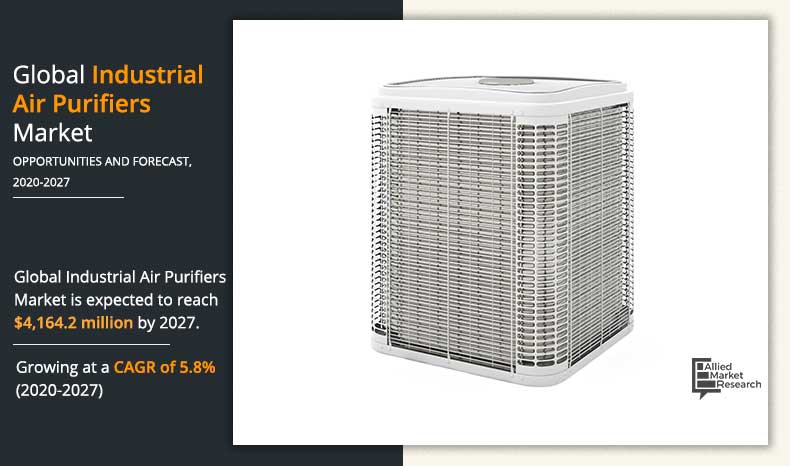
The global industrial air purifiers market size at USD 2,711.0 million in 2019, is projected to reach USD 4,164.2 million by 2027, exhibiting a robust compound annual growth rate (CAGR) of 5.8% during the forecast period from 2020 to 2027.
Industrial air purifiers, also referred to as industrial air cleaners, are critical devices designed to enhance indoor air quality (IAQ) in industrial settings, ensuring a safe and healthy environment for workers. These systems, available in portable and non-portable configurations, address air contamination caused by industrial processes such as metal processing, food and beverage production, woodworking, and welding. This analysis delves into the market dynamics, segmentation, regional trends, competitive landscape, and key opportunities driving the growth of the industrial air purifiers market.
𝐃𝐨𝐰𝐧𝐥𝐨𝐚𝐝 𝐏𝐃𝐅 𝐒𝐚𝐦𝐩𝐥𝐞 𝐂𝐨𝐩𝐲@ https://www.alliedmarketresearch.com/request-sample/A06290
Industrial Air Purifiers Market Overview
Industrial air purifiers are engineered to mitigate indoor air pollution in industrial environments, where processes generate harmful particulates, including smoke, fine dust, mold spores, chemical fumes, and oil mist. These pollutants pose significant health risks to employees who spend extended periods—typically eight to nine hours per shift—in enclosed industrial spaces. The adoption of advanced filtration technologies, such as high-efficiency particulate air (HEPA) filters and molecular filters, enables these purifiers to capture both bacterial and non-bacterial contaminants effectively. HEPA filters are particularly adept at trapping fine particles, while molecular filters target gaseous pollutants, making these systems indispensable for maintaining a safe workplace.
The demand for industrial air purifiers is fueled by the need to protect workers from prolonged exposure to hazardous air pollutants, which can lead to severe health issues, including respiratory and cardiovascular problems. Additionally, the global rise in industrial activities, particularly in sectors like processed food production and metal fabrication, has heightened the necessity for air purification systems to ensure compliance with occupational health and safety regulations.
Industrial Air Purifiers Market Dynamics
Drivers
The growth of the global industrial air purifiers market is primarily driven by the increasing global employment in industries and the rising awareness of workplace health and safety. The surge in industrial activities, particularly in food processing and metal fabrication, has led to higher emissions of dust, smoke, and chemical fumes in enclosed workspaces. For instance, processes like welding and metal cutting release fine particles that degrade IAQ, posing direct health risks to workers. Prolonged exposure to such environments can result in chronic health conditions, necessitating the deployment of air purifiers to maintain a safe indoor environment.
Moreover, global air pollution, both outdoor and indoor, has emerged as a critical concern, with phenomena like thick smog and acid rain underscoring the urgency of air quality management. In industrial settings, where pollutants are concentrated due to limited ventilation, the need for efficient air purification systems is even more pronounced. Governments and regulatory bodies worldwide are implementing stricter environmental and workplace safety standards, further driving the adoption of industrial air purifiers.
Restraints
Despite the clear benefits, the high initial cost of industrial air purifiers remains a significant barrier to market growth. These systems, designed to handle large air volumes and equipped with advanced filtration technologies, are expensive to install and operate. The energy consumption of industrial-grade purifiers, particularly those with high-capacity HEPA and molecular filters, adds to the operational costs, making them less affordable for small and medium-sized enterprises (SMEs). This cost factor can deter widespread adoption, particularly in price-sensitive markets.
Opportunities
Technological advancements in air purification systems present lucrative opportunities for market expansion. Innovations such as smart air purifiers, which integrate sensors and IoT (Internet of Things) capabilities for real-time air quality monitoring and automated operation, are gaining traction. These systems offer enhanced efficiency and user convenience, appealing to industries seeking sustainable and cost-effective solutions. Additionally, the development of energy-efficient filters, such as Camfil’s Megalam EnerGuard and Absolute V HEPA filters, is expected to reduce operational costs, making air purifiers more accessible to a broader range of industries.
𝐄𝐧𝐪𝐮𝐢𝐫𝐞 𝐁𝐞𝐟𝐨𝐫𝐞 𝐁𝐮𝐲𝐢𝐧𝐠@ https://www.alliedmarketresearch.com/purchase-enquiry/A06290
Industrial Air Purifiers Market Segmentation
The global industrial air purifiers market is segmented by type, portability, end-user industry, and region, providing a comprehensive view of its structure and growth potential.
By Type
The market is divided into molecular and particulate air purifiers. In 2019, the molecular segment generated the highest revenue, driven by the increasing demand for purifiers capable of addressing gaseous pollutants and chemical fumes. Molecular filters, which use activated carbon or other adsorbents, are highly effective in capturing volatile organic compounds (VOCs) and odors, making them essential for industries like chemical manufacturing and food processing. The particulate segment, which includes HEPA-based systems, is also witnessing significant growth due to its ability to trap fine dust and smoke particles.
By Portability
Industrial air purifiers are classified into portable and non-portable systems. Non-portable systems, typically integrated into large industrial facilities, dominate the market due to their high air intake capacities and ability to serve expansive workspaces. Portable purifiers, however, are gaining popularity in smaller facilities or for targeted applications, offering flexibility and ease of installation.
By End-User Industry
The market is segmented into food and beverage, metal processing, agriculture, construction, and other industries. In 2019, the metal processing segment held the largest market share, driven by the high volume of pollutants generated during activities like welding, grinding, and cutting. These processes release fine particulate matter and fumes, necessitating robust air purification systems. The food and beverage industry is also a significant contributor, as powdered ingredients and processing activities generate dust that can compromise product quality and worker health. The agriculture and construction sectors are emerging as growth areas due to increasing awareness of air quality issues in these industries.
By Region
Geographically, the market is analyzed across North America (U.S., Canada, Mexico), Europe (Germany, UK, France, rest of Europe), Asia-Pacific (China, India, Japan, rest of Asia-Pacific), and LAMEA (Latin America, Middle East, Africa). In 2019, Asia-Pacific accounted for the largest market share, driven by rapid industrialization, particularly in China and India, and stringent environmental regulations. The region’s large manufacturing base and growing awareness of workplace safety are key growth drivers. LAMEA is expected to register the highest CAGR during the forecast period, fueled by increasing industrial activities and investments in air quality management in countries like Brazil, South Africa, and Saudi Arabia.
Competitive Landscape
The global industrial air purifiers market is highly competitive, with key players focusing on product innovation and strategic acquisitions to strengthen their market position. Leading companies include Camfil, Honeywell International Inc., SPX Corporation, Trotec GmbH, Parker Hannifin Corporation, Euromate BV, VFA Solutions B.V., Daikin Industries, Ltd. (AAF International), Airoshine Air Purifiers, and Mankastu Impex Pvt. Ltd. (Atlanta Healthcare).
Product launches are a prominent strategy among market players. For example, in February 2020, Camfil introduced the Megalam EnerGuard and Absolute V HEPA filters, designed for cleanroom applications and offering significant energy savings. The Absolute V filters, in particular, provide over 20% energy efficiency, addressing the high operational cost concerns of industrial users. Similarly, acquisitions are being leveraged to expand market presence. In February 2017, Parker Hannifin acquired Clarcor, a U.S.-based provider of industrial air filters, to bolster its air purification portfolio.
Key Benefits for Stakeholders
This report provides a detailed analysis of the industrial air purifiers market, offering insights into current trends and future opportunities. Key benefits include:
- Comprehensive Market Analysis: In-depth evaluation of market size, growth drivers, and emerging trends from 2019 to 2027.
- Segmental Insights: Detailed segmentation by type, portability, end-user industry, and region, enabling stakeholders to identify high-growth areas.
- Competitive Intelligence: Analysis of key players’ strategies, including product launches and acquisitions, to understand the competitive landscape.
- Regional Opportunities: Identification of high-potential regions, such as LAMEA, for investment and expansion.
- Forecast Accuracy: Robust market forecasts based on extensive data analysis, aiding strategic decision-making.
The global industrial air purifiers market is poised for steady growth, driven by increasing industrialization, rising health and safety concerns, and stringent regulatory standards. Despite challenges like high initial costs, advancements in energy-efficient and smart purification technologies are expected to create new opportunities. The metal processing industry and Asia-Pacific region remain key growth drivers, while LAMEA is emerging as a high-potential market. With leading players investing in innovation and strategic expansion, the industrial air purifiers market is well-positioned to address the growing demand for clean and safe indoor environments in industrial settings. Stakeholders can leverage this analysis to make informed decisions and capitalize on the market’s growth potential through 2027.




