
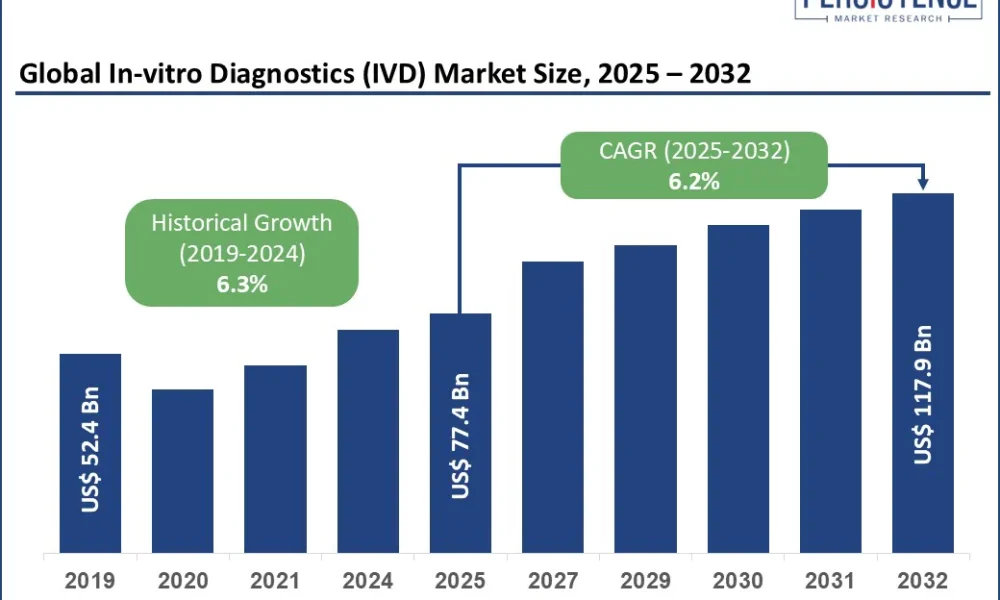
The global in-vitro diagnostics (IVD) market is poised for significant growth over the coming decade. Valued at approximately US$ 77.4 billion in 2025, the market is projected to reach US$ 117.9 billion by 2032, reflecting a compound annual growth rate (CAGR) of 6.2% during 2025–2032. IVD technologies are rapidly transforming healthcare by enabling clinicians to make timely, data-driven decisions through the analysis of biological samples outside the human body. These solutions facilitate both routine health screening and complex genomic profiling, supporting a more precise, personalized approach to patient care. The integration of automation, digital platforms, and molecular diagnostics is driving a paradigm shift in diagnostic services, resulting in more efficient workflows and improved patient outcomes.
The market’s expansion is fueled by multiple factors, including the rising prevalence of chronic and genetic disorders, increased adoption of decentralized care models, and the growing emphasis on early disease detection. Among IVD segments, reagents are expected to lead, capturing an estimated 66.4% market share in 2025 due to their essential role in diagnostic testing and frequent replenishment requirements. Geographically, North America is anticipated to dominate the market, accounting for nearly 48.2% of the global share in 2025, primarily due to advanced healthcare infrastructure, favorable reimbursement policies, and widespread adoption of molecular and companion diagnostics.
Download Your Free Sample & Explore Key Insights: https://www.persistencemarketresearch.com/samples/35529
Key Highlights from the Report
• Widespread implementation of national screening programs for diseases such as HPV, HIV, and hepatitis is sustaining test uptake.
• Growth of direct-to-consumer (DTC) health diagnostics systems is transforming patient engagement and diagnostic access.
• Collaborations between IVD companies and pharmaceutical firms for developing companion diagnostics in immunotherapy are creating opportunities.
• Reagents are expected to hold around 66.4% market share in 2025 owing to high demand for disease-specific panels and multiplex assays.
• Immunoassays are gaining momentum as they offer high sensitivity and specificity across a wide range of clinical applications, including hormone testing.
• Favorable reimbursement policies and regulatory support are encouraging widespread use of molecular and companion diagnostics in North America.
Market Segmentation
The in-vitro diagnostics market is segmented primarily by product type, technology, and end-user. Product-wise, the market is categorized into instruments, reagents, and other consumables. Reagents remain the leading segment due to their essential role in testing processes across molecular diagnostics, immunoassays, and hematology platforms. The recurring nature of reagent usage ensures continuous demand and revenue streams for IVD manufacturers. Instruments, including high-throughput analyzers and modular systems, are also witnessing growth as hospitals and laboratories invest in automated solutions that enhance efficiency and data integration with laboratory information systems.
Technologically, the market is divided into immunoassays, hematology, clinical chemistry, molecular diagnostics, coagulation, microbiology, and others. Immunoassays lead the segment due to their versatility, sensitivity, and suitability for automation, particularly in hormone, metabolic, and chronic disease monitoring. Coagulation diagnostics are gaining traction amid rising cardiovascular disease prevalence, necessitating continuous monitoring of parameters like activated Partial Thromboplastin Time (aPTT) for effective disease management. The end-user segmentation includes hospitals, diagnostic laboratories, and research centers, with hospitals and centralized labs remaining the primary consumers due to their high testing volume and adoption of advanced platforms.
Regional Insights
North America is the dominant region in the IVD market, driven by robust healthcare infrastructure, early adoption of innovative technologies, and strong reimbursement frameworks. The U.S. leads with advanced molecular diagnostics and companion diagnostics integrated into chronic disease management. Europe is undergoing regulatory transformation with the enforcement of the EU In Vitro Diagnostic Regulation (IVDR), creating challenges for small manufacturers but offering growth opportunities for established players capable of meeting compliance standards. Germany is a regional leader due to its mature diagnostics ecosystem and innovation hubs.
Asia Pacific is experiencing steady growth, underpinned by increased healthcare spending, local manufacturing capabilities, and accelerated diagnostic infrastructure development post-COVID-19. China and India are emerging as key markets due to both consumption and production growth, with domestic companies increasingly expanding their portfolios in molecular diagnostics and portable point-of-care platforms. Southeast Asian markets, including Thailand, Malaysia, and Vietnam, are benefitting from public-private partnerships and medical tourism, further bolstering IVD adoption.
Get Custom Insights Designed for Your Business: https://www.persistencemarketresearch.com/request-customization/35529
Market Drivers
The IVD market is primarily driven by the rising prevalence of chronic and genetic disorders. Conditions such as Alzheimer’s disease, Parkinson’s disease, diabetes, cardiovascular disorders, and Turner syndrome necessitate early and precise diagnostic testing. Blood-based biomarker assessments and genomic profiling are becoming integral to patient management, offering alternatives to expensive or invasive traditional diagnostic procedures. The global emphasis on personalized medicine and precision therapies further fuels demand for IVD, particularly in companion diagnostics for oncology and immunotherapy. Advancements in automated, high-throughput platforms also accelerate market adoption by reducing manual intervention and improving turnaround time, which is critical in acute and chronic care scenarios.
Market Restraints
Despite its growth, the IVD market faces notable restraints, primarily due to cost barriers and diagnostic limitations. Advanced molecular tests, including digital PCR and comprehensive genomic profiling, are expensive, often ranging from US$ 3,000 to US$ 5,000 per test. The high capital expenditure for instruments, training, and validation further constrains adoption in low- and middle-income countries. Additionally, IVD tests cannot fully replicate in vivo biological complexity, which can occasionally result in false negatives or clinically inconclusive outcomes. These factors, combined with a preference for traditional in vivo diagnostics in certain regions, pose significant challenges to market penetration.
Market Opportunities
The shift toward decentralized and rapid testing presents significant opportunities for IVD companies. Point-of-care platforms, lab-on-a-chip systems, and microfluidics technologies are transforming diagnostics by enabling faster results outside traditional laboratory settings. Devices such as Abbott’s ID NOW and LumiraDx’s immunoassay platforms demonstrate the scalability and accessibility of rapid IVD solutions for infectious disease, chronic condition, and emergency care applications. Expanding access in remote or resource-limited areas through portable, user-friendly devices creates new revenue streams while improving healthcare outcomes, particularly in emerging markets. Furthermore, the growing demand for multiplex assays and home-based testing solutions supports continued innovation in IVD technologies.
Checkout Now & Download Complete Market Report: https://www.persistencemarketresearch.com/checkout/35529
Company Insights
• Abbott Laboratories
• Siemens Healthineers AG
• Bio-Rad Laboratories, Inc.
• F. Hoffmann-La Roche Ltd.
• Quidel Corporation
• QIAGEN
• Becton, Dickinson and Company
• Danaher
• BIOMÉRIEUX
• Agilent Technologies, Inc.
• Quest Diagnostics Incorporated
Recent Developments:
In May 2025, Diagnostics.ai launched the first fully transparent machine learning platform for real-time PCR diagnostics to comply with CE-IVDR standards, emphasizing algorithm transparency and diagnostic accuracy.
Nepal established a National Essential In-vitro Diagnostics List (NEIDL) in May 2025, with WHO support, to improve access to quality reagents and laboratory equipment, enhancing public health infrastructure.
Conclusion
The global in-vitro diagnostics market is poised for robust growth, driven by the rising prevalence of chronic and genetic disorders, rapid adoption of advanced technologies, and an increasing focus on decentralized and rapid diagnostics. While cost and biological limitations present challenges, opportunities in point-of-care solutions, multiplex testing, and emerging markets offer substantial potential. North America remains the leading region due to technological innovation and favorable regulatory frameworks, while Asia Pacific is emerging as a growth hotspot supported by local manufacturing and public health initiatives. The competitive landscape continues to evolve with major players investing in molecular diagnostics, automation, and companion diagnostics to capitalize on the rising demand for precision healthcare. Overall, the IVD market represents a critical component of modern healthcare, shaping the future of disease detection, patient monitoring, and personalized treatment strategies.




