
Definition
Hydrogen storage and transport containers are specialized vessels engineered to safely store and transport hydrogen in various forms, including compressed gas, liquid, and chemical carriers. These containers are critical components in the emerging hydrogen economy, ensuring the secure containment of hydrogen for applications across transportation, energy, and aerospace sectors.
- Compressed Gas Storage: High-pressure tanks that store hydrogen at up to 700 bar, commonly used in fuel cell vehicles and industrial hydrogen transport.
- Liquid Hydrogen Storage: Cryogenic tanks maintaining -253°C, enabling long-distance transport and aerospace applications.
- Chemical Storage: Includes metal hydrides and liquid organic carriers that store hydrogen in solid or chemical form for specialized applications.
These solutions are designed to withstand extreme pressures, temperatures, and environmental conditions while maintaining safety and operational efficiency. Recent advancements, such as Hexagon Purus’ Type IV composite cylinders, demonstrate the innovation and performance improvements driving this market forward.
Market Size
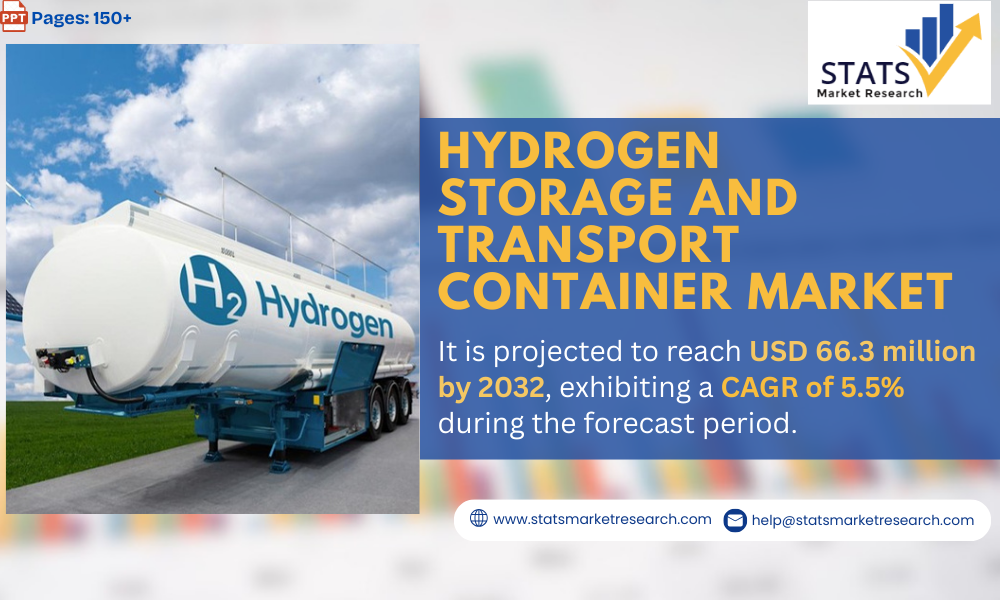
Global hydrogen storage and transport container market was valued at USD 45.9 million in 2024 and is projected to reach USD 66.3 million by 2032, growing at a CAGR of 5.5% during the forecast period.
Download FREE Sample of this Report @ https://www.statsmarketresearch.com/download-free-sample/8061320/global-hydrogen-storage-transport-container-forecast-market
- Transportation applications account for nearly 30% of container demand, fueled by the rising adoption of fuel cell electric vehicles in commercial and personal transportation.
- Technological advancements in composite materials, cryogenic insulation, and pressure vessel design are driving efficiency gains, enabling storage pressures up to 700 bar and extending liquid hydrogen retention from days to weeks.
- Governments worldwide are investing in regional hydrogen hubs, creating clusters of demand for both stationary and transport storage solutions.
Market expansion is supported by the adoption of lightweight Type IV composite cylinders, modular smart container solutions with IoT-enabled monitoring, and emerging applications in heavy-duty transportation and aviation. However, high capital costs, technical complexities, and fragmented regulations present challenges that need to be addressed for broader adoption.
Recent Developments
The hydrogen storage and transport container market is undergoing a rapid transformation, driven by the global push for a clean energy transition. A key recent development is the advancement in composite materials for high-pressure tanks, particularly the widespread adoption of Type III and Type IV composite tanks. These lighter, stronger, and more efficient containers can safely store hydrogen at pressures up to 700 bar, which is crucial for increasing the range of fuel cell vehicles and for on-site storage at refueling stations. There is also a significant focus on developing solid-state storage technologies, such as metal hydrides, which offer enhanced safety and lower costs by storing hydrogen within a solid material. Furthermore, the market is seeing major investment in large-scale cryogenic liquid hydrogen tanks for long-distance shipping and large-scale industrial applications, as well as the development of mobile refueling units to service the growing fleet of hydrogen-powered vehicles.
Major Distribution
The distribution of hydrogen storage and transport containers is a highly specialized, B2B-centric process. Major container manufacturers primarily sell their products directly to key players in the hydrogen ecosystem, including automotive OEMs (for on-board vehicle tanks), industrial gas companies, and engineering firms that design and build hydrogen refueling stations and large-scale industrial projects. For smaller-scale applications, distribution is often managed through a network of specialized industrial equipment suppliers and wholesalers. The containers are a critical component of a larger infrastructure, and their distribution is closely linked to the development of hydrogen pipelines, which are the most cost-effective method for long-distance transport. As the hydrogen economy expands, distribution channels are evolving to include a mix of direct sales for large projects, and a more diversified network of distributors to serve the growing number of localized and smaller-scale end-users.
Market Dynamics (Drivers, Restraints, Opportunities, and Challenges)
Drivers
Global Push for Clean Energy Transition
- Hydrogen is central to decarbonization strategies and achieving net-zero emissions by 2050.
- Governments are creating favorable conditions for hydrogen infrastructure, driving adoption of storage and transport containers in transportation, energy, and industrial applications.
Technological Advancements in Storage Solutions
- Type IV composite pressure vessels dominate with over 60% market share due to superior strength-to-weight ratio.
- Innovations have nearly doubled energy density in automotive applications, with pressures reaching 700 bar, and extended liquid hydrogen storage durations, facilitating long-distance transport.
Government Incentives and Policy Support
- Funding programs like the U.S. Inflation Reduction Act provide $9.5 billion for clean hydrogen initiatives.
- Harmonized safety standards and regulations are encouraging private sector participation and infrastructure development.
Restraints
High Capital Costs and Infrastructure Challenges
- Production requires costly composite materials; carbon fiber alone accounts for ~70% of costs, making containers 3-5 times more expensive than conventional fuel tanks.
- Limited hydrogen refueling infrastructure, with less than 1,000 stations worldwide, restricts practical adoption.
Technical Complexities in Hydrogen Handling
- Hydrogen embrittlement and cryogenic temperature requirements necessitate specialized materials, insulation, and thermal management, increasing system complexity and cost.
Regulatory Fragmentation
- Certification requirements vary by region, leading to compliance challenges and increased operational costs.
- Approval processes can take up to 18 months, complicating global supply chain expansion.
Opportunities
Emerging Applications in Heavy Transport and Aviation
- Hydrogen-powered trucks and maritime vessels demonstrate potential for long-range, high-value applications.
- Aerospace adoption of liquid hydrogen tanks for next-generation aircraft provides premium market opportunities.
Modular and Smart Container Solutions
- IoT-enabled containers enable predictive maintenance, leak detection, and optimized fleet utilization.
- Telemetry and blockchain integration enhance supply chain transparency and asset management.
Regional Hydrogen Hubs
- Government-backed regional hubs create localized demand for specialized storage and transport containers.
- The U.S. Department of Energy allocated $7 billion for seven clean hydrogen hubs, with similar initiatives in Europe and Asia-Pacific expected to drive demand.
Challenges
Material Supply Chain Vulnerabilities
- Critical materials like carbon fiber and specialized alloys are concentrated in few regions, creating potential bottlenecks.
- Carbon fiber production capacity needs to triple by 2030 to meet projected demand.
Safety Concerns and Public Perception
- Despite rigorous safety standards, high-profile incidents create public skepticism.
- Education, demonstration projects, and transparency are essential to drive acceptance.
Workforce Development and Skills Gap
- Acute shortages in composite materials engineering and high-pressure system design; 40% skill gap exists in key manufacturing regions.
- Training and workforce development are critical for scaling production and innovation.
Regional Analysis
- Asia-Pacific leads due to domestic hydrogen initiatives, EV adoption, and industrial applications in China, Japan, and South Korea.
- Europe grows through renewable energy integration, regional hydrogen hubs, and strict decarbonization policies.
- North America benefits from government incentives and the presence of industrial gas leaders like Air Liquide and Linde.
- Emerging markets in Latin America and the Middle East are adopting hydrogen storage for transportation and energy applications.
Get the Complete Report & TOC @ https://www.statsmarketresearch.com/global-hydrogen-storage-transport-container-forecast-market-8061320
Competitor Analysis
The global hydrogen storage and transport container market is dynamic, combining established industrial gas giants and innovative technology providers:
- Hexagon Purus and Chart Industries lead with ~22% combined revenue share in 2024, offering comprehensive compressed, liquid, and solid-state storage solutions.
- Linde and Air Liquide leverage global distribution for bulk hydrogen transport.
- NPROXX specializes in advanced lightweight composite tanks for mobility applications.
- Mergers and acquisitions, such as Worthington Industries acquiring regional players, expand manufacturing capabilities.
- Chinese firms like CIMC Enric are scaling production to meet domestic demand supported by government incentives.
Global Hydrogen Storage and Transport Container: Market Segmentation Analysis
This report provides a deep insight into the global hydrogen storage and transport container market, covering all its essential aspects. This ranges from a macro overview of the market to micro details of the market size, competitive landscape, development trend, niche market, key market drivers and challenges, SWOT analysis, value chain analysis, etc.
The analysis helps the reader to shape the competition within the industries and strategies for the competitive environment to enhance the potential profit. Furthermore, it provides a simple framework for evaluating and assessing the position of the business organization. The report structure also focuses on the competitive landscape of the Global Hydrogen Storage and Transport Container. This report introduces in detail the market share, market performance, product situation, operation situation, etc., of the main players, which helps the readers in the industry to identify the main competitors and deeply understand the competition pattern of the market.
In a word, this report is a must-read for industry players, investors, researchers, consultants, business strategists, and all those who have any kind of stake or are planning to foray into the hydrogen storage and transport container market in any manner.
Market Segmentation (by Application)
- Transportation
- Energy
- Aerospace
- Research
- Others
Market Segmentation (by Type)
- Compressed Gas Storage
- Type I
- Type II
- Type III
- Type IV
- Liquid Hydrogen Storage
- Chemical Storage
- Metal hydrides
- Chemical hydrides
- Cryogenic Storage
- Others
Key Company
- Hexagon Purus (Norway)
- Chart Industries (U.S.)
- Linde plc (Ireland)
- Air Liquide (France)
- NPROXX (Netherlands)
- Worthington Industries (U.S.)
- McPhy Energy (France)
- Luxfer Gas Cylinders (U.K.)
- CIMC Enric (China)
- DSM (Netherlands)
- WIKA (Germany)
Geographic Segmentation
- North America – U.S., Canada, Mexico
- Europe – Germany, France, U.K., Netherlands
- Asia-Pacific – China, Japan, South Korea
- Latin America – Brazil, Argentina
- Middle East & Africa – UAE, South Africa
FAQ
Q1: What is the current market size of the hydrogen storage and transport container market?
A1: The market was valued at USD 45.9 million in 2024 and is projected to reach USD 66.3 million by 2032, growing at a CAGR of 5.5%.
Q2: Which are the key companies operating in the hydrogen storage and transport container market?
A2: Key players include Hexagon Purus, Chart Industries, Linde plc, Air Liquide, NPROXX, Worthington Industries, McPhy Energy, Luxfer Gas Cylinders, CIMC Enric, DSM, and WIKA.
Q3: What are the key growth drivers in the hydrogen storage and transport container market?
A3: Growth is driven by the clean energy transition, technological advancements in storage solutions, and government incentives for hydrogen infrastructure.
Q4: Which regions dominate the hydrogen storage and transport container market?
A4: Asia-Pacific leads due to hydrogen adoption in transportation and industrial applications, followed by Europe and North America.
Q5: What are the emerging trends in the hydrogen storage and transport container market?
A5: Trends include Type IV composite cylinders, modular smart container solutions with IoT sensors, and adoption in heavy transport and aerospace applications.
About Us
☎️ International: +1 (332) 2424 294
📄 Website: www.statsmarketresearch.com
Join us on LinkedIn:- https://www.linkedin.com/company/statsmarketresearch




