
HVAC Valves Market Overview:
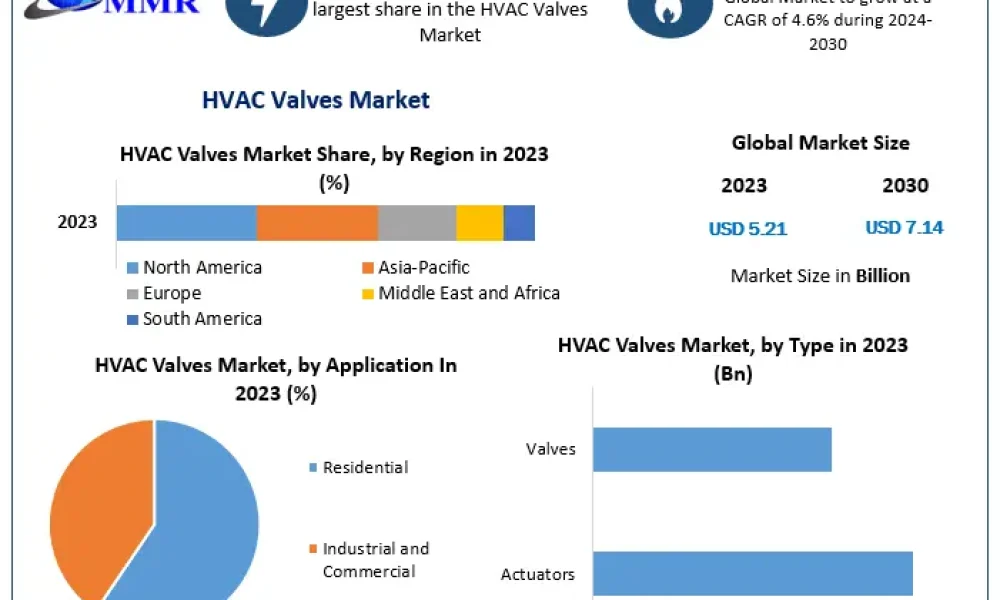
HVAC valves market, valued at USD 5.21 billion in 2023, is projected to grow at a CAGR of 4.6% from 2024 to 2030, reaching approximately USD 7.14 billion. This growth is stimulated by expanding construction activities, growing demand for energy-efficient HVAC systems, and stringent government regulations promoting sustainable building infrastructure. Asia Pacific dominates the market due to rapid urbanization, surging industrialization, and widespread adoption of climate control solutions in residential and commercial sectors.
Key Highlights & Insights
Market Size & Growth: Forecast to grow from USD 5.21 billion in 2023 to USD 7.14 billion by 2030, at a CAGR of 4.6%.
Dominating Region: Asia Pacific leads the market, propelled by booming construction industries in China, India, Japan, South Korea, and Southeast Asia, alongside aggressive pollution control and energy efficiency regulations.
Leading Segment: Ball valves hold significant market share due to their reliability, versatility, and critical role in flow regulation in HVAC systems.
Key Driver: Increasing government mandates for energy-efficient and smart building technologies boost demand for advanced HVAC valves enhancing system performance and reducing operational costs.
Download a Free Sample Report Today : https://www.maximizemarketresearch.com/request-sample/72703/
Recent Developments
Expansion of HVAC valve manufacturing capacity by leading players like Belimo Holding AG, Danfoss A/S, Johnson Controls, and Siemens AG across Asia-Pacific and Europe.
Adoption of smart HVAC valve actuators integrated with IoT for monitoring and automation in commercial and industrial buildings.
Government incentives and policies encouraging retrofitting of older buildings and deploying energy-saving climate control systems support market growth.
Technological advancements improving valve materials and designs to enhance durability, reduce leakage, and optimize energy consumption.
Market Dynamics
Growth Drivers:
Urbanization and large-scale construction fueling demand for HVAC systems.
Increasing need for controlling indoor air quality and comfort in residential, commercial and institutional buildings.
Stringent environmental regulations pushing for optimized energy consumption.
Rising adoption of smart building management systems incorporating advanced HVAC valves.
Challenges:
High capital cost of advanced HVAC systems including valves affecting affordability.
Complexity in integrating new HVAC valve technologies with existing infrastructure.
Maintenance and operational challenges limiting retrofitting in older buildings.
Regional Analysis
Asia Pacific: Market leader with highest growth, driven by infrastructure investments, government policies, and urban expansion.
North America: Steady growth supported by demand for efficient HVAC systems in residential and commercial applications, stricter energy compliance, and smart building penetration.
Europe: Significant adoption of HVAC valves aligned with environmental regulations and energy conservation measures.
Middle East & Africa and Latin America: Emerging markets with increasing construction and renovation activities.
HVAC Valves Market Segment Analysis
Global HVAC Valves Market is segmented By Product (Ball Valve, Globe Valve, Butterfly Valve, Pressure Independent Valves), by Application (Residential, Industrial and Commercial), and by Region (North America, Europe, Asia Pacific, Middle East and Africa, and Latin America). The Global market is anticipated to get highest market share in forecasted period. Global market is emerging in region like Europe and Asia Pacific where highest amount of pollution control initiatives is in progress.
By Product Type: Ball valve (dominant), globe valve, butterfly valve, pressure independent valves.
By Application: Residential, industrial, commercial.
By Valve Type: Actuators and valves.
By Distribution: Direct sales, dealers, and service providers.
Key Trends
Growing integration of HVAC valves with automated building management and IoT systems.
Increasing focus on energy conservation leading to demand for pressure independent and smart valves.
Technological innovation driving development of durable, low-maintenance valve materials.
Government programs promoting green building construction and HVAC retrofits.
Expansion of HVAC valve consumption in commercial infrastructure like hotels, airports, and hospitals.
Quote
“The surge in infrastructure development, combined with stringent energy efficiency mandates, has positioned Asia Pacific at the forefront of the HVAC valves market. Advancements in smart valve technologies and government initiatives are set to reshape how HVAC systems contribute to sustainable building management globally.”




