
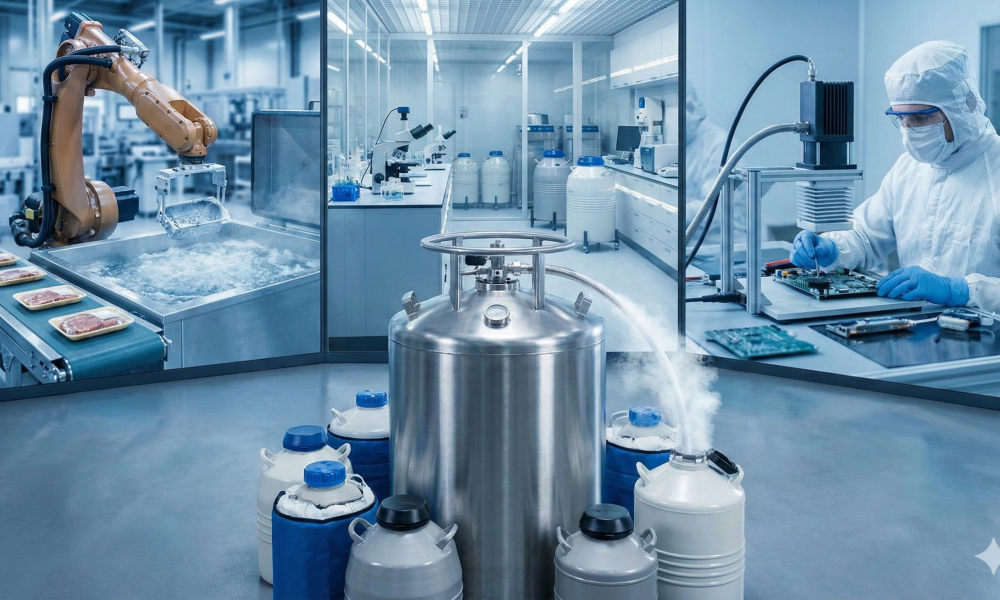
Liquid nitrogen is a versatile substance utilised across various industries and research fields. Its unique properties enable applications ranging from cryogenics and food preservation to advanced scientific experimentation. This article delves into the wide-ranging uses of liquid nitrogen, highlighting its importance in several domains.
One of the most significant uses of liquid nitrogen is in the field of manufacturing, particularly where extreme cold is required. For instance, in the rubber and plastic industries, liquid nitrogen is essential for cryogenic deflashing, a process where excess rubber or plastic is removed from moulded items. This method ensures clean, precise finishes without compromising the integrity of the material. Additionally, workplaces dealing with hazardous gases also rely on various gas supplies, such as Acetylene Gas Supply for Medical Use, aiding in the safe management of explosive or reactive substances.
Cryogenics and Research
In the realm of scientific research, liquid nitrogen plays a pivotal role in maintaining ultra-low temperatures essential for preserving biological samples and conducting low-temperature experiments. Laboratories often use it to freeze cells, tissues, and other biological materials, effectively halting all metabolic processes and enabling long-term storage.
Furthermore, liquid nitrogen is used in cryogenic grinding, a process that involves chilling materials before grinding them into powder. This is particularly useful for researchers and industries dealing with materials sensitive to heat.
Medical and Healthcare Applications
Liquid nitrogen’s applications within the medical field are vital. It is used in cryosurgery to remove skin abnormalities and in dermatology for the treatment of warts and other skin lesions. Its rapid freezing capability makes it an indispensable tool for precise and effective medical treatments.
Beyond these applications, healthcare facilities depend on reliable gas supplies, including Carbon Dioxide Gas Supply for Medical Use, to maintain high standards of patient care and operational efficiency.
Food Industry
The food industry extensively utilises liquid nitrogen for flash freezing, a technique that enhances the quality and shelf life of perishable goods. By freezing products quickly, the formation of large ice crystals is minimized, preserving the texture and flavour of the food. This is particularly advantageous for seafood, fruits, and vegetables.
Additionally, liquid nitrogen is used in molecular gastronomy, where chefs create innovative dishes with extraordinary textures and presentations.
Electronics and Engineering
In electronics, liquid nitrogen is often used to cool down components, preventing overheating and enhancing performance. This is critical in the development and testing of high-performance computing systems and semiconductor manufacturing.
Engineers and manufacturing specialists also benefit from the properties of liquid nitrogen, employing it in processes that require rapid material cooling or in precision machining applications.
Conclusion
Liquid nitrogen’s role in modern industry and research is undeniable. From its use in cryogenics, medical applications, and food preservation to its contributions to engineering and electronics, liquid nitrogen remains a backbone of innovation and efficiency. Ensuring a consistent and safe supply of gases, such as Oxygen Gas Supply for Medical Use, further extends the reliability and effectiveness of operations across various sectors. As technology advances, the demand for liquid nitrogen in new and existing applications will likely continue to grow.
Liquid Nitrogen Safety Checklist
Because liquid nitrogen is extremely cold and expands rapidly when vaporized (at a ratio of 1:694), strict safety protocols are essential to prevent frostbite, asphyxiation, and pressure explosions.
1. Personal Protective Equipment (PPE)
Cryogenic Gloves: Heavy-duty, insulated gloves are required. They should be loose-fitting so they can be thrown off quickly if liquid spills inside.
Face Shield: A full face shield must be worn over safety glasses or goggles to protect against splashes and “boil-back” during pouring.
Body Protection: Long-sleeved shirts, long trousers (without cuffs), and closed-toe leather shoes are mandatory. Ensure trousers cover the tops of the shoes to prevent liquid from pouring into them.
No Jewelry: Avoid wearing watches, rings, or bracelets, as they can trap extremely cold liquid against the skin.
2. Handling & Storage
Use Only Approved Containers: Store liquid nitrogen only in Dewar flasks or specialized cryogenic cylinders designed for extreme temperature gradients. Never use a standard thermos or a sealed glass bottle.
Pressure Relief: Ensure all storage vessels have functioning pressure relief valves. Because liquid nitrogen constantly evaporates, a sealed container without a vent will eventually explode.
Avoid Tipping: Always secure Dewars to prevent them from tipping over during transport.
3. Ventilation & Environment
Oxygen Depletion Monitoring: Liquid nitrogen displaces oxygen as it vaporizes. Use it only in well-ventilated areas. In confined spaces, an oxygen monitor with an audible alarm is required.
Avoid Elevators: Never travel in an elevator with a Dewar of liquid nitrogen. If the elevator stalls, a small leak could lead to rapid asphyxiation.
Indoor Air Quality: Be aware that a “fog” of condensed water vapor is a sign of cold gas but does not indicate where the nitrogen gas (which is invisible) has traveled.
4. First Aid for Cryogenic Burns
Immediate Action: If liquid nitrogen touches the skin, treat it as a thermal burn.
Rewarming: Immerse the affected area in a lukewarm water bath (38°C to 42°C). Never use hot water or dry heat (like a heating pad).
Seek Medical Help: Even if the area looks minor, deep tissue damage can occur. Seek professional medical attention immediately.




